How students and faculty find resilience amid the trauma of war
Jun 01, 2026
When I first entered digital education a quarter of a century ago, I envisioned all sorts of unconventional students enrolling in remote learning—full-time workers, home-bound patients, parents caring for young children, older folks, and rural families far from campus. Digital education has become essential, giving them access they can’t manage on campus.
Now, online learning is tasked with yet a new, quite forbidding job, keeping education alive in wartime. I never imagined digital education holding classes together under missiles and drones. When remote classes were first tested so many years ago, who would have dreamed they would become a refuge for students and faculty cut off from campus by traumatic conflict? When the U.S. and Israel unexpectedly launched a war with Iran in late February, American colleges with branches in the Middle East took cues from the global Covid epidemic, closing campuses, moving everything online.1 Qatar ordered all schools and universities to switch to distance learning on the first day of the conflict. By late March, after Iran threatened that U.S. campuses were legitimate targets, American campuses in the country—including those run by Georgetown, Virginia Commonwealth, and Texas A&M—had moved online-only, where they remain.2
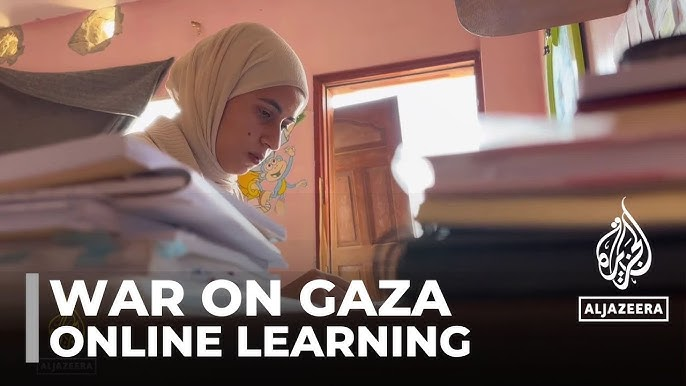
Universities in Ukraine and Gaza also found a haven in remote education, moving to digital learning to maintain classes. Online education has assumed a grim challenge for which it was never intended, securing higher education for students as campuses crumble under attack. In Gaza, for example, despite the destruction of nearly all universities in the zone, learning and academic life continues remarkably online.
“Universities in the Gaza Strip have demonstrated exceptional resilience by resuming distance learning despite the ongoing challenges resulting from the Israeli war,” say a couple of Palestinian psychologists at the Islamic University of Gaza.3
In Ukraine, Internet access is still reliable, except for villages and remote areas without good coverage. Internet services are relatively inexpensive and Ukrainians are largely comfortable using digital tools, exhibiting an unexpected level of faculty and student readiness, allowing online classes to continue relatively uninterrupted. A local observer claims, “From the beginning of the Russian invasion, distance learning has become the only available option.”4
It surprised me to learn that university classes in Iran continue entirely online in the aftermath of the U.S.-Israeli assault. The country’s faculty and students transitioned to remote education almost immediately.5
Trauma in War
Despite the speed with which students in these war-torn countries today have been able to go online, war affects nearly everything else in their academic and daily lives—concentration, commitment, resilience, and especially emotional wellbeing.
“The war may have begun with military strikes, but some of its deepest consequences are appearing quietly inside classrooms—or in many cases, in the absence of classrooms,” reports the Financial Tribune. “If these educational wounds are left untreated, their effects will outlast the conflict itself.”6
Students in war zones encounter death and destruction on nearly every street corner. Faced with the day-in, day-out grind of war, they are gashed with deep emotional scars. Traumatized by school closure, with no clear way of earning their degree or getting a job, many struggle with being separated from campus friends and faculty. At home, students may encounter family tensions, with members confronted with job losses, financial stress, illness and death.7
Exposure to violence often leads to anxiety, depression, anger, hopelessness and post-traumatic stress disorder, among other afflictions, hindering students’ ability to concentrate, engage, and perform academic tasks. Psychologists say trauma disrupts cognitive functions, emotional regulation and social interaction, with sufferers often experiencing feelings of intrusion and avoidance, often forcing them to react negatively, their mood disorders making them feel paralyzed.8
Faculty, too, are subject to the effects of trauma, affecting instruction, limiting their capacity to engage fully and effectively. They can often feel restless, irritable, and angry. Or disconnected, numb or fatigued, often suffering unexplained aches and pains.9
How Online Mitigates Trauma
Unexpectedly, it turns out that online learning can partially mitigate the psychic damage inflicted in war. In the midst of cascading bombs, terrorizing missiles, and bewildering, AI-propelled drones, digital education uncannily provides a sense of normalcy and continuity when cities are torn apart and campuses crushed. Remote learning can help build resilience, allowing students to continue learning, despite being damaged by trauma. With flexible pacing, it enables students to learn at their own pace, a vital option for the traumatized, giving them time to gain their footing. It provides structured, predictable routine, reducing trauma and anxiety—a “safe space” for learning and interaction.
Of course, digital education is no panacea. In war, digital tools and platforms are often cut off by power outages and Internet failure. And for some, remote classes don’t meet their social needs. Many are unhappy not meeting in person, feeling alienated, learning exclusively online. In totally destroyed zones, some institutions now rely on low-bandwidth, offline solutions, exploiting digital libraries to avoid constant Internet disruption.10
Collective Trauma
The Guardian reports that “eighty percent of schools have been destroyed or damaged in Gaza” as of 2024, amounting to “scholasticide, the systematic destruction of Palestinian education ongoing since the Nakba.” All 19 universities in Gaza have been bombed, wholly or partly destroyed. Numerous libraries, archives, publishing houses, museums, bookstores, and archival materials are in ruin.11
In Ukraine, more than 340 educational facilities were damaged or destroyed in 2025 alone, with some 2,800 schools struck since the start of the Russian invasion.12 And in Iran, authorities say at least 30 universities have been struck by U.S. and Israeli fire since the start of the war. In a recent bombing of Shahid Beheshti University, fortuitously, no fatalities or injuries were reported because the campus was vacant, with students and faculty now only online.13
In these new conflicts, schoolhouses and college campuses have themselves become targets, not merely casualties caught in the path of war. The damage reaches past any single student or teacher. Columbia curator Betti-Sue Hertz, in a different context, describes “collective trauma [as] a blow to the basic tissues of social life that damages the bonds attaching people together and impairs the basic sense of community. When a university is destroyed, what is lost is not only its buildings but the shared life they held.”14
Trauma-Informed Pedagogy
With campuses being bombed in Europe and the Middle East, I jumped at the chance to write about online learning in war because it didn’t seem like a contested field. High-tech alternatives looked right, with little or no good reason to oppose them. As everyone knows, since the invention of digital education, online has been subject to vigorous opposition, mostly from those who believe the only good education is conducted in a classroom, with a teacher’s desk up front, students sitting in rows facing it, just like schoolrooms we occupied as children. Conventional education has been good for very long, they say, no reason to go for something new and foolish. But war seems to have ended the online versus on-campus dichotomy because it turns out that the reasons online learning is good for students facing desperate attacks are the very same that make it good in ordinary times.
Researching what has come to be known as “trauma-informed pedagogy,” I was struck by how much methods proposed by specialists aligned with online instruction. In my early book, Going Online, published nearly a decade ago, I outlined key principles faculty might follow to teach effectively using active-learning strategies online15 Taking cues from John Dewey and other early twentieth-century reformers, digital education at its best places the student at the center of instruction, encouraging active participation, peer-to-peer interaction, group discussions, among other active-learning approaches.
Faculty in bombed-out campuses are turning to those same methods to help students overcome war’s devastation. Earlier this year, a hundred faculty members from Gaza’s universities joined online training sessions covering how to implement trauma-informed pedagogy. With electricity cuts and unstable internet, the training itself persisted on WhatsApp, delivered in tiny, low-bandwidth pieces so it could reach teachers anywhere. To manage student trauma, faculty move them to safety online as trusted stewards, flexibly encouraging resilience.16
“When your university is destroyed, when you’ve been displaced more than once, when your students are living through unimaginable loss—how do you keep teaching?” asks Saida Affouneh, Professor of Education in Emergency and Online Learning at An-Najah University in Nablus, a West Bank city in Palestine. Her answer, and that of faculty across the war zones, is that you keep teaching online—not because it’s ideal, but because it’s what remains.17
1 Johanna Alonso. Amid War in Iran, Campuses Close and Study Abroad Trips End. Inside Higher Ed. March 31, 2026.
2 Adam Pourahmadi. Universities become new frontline as the US-Israel war against Iran escalates. CNN. March 31, 2026.
3 Basel El-Khodary, Sanaa Aboudagga. The impact of Gaza war: online educational challenges and mental health of university students. Springer Nature. Middle East Curr Psychiatry 32, 48 (2025).
4 Tetiana Perepelytsia. Online Learning and War: How Pandemic Experience Can Help Ukrainian Education? Ilko Kucheriv Democratic Initiatives Foundation. May 27, 2022.
5 War’s Deep Scars on Education in Iran. Financial Tribune. April 26, 2026.
7 Karen Gross. Can Online Learning Be Trauma-Responsive? New England Board of Higher Education. August 18, 2020.
8 Tuğba Yılmaz. Victimology from clinical psychology perspective: psychological assessment of victims and professionals working with victims. Curr Psychol. 2021;40(4):1592-1600.
9 Megan MacFarland. Supporting ourselves After trauma: a guide for faculty. OAI+. Portland University.
10 Caroline Damren, Emily Canosa. Teaching Through Trauma: Insights on Trauma-Informed Pedagogy in Online Learning from University of Michigan’s Leading Educators. University of Michigan Online Teaching. July 11, 2025.
11 Chandni Desai. Israel has destroyed or damaged 80% of schools in Gaza. This is scholasticide. Guardian. June 8, 2024.