In China, Online Degrees on Hold, Even as MOOCs Rise

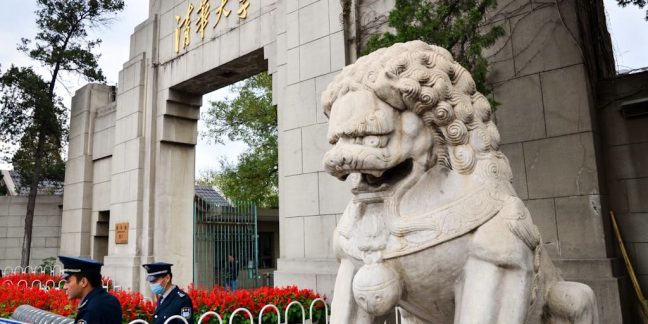
With China muscling its way into the first ranks as a global power in science and technology—[building](https://www.bbc.com/news/business-35776555) vast new academic complexes, [climbing](https://www.weforum.org/agenda/2020/03/best-universities-in-emerging-economies-china/) to the top ranks of the world’s elite universities, [surpassing the U.S.](https://www.forbes.com/sites/michaeltnietzel/2021/08/07/us-universities-fall-behind-china-in-production-of-stem-phds/?sh=38adf2604606) in PhD graduates in science and engineering, and on its way to [outperforming](https://cset.georgetown.edu/publication/state-council-notice-on-the-publication-of-the-national-13th-five-year-plan-for-st-innovation/) all other nations in science and technology academic citations—I was puzzled to discover that China is on hold [in offering online higher ed degrees](https://internationaleducation.gov.au/news/latest-news/Pages/Online-education-in-China.aspx).

In fact, the country has no institution that is approved to deliver online degrees, even though it has moved rapidly to embrace MOOCs, free or low-cost online courses offered to millions throughout the country.

Since virtual degrees and MOOCs are both digital inventions, I wondered what accounts for China’s reluctance to award remote degrees, while it moves full-speed-ahead with MOOCs. It’s a confounding paradox, since you’d think China would view remote higher education as a piece of its global ambitions.

Seeing [the rise of China](https://hbr.org/2021/05/americans-dont-know-how-capitalist-china-is), I imagine how Europeans must have felt at the end of World War II, when their long-held domination [was overtaken by the U.S.](https://www.erih.net/how-it-started/the-industrial-revolution-in-europe) After all, the U.S. was once—like China—[a backwater agrarian outpost.](https://www.nap.edu/catalog/2103/mastering-a-new-role-shaping-technology-policy-for-national-economic) After the war, mighty imperial centers in London, Paris and Berlin were reduced to runners-up, no longer able to exercise their former power. Today it is China, now the second biggest economy in the world, [elbowing the U.S. out of global technical supremacy](https://www.economist.com/graphic-detail/2018/10/27/the-chinese-century-is-well-under-way).

## Online Degrees On Hold

China actually has a long history of distance learning—mostly at correspondence schools and on broadcast TV. And at one point the Chinese Ministry of Education approved 68 pilot online colleges, including several at elite institutions, such as Peking, Tsinghua, Shanghai Jiaotong and Fudan Universities. But to earn a fully-accredited degree, students in online pilot programs must take additional exams to qualify—credentials that don’t carry the same academic standing as those awarded on campus.

Michael Wang, CEO of Beacon Education, a Beijing company I consult with that delivers U.S. online degrees to Chinese working professionals, says that China’s distance-learning programs are largely two- to three-year, second-rank vocational and professional schools. “They are not as rigorous as degrees earned from more expensive, four-year Chinese colleges,” Wang told me in a call from Beijing last week. “Nor are they at the same standard as online degrees from U.S colleges.”

Several obstacles stand in the way of the Chinese education ministry approving online degrees. “With 1.5 million enrolled in graduate programs, the country just doesn’t have enough faculty to manage an online population beyond its current commitment,” Wang said. “With no experience teaching online, neither is the faculty ready.”

Noting that the Chinese government is very conservative, Wang remarked that the ministry is likely fearful that its academic reputation will suffer if it approved online degrees prematurely. Wang thinks that officials will take another three to five years before they approve any virtual degrees.

To expand the nation’s technical talent pool, Chinese universities are upgrading their capacity to offer more up-to-date science and technology courses, with universities [just beginning to introduce degrees](https://www.caixinglobal.com/2019-04-01/you-can-now-major-in-artificial-intelligence-in-china-101399628.html) in artificial intelligence, machine learning, software engineering and other advanced specialties. For China, the move is a departure from its centuries-old tradition of favoring literature and the liberal arts.

“Most Chinese schools are content to deliver new programs on campus only, rather than on digital platforms,” said Charles Iannuzzi, Wang’s colleague and Beacon’s global president. To fill the gap, Beacon offers Chinese mid-career workers technical graduate degrees by partnering with U.S. colleges and universities to deliver U.S. online degrees in China.

## Joint International Programs

As dean of online learning at Stevens more than a decade ago, I ran [three hybrid master’s degrees](https://www.edsurge.com/news/2018-05-15-how-risk-averse-universities-take-risks-with-satellite-campuses-abroad) at two top Chinese institutions: Beijing Institute of Technology and Central University of Finance and Economics. While our Chinese students in Beijing accessed Stevens’ digital courses on laptops at home or elsewhere, just as our students in Hoboken did, online learning at most Chinese universities at the time was conducted in conventional classrooms, streaming videos or broadcasting live TV lectures on screens up front, as in a movie theater.

Stevens’ programs in China represent two out of about a thousand similar joint degrees [launched by foreign colleges and universities](https://theconversation.com/how-china-has-been-transforming-international-education-to-become-a-leading-host-of-students-157241). Today, in addition to about 10 fully-built residential campuses, including the University of Nottingham in Ningbo, University of Liverpool on the Xi’an Jiaotong campus and New York University in Shanghai, [40 online degree programs](https://www.classcentral.com/report/china-online-degrees/) are also offered in China by international colleges and universities.

According to the Chinese education ministry, on-campus joint international programs are launched to promote education reform and [to encourage modern pedagogical practices](https://www.insidehighered.com/news/2018/07/11/chinas-ministry-education-approves-termination-more-200-chinese-foreign-cooperative). The ministry must also be eager to encourage Chinese academic institutions to mimic Western institutions that helped propel dynamic capitalist economies.

Recently, in the wake of uneasy relations with the U.S. and other countries in the West, the Chinese Ministry of Education closed more than 200 foreign programs, [two dozen of which are with U.S. colleges and universities](https://internationaleducation.gov.au/international-network/china/PolicyUpdates-China/Pages/Article-Chinas-Ministry-of-Education-confirms-formal-termination-of-234-defunct-transnational-education-partnerships.aspx).

## MOOCs Rising

China has come a long way from cinema-style instruction to adopt more common digital learning practices, often closely following U.S. advances in online pedagogy, such as [flipped classrooms and MOOCs](https://www.igi-global.com/chapter/e-learning-in-china/188046).

Wu Yan, head of China’s Higher Education Department, says, “MOOCs are critical to reform China’s traditional [cramming teaching model.](https://www.classcentral.com/report/china-national-moocs/)”

MOOCs have proven wildly popular in China. In 2016, MOOCs claimed [more than 10 million enrollments](https://thepienews.com/news/chinese-mooc-learners-top-10-miilion-year-end/) in the country. By now, the Chinese MOOC learner population must be twice—or even three times—that number, if we measure its trajectory against booming MOOC enrollment worldwide. Class Central, a site that tracks MOOC enrollment, reports 180 million MOOC learners across the globe, [jumping from 58 million only 8 years ago](https://www.classcentral.com/report/mooc-stats-2020/).

Last year after [postponing](https://www.classcentral.com/report/china-moocs-coronavirus/) the start of the new higher ed semester in January because of the pandemic, the ministry endorsed [a list of free MOOCs for use by universities](https://www.classcentral.com/report/chinese-mooc-providers/). Today, following the global pandemic surge, 24 Chinese MOOC platforms offer an astonishing 52,000 courses, [more than double the number in 2019](https://www.classcentral.com/report/chinese-mooc-providers/).

Curiously, China’s reluctance to offer online degrees parallels the attitude toward online degrees [in the Ivy League in the U.S](https://www.edsurge.com/news/2021-10-04-why-most-ivies-offer-few-online-degrees-and-what-s-happening-to-change-it).—both have embraced MOOCs while turning away from virtual degrees out of concern that remote degrees will damage their reputations.

But by protecting prestige and failing to see the need to move into the online-degree space, they will let others take the digital lead.

It seems worth reminding Chinese officials of [a passage](https://www.marxists.org/reference/archive/mao/works/red-book/ch24.htm) from Mao’s Little Red Book, “Quotations from Chairman Mao Tse-Tung”: “Many things may become baggage, may become encumbrances if we cling to them blindly and uncritically.”

Original URL: https://www.edsurge.com/news/2021-12-10-in-china-online-degrees-on-hold-even-as-moocs-rise

Why Most Ivies Offer Few Online Degrees – And What’s Happening to Change It

Writing about online learning in higher education over the last several years, I often noted the steady growth of remote learning nationwide against the sluggish adoption of digital instruction among most Ivy League colleges. Virtual instruction continues to whiz across the country, racing recently with [unprecedented gains](https://www.insidehighered.com/news/2021/09/16/new-data-offer-sense-how-covid-expanded-online-learning). But getting your degree at an Ivy League college means mostly sitting in a classroom.

In fact, I decided to compile a list of all the online degrees offered in the Ivy League, and it’s surprisingly short, including only about two dozen online degree programs. Some in this elite group of colleges—specifically Princeton—offers no online degree at all.

What, I wondered, accounts for the reticence? Why do Harvard and other Ivies offer so few virtual degrees?

One Ivy, Columbia University, actually got an early start 35 years ago at the dawn of the digital age, when it launched its Video Network that now produces [about a dozen online engineering master’s degrees](https://www.cvn.columbia.edu/content/columbia-video-network). And in the past ten years these colleges have been active in offering so-called MOOCs, or massive open online courses, which are free or low-cost courses, usually for no official credit. Ivy League colleges [now offer more than 450 of these courses](https://www.studyinternational.com/news/free-online-courses-ivy-league/). And some Ivies offer graduate certificate programs online. Cornell, for example, lists about 90 in such fields as hospitality, [human resources and engineering](https://ecornell.cornell.edu/certificates/project-leadership-and-systems-design/).

But full degrees remain rare from these institutions. Harvard just introduced its [first online degree](https://www.gse.harvard.edu/masters/online-program) as late as June this year.

## Online Degree Programs By Ivy League Universities

**Brown University**

[Master of Science in Cybersecurity](https://www.brown.edu/graduateprograms/cybersecurity)

[Master’s in Technology Leadership](https://professional.brown.edu/technology)

[Master’s in Healthcare Leadership](https://professional.brown.edu/healthcare)

**Columbia University**

[Columbia Video Network](https://www.cvn.columbia.edu/fields) offers master’s in applied mathematics, applied physics; computer science; operations research; biomedical, chemical, civil, earth and environmental, industrial, and mechanical engineering; and materials science and engineering.

[Master’s in Social Work](https://socialwork.columbia.edu/academics/online-msw/ttps://www.cvn.columbia.edu/fields)

**Cornell University**

[Master of Engineering in Systems Engineering](https://www.systemseng.cornell.edu/se/programs/meng-degree-distance-learning)

[Master of Engineering in Engineering Management](https://www.engmanagement.cornell.edu/em/programs/meng-distance-learning) [Executive](https://www.ilr.cornell.edu/programs/graduate-degree-programs/emhrm)

[Master’s in Human Resources Management](https://www.ilr.cornell.edu/programs/graduate-degree-programs/emhrm)

**Dartmouth College**

[Master’s in Healthcare Delivery Science](https://mhcds.dartmouth.edu/curriculum-schedule/)

[Master’s in Public Health](https://tdi.dartmouth.edu/education/degree-programs/masters-in-public-health/online/online-mph-programs)

**Harvard University**

[Master’s in Educational Leadership](https://www.gse.harvard.edu/masters/online-program)

**University of Pennsylvania**

[Bachelor of Applied Arts & Sciences](https://lpsonline.sas.upenn.edu/academics/bachelors-degree)

[Master of Computer and Information Technology](https://online.seas.upenn.edu/degrees/mcit-online/) (co-hosted with Coursera)

[Master of Healthcare Innovation](https://improvinghealthcare.mehp.upenn.edu/master-of-health-care-innovation)

[Master of Science in Nonprofit Leadership](https://www.sp2.upenn.edu/academics/ms-in-nonprofit-leadership/)

[Master of Science in Animal Welfare and](https://www.vet.upenn.edu/education/graduate-programs/msc-animal-welfare-behavior) [Behavior](https://www.vet.upenn.edu/education/graduate-programs/msc-animal-welfare-behavior)

[Doctorate in Clinical Social Work](https://www.sp2.upenn.edu/academics/doctorate-in-clinical-social-work/)[](https://www.nursing.upenn.edu/dnp/)

[Post-Master’s Doctor of Nursing Practice](https://www.nursing.upenn.edu/dnp/)

**Princeton University**

None offered

**Yale University**

[Physician Assistant Online](https://medicine.yale.edu/pa/)

[Executive Master of Public Health](https://ysph.yale.edu/school-of-public-health/graduate-programs/online-mph-program/)

[Doctor of Nursing Practice](https://nursing.yale.edu/enrollment-management/admissions/doctor-nursing-practice-dnp)

Two beliefs stand in the way of Ivies accelerating virtual degrees. One is the assumption that the pedagogy Harvard and other Ivies have always practiced—close-knit groups of students and faculty living and studying together immersively on campus—is the [finest in post-secondary education](https://college.harvard.edu/about/mission-vision-history), with no other approach coming close, especially not online. The other is the fear that if they adopt remote instruction, it will surely damage their centuries-long accumulation of prestige, undermining what have become the world’s most coveted academic brands.

“The Ivies are all risk-averse,” says Peggy McCready, former associate vice provost for technology and digital initiatives at UPenn Libraries. “The last thing they want is to damage their reputation.”

But the Ivies need not fear their top-of-the-line standing will be undermined by digital education. Nothing can topple their exalted position at the pinnacle of the academic world, least of all online students clacking away on keyboards far from campus.

According to researchers from Dartmouth and UCLA whose [results are published in MIT Sloan Management Review](https://sloanreview.mit.edu/article/brand-equity-dilution/), the Ivies need not worry about diluting their brand equity if they launch more online degrees. “Parent brands have been shown not to be particularly vulnerable,” even if extensions fail, the scholars conclude.

Donors—who have made the Ivies astonishingly wealthy, now with combined endowments [totaling more than $140 billion](https://www.thenewportbuzz.com/americas-ivy-league-schools-sit-atop-140-billion-in-endowments-and-theyre-about-to-get-millions-more-in-coronavirus-aid/23445)—are highly unlikely to stop giving if their alma maters go online more aggressively.

On the contrary, trustees may already question the academic wisdom of shrinking from the digital economy when nearly all of industry underwent virtual transformation long ago. They may wonder whether Ivy academic officers are not bold enough to take their proper place among the leaders of the academic digital age.

Equitably conscious alumni may be uneasy about whether senior academic officers are fulfilling their social mission. Worldwide, the Ivies are praised for being at the forefront of scholarship, but have lagged behind in other important ways. Going back in history, Ivies were late to respond until recently to admitting brilliant, low-income students [without paying tuition](https://nonprofitquarterly.org/harvard-initiative-to-attract-low-income-students-includes-free-tuition/). Ivies were also [late to admit Blacks](https://www.complex.com/pop-culture/2013/02/the-first-black-students-admitted-to-15-prestigious-us-universities-and-their-stories/james-pennington), [late to admit women](https://www.wgbh.org/news/2017/03/23/innovation-hub-podcast/when-women-entered-ivies), and now they are late to fulfilling the needs of working students by denying them online access to degrees. Opening virtual gates to working students may very likely enhance their reputations–not damage them.

Digital students enter the Ivies not by passing through [exquisite wrought-iron gates](https://college.harvard.edu/life-at-harvard/residential-life), but on virtual clouds, floating high above campus, never occupying a single seat in a face-to-face classroom, nor sleeping in a bed in a residential house.

Admittedly, the physical closeness and intimate connections in dorm rooms and houses cannot be replicated online. Yes, it’s a wonderful, engaged and fulfilling way of being educated. But it’s for the privileged few who don’t need to work. Others are not so fortunate, especially those who cannot attend college without working. Time off from earning an income is a luxury few can afford.

The troubling fact is that of all undergrads in the nation’s colleges, [about 40 percent of full-time and approximately 80 percent of part-time students work](https://nces.ed.gov/programs/digest/d18/tables/dt18_503.40.asp). One of the greatest achievements of digital education in this century is its capacity to offer greater access to colleges and universities to students who must work while they advance their studies.

## An Alternative Ivy League Pathway to Online Degrees

The University of Pennsylvania is not wobbling on the bumpy road to online education. Instead, it has introduced [an initiative](https://www.semanticscholar.org/paper/Supporting-Online-Initiatives:-From-MOOCs-to-Stein/513bda15a34cfb2f3e3e5645056f088fed239a3b) that invites faculty to propose virtual degrees where they see a clear need, mostly for working undergraduates and mid-career professionals. In the last several years, Penn faculty have introduced seven new online degrees—not only master’s, as at other Ivies, but also, uncommonly, a bachelor’s and a pair of doctorates, rare for most colleges in higher education.

When Penn’s [Online Learning Initiative](https://www.onlinelearning.upenn.edu/) was launched in 2012, Rebecca Stein, its executive director, recalled, “At first, there was a lot of fear and antagonism, but it opened an opportunity to engage with new technologies.” Eventually, 12 schools at Penn joined, with the School of Social Work proposing a [virtual doctoral program](https://www.sp2.upenn.edu/academics/doctorate-in-clinical-social-work/), now with students drawn from across the country pursuing degrees without flying to Philadelphia to attend courses face-to-face. Stein says that it and most other Penn online degrees “are for people with established careers who need flexibility.”

The biggest departure from convention came when Penn’s College of Liberal and Professional Studies saw the need for an online undergraduate degree for nontraditional students, an [online Bachelor of Applied Arts & Sciences](https://lpsonline.sas.upenn.edu/academics/bachelors-degree).

“Students in the program work; many with families,” Stein says. “Our motivation was to serve students where they are—which is online—a different population than our traditional undergrad.”

Penn’s online unit acts as a virtual machine shop, with tools designed to launch online degrees—instructional technology, marketing and student affairs, among other crafts. The staff partners with each new program, transferring skills to help build their own digital toolkits.“We chaperone programs, but don’t create them,” Stein says.

Joshua Kim, director of online programs and strategy at Dartmouth’s Center for the Advancement of Learning, calls Penn an outlier. “Fully online degrees at low-cost—designed to scale—are unusual among elite institutions,” observed Kim.

Like players in a schoolyard competing in a tug-of-war, the Ivies and other selective colleges face two contesting claims—one towards high-priced, non-degree alternative credentials, the other for more affordable, virtual degrees for a broader student population.

_Correction:_ This article originally misstated that Yale offers no online degrees. It has three.

Original URL: https://www.edsurge.com/news/2021-10-04-why-most-ivies-offer-few-online-degrees-and-what-s-happening-to-change-it

What It Takes For a College to Go Online

As the pandemic continues to stumble its way across the country, colleges that had never considered setting up online programs are now exploring how to do it. Most haven’t a clue.

That’s why [many have turned to Online Program Managers](https://www.edsurge.com/news/2021-06-07-lacking-online-programs-many-colleges-are-rushing-to-partner-with-opms-should-they), known as OPMs, commercial vendors that create and market digital programs. Some colleges, meanwhile, have decided to go it alone and build their own systems.

Whatever a college does, though, the decision to go online should involve a few key factors. That was driven home as I checked in with a handful of former colleagues from [NYU Tandon Online](https://engineering.nyu.edu/academics/departments/nyu-tandon-online) and others—most now at other programs—to hear what advice they have for college leaders today.

## 1\. Engage Faculty in the Decision to Go Online

“If faculty don’t participate, you won’t have a program,” says Lisa Springer, provost at LIM College, a small Manhattan fashion business school. Earlier, Springer was associate dean at NYU’s School of Professional Studies. “When creating on-campus programs, everyone says you need faculty engagement, but why not online, too?”

In Springer’s recent [doctoral research](https://www.limcollege.edu/news/provosts-doctoral-research-previews-shift-post-covid-world), she found it common for colleges to set up virtual degrees out of new divisions rather than from existing academic departments. “You would never do that on campus,” Springer continued. “You set up conflict immediately.”

My own experience bears that out. A few years ago, when colleagues and I recognized the need for launching a remote undergraduate degree in a highly in-demand field, we moved ahead for months with plans without routinely consulting faculty members along the way. In the end, when it was time to submit our proposed online degree for university approval, our eagerly sought-after debut was rejected by department faculty members in an embarrassing, thumbs-down vote.

To avoid such blunders, some schools wisely invite faculty to participate in focus groups, not only to tease out objections, but to encourage them to contribute to the effort. In one focus group I attended, faculty members recommended that online courses include real-time sessions, that the school stream on-campus lectures and events to remote students, and that faculty establish a uniform and consistent online course evaluation rubric following industry best practices.

It’s especially fruitful to establish a university-wide online committee with senior faculty as members, tasked with studying the potential impact of digital education on the institution. It’s best to keep this high-level group running even after the virtual program is established, to assure professors have a hand in remote learning as it moves forward.

## 2\. Calculate Solid Enrollment and Revenue Projections

“The first thing you want is a commitment from your college to finance your unit’s start-up costs,” advised Marlene Leekang, executive director of the Field Center for Entrepreneurship at Baruch College in New York. “You must then project when your new online unit will deliver a return on the school’s investment. Leaders at your college will resist financing it unless you can assure them it will eventually return the school’s stake.” Leekang worked closely with me at NYU’s Tandon School where she was executive director of finance and management for the online unit, which consistently generated serious surpluses.

Leekang encourages colleges to base remote enrollment and revenue estimates on judicious analysis, after performing careful market research—rather than depending merely on speculation—to support claims. At its best, research will identify direct competitors, as well as ways new digital programs can differentiate themselves from others to attract wide appeal.

That often means hiring consultants and running feasibility studies to determine whether there’s demand for the online degrees colleges have in mind. It’s unwise to launch new remote programs in fields new to the school. It’s far more productive to initiate online degrees paralleling popular ones already running on campus.

“You must provide senior officers with strong evidence that digital education will offer your institution long-term financial stability, delivering a new way of supporting your college as a whole,” Leekang said. “You must show that your unit is not just a service arm, but wholly integrated into the rest of the institution.”

Apart from repaying the school for its initial subsidy and, crucially, adding new revenue streams to your institution’s bottom line, it’s prudent to build reserves to support continuing growth for ongoing sustainability.

Devising a positive economic case for a new online unit demonstrates that digital learning is not just a passing fad, but offers a compelling way forward, re-routing colleges away from a shaky on-campus-only fate.

## 3\. Hire a Team of Instructional Designers

“Instructional designers form the bridge that helps faculty members teach online—a talent in which they are not commonly experts,” observes John Vivolo, director of online and campus learning at the Katz School at Yeshiva University in New York. “When most faculty members earn their scholarly degrees, naturally, they absorb the subject matter of their discipline. But while they are skilled at what they teach, they are not often qualified at teaching it online.” Vivolo was director of online and virtual learning at the Tandon School when I was online dean a few years ago.

To alleviate virtual anxiety among rookie online faculty, Vivolo says that instructional designers should be brought in to support and collaborate with them on how to teach online effectively. “An instructional designer’s role is not just to put stuff on the LMS, but to partner with faculty to show how a course should be delivered virtually,” says Vivolo.

When I taught online a few years ago at The New School, a liberal arts college in Manhattan, an insightful instructional designer steered me through dozens of ways of making my course interactive, reducing time lecturing by replacing it with stimulating student engagement, encouraging students to work actively with digital, video and print materials, but especially with their peers, working in groups.

When I first entered digital education more than two decades ago, instructional design was just at the starting gate. Most early online units sent virtual instructors off on their own, with little or no support. Today, with pandemic-fueled breakneck remote learning growth, it’s among the fastest expanding technical occupations. In 2018, long before the present health crisis, the Bureau of Labor Statistics projected job growth over the following ten years at 9 percent, [greater than average for all other careers](https://www.northeastern.edu/graduate/blog/instructional-designer-salary/). According to the eLearning Guild, instructional designers earn an average of about $85,000 a year (but keep in mind that salaries vary, based on level of education and location).

“At its best,” Vivolo concluded, “online teaching does not consist of lectures accompanied by PowerPoints—putting your course together with Scotch Tape and bubble gum—but devising new ways of making it active.”

## 4\. Provide Online Student Services

“If student services are important on campus, they are even more so online,” argued Anita Crawley, co-founder of [Educators 4 Equity and Justice](https://educators4equityandjustice.org/) and author of [Supporting Online Students](https://www.wiley.com/en-us/Supporting+Online+Students:+A+Practical+Guide+to+Planning,+Implementing,+and+Evaluating+Services-p-9781118076545). “But often, when launching an online unit, student services staff are not at the table.”

My own experience confirms Crawley’s observation. At a high-level NYU committee, called years ago to review virtual education requirements, most departments—except student services—were represented. When the omission was called to the chair’s attention, it took months before a special subcommittee was appointed. It met only once and was never invited to participate in the work of the wider committee. When initiating new remote learning units, the absence of student services is no longer responsible.

“To achieve success and maintain retention, remote learners need support from student services,” continued Crawley. “Without them, they are likely to flounder and not do well.”

That’s especially true for remote students, with many first in their family to attend college and most who work full time. Data reveal that 70 percent of virtual undergrads and 80 percent of online graduate students work full or part time, with [just 25 percent of residential students working full time](https://www.edsurge.com/news/2018-07-17-does-online-education-help-low-income-students-succeed).

Cawley says that running an orientation for online students to learn how to learn online is a top priority. “Remote students need to understand not only how the school’s learning management system works, but also what are the expectations of being an online student,” Crawley said. “They also need to be informed about technical requirements, software and connections, how to communicate virtually with instructors and peers and how to organize themselves remotely as learners.”

After all, student services abound on campus—study centers, career and mental health services, clubs and support for learning, among dozens of other benefits. Crawley insists that many of these must also be available to remote students as well.

“We have the capability now to perform many student services seamlessly with technology,” Crawley noted. A splendid example is found on Arizona State University’s mobile app, an online one-stop-shop, helping students on and off campus. With just one click, students can access the school’s academic calendar, library and [any of dozens of other sites](https://m.asu.edu/).

## 5\. Engage Digital Recruitment Specialists

Because prospective students—like all of us today—acan social media and search online relentlessly, [digital marketing has replaced most traditional ways of reaching out](https://www.edsurge.com/news/2017-09-06-forget-us-news-rankings-for-online-college-programs-google-is-kingmaker) to the online learning marketplace. Today, colleges promote programs and recruit students by exploiting email, social media and search-engine marketing, hunting for the biggest return on their sales dollars by investing in digital real estate where prospective online learners are sure to be found.

These new techniques require an altogether new set of commercial skills—selecting muscular databases, bidding on digital ad space and optimizing rank on search engines, among other methods—capabilities not commonly used in conventional campaigns. Nowadays, however, digital recruitment is not only deployed in virtual programs, but is pursued equally aggressively to generate face-to-face enrollments.

“Old-fashioned marketing was buying print media,” recalled Ardis Kadiu, CEO of Element 451, a higher ed digital recruitment and CRM firm. “Today, you can target prospective students much easier digitally. You now compete with many other online institutions—state, nonprofits and for-profits—many offering the same courses, competing with you on the same platform, playing in the same playground with everyone else.” Some years ago, Kadiu was an adjunct professor at the Tandon School.

Kadiu cautioned that if a college’s technology is not up to the mark—for example, if students don’t get a quick response to an inquiry—prospects are likely to go elsewhere. Typically, students explore a few dozen potential colleges before enrolling in the one they select. Most successful online units use marketing automation and customer relations management platforms that track and manage campaigns, driving efforts to convert leads to enrollments.

“The first college to catch students’ attention will have the greatest chance of capturing them,” said Kadiu, who acknowledges that digital media can be very expensive, running about $100,000 to $200,000 for a start-up campaign, with about 60 percent going for media buys, 30 percent for creative and agency fees, and 10 percent for technology. “Figure on spending a couple of thousand dollars to recruit an online student,” calculates Kadiu.

Most of the steps to go online take some doing—but they are no greater or more expensive than initiatives colleges undertake as a matter of course. Think of what it takes to build a fairly undistinguished academic building on campus that may take years, if ever, to earn back its investment.

Going online commonly requires far less financial and other major commitments than the millions required to run a modern university campus—but it takes a little more courage and inspiration.

Original URL: https://www.edsurge.com/news/2021-08-25-what-it-takes-for-a-college-to-go-online

What’s the Right Price for an Online Degree?

I recently came upon a pair of contradictory articles about what colleges will be charging for tuition next academic year: One reporting that Ohio State University found reasons last month [to nearly double its online tuition](https://www-forbes-com.cdn.ampproject.org/c/s/www.forbes.com/sites/dereknewton/2021/05/31/ohio-state-raising-fees-for-online-courses-is-a-big-deal/amp/), and another noting that some colleges are [in a race to lower tuition](https://www.cnbc.com/2020/12/21/colleges-slashing-tuition-for-2021-22.html).

So I wondered: What compels some colleges to double online tuition while others cut theirs?

Classical economics tells us that price is mostly determined by cost of production plus profit. Yes, these colleges are nonprofit institutions, but these incongruous cases seem to contradict that simple formula. Other forces must be in play.

The dilemma of what price to set for online tuition has a long history, going back to the early days of digital education, when many of us contended that online tuition should be no different than on campus. I was among those who argued that if students receive the same education from the same faculty, leading—more or less—to the same outcomes, [tuition should be the same for both](https://www.edsurge.com/news/2018-12-13-can-online-learning-help-higher-ed-reverse-its-tuition-spiral/).

A quarter of a century ago, as digital degrees were first being launched at a handful of the nation’s colleges, many of us leading online programs worried that differential pricing might stigmatize fledgling virtual programs, causing families to feel uneasy about sending their college-age children to cheaper versions of expensive (and seemingly far-more-worthy) degrees on campus. By charging less for digital degrees, colleges might be fulfilling the market’s presumption that virtual education is illegitimate and that only costly on-campus degrees are justified.

Even though the cost of delivering online courses was then far less than on campus, we worried that if colleges set a lower price for remote instruction, students and their families might get the wrong impression, with lower prices signaling that digital learning was less valuable. To avoid introducing an upstairs-downstairs academic hierarchy, with on-campus honored on top and virtual demeaned below, many of us insisted on a single price covering both.

But since then, so much has changed in remote delivery, online faculty participation and virtual enrollment that these debates have taken on complex repercussions, including institutional survival. So it’s worth illuminating various cases for different pricing strategies for online tuition. In fact, I argue that the debate about how to price tuition is among the academy’s most threatening struggles.

## Tuition and Consequences

When taking a cross-country airplane flight, you can never tell what someone seated right next to you is paying. A passenger in first class can be flying free on points, while a traveler jammed into coach might be charged a premium for a last-minute booking. So, too, students seated in the same class at most of the nation’s colleges and universities can pay as little as nothing or many thousands of dollars to attend the same lecture. Students on full scholarship, for instance, may take classes totally free, while an undergraduate from Amsterdam pays top dollar as an international student.

The value of college is hard to measure. Price is in part a measure of how much others value a college degree, how much it’s admired and how effective it is in securing social capital—giving graduates access to powerful networks, including often seamless entry into top positions in the job market.

According to the French social theorist Pierre Bourdieu, a college education provides graduates, especially those from elite universities, with not just a college degree, but with distinctive cultural qualities—the way graduates carry themselves, tastes they acquire and the economic class of their peers. These and other markers often secure graduates [powerful positions in society](https://us.sagepub.com/en-us/nam/reproduction-in-education-society-and-culture/book203162).

And of course a college degree does have an economic payoff. Comparing the lifetime potential earning power of college graduates with those who complete high school only, [a U.S. Census Bureau report](https://www.thoughtco.com/lifetime-earnings-soar-with-education-3321730) calculates that over a working life, a college degree is worth nearly twice a high school diploma—or $2.1 million by contrast with $1.2 million for a high school graduate.

Colleges that set online tuition at less than what they charge on campus commonly follow the widely accepted belief that online degrees should be cheaper than those on campus. After all, campuses include expensive academic buildings, sports facilities, dormitories and other routine services, such as dining halls and libraries, requiring constant costly maintenance. Online courses, meanwhile, delivered in the cloud above campus, require far less infrastructure. For many, it seems reasonable to pass on the savings to students.

Yet some say that instructional costs online tend to be [about the same as on campus](https://www.brookings.edu/blog/brown-center-chalkboard/2020/07/28/why-the-move-to-online-instruction-wont-reduce-college-costs/) while others conclude that teaching online is even [more expensive than on campus](https://www.insidehighered.com/news/2017/02/17/study-challenges-cost-and-price-myths-online-education), and as a result, many colleges add supplemental fees to virtual courses.

A [study conducted by WECT before the pandemic](https://wcet.wiche.edu/initiatives/research/price-cost-distance-ed%5D) found that only about 20 percent of colleges they surveyed charged less tuition and lower fees than they do to those who study in person. Counterintuitively, the study also revealed—to my surprise—that more than half of the colleges charged more tuition and higher fees to their remote students than to those studying on campus. The survey also uncovered another revelation: online fees added to tuition can be so large that [they are greater than tuition alone](https://www.usnews.com/higher-education/online-education/articles/what-youll-pay-for-an-online-bachelors-degree). In a more recent analysis, however, US News & World Report last year found that average tuition for in-state online students was $316 per credit, while for those on campus, it was $311—a marginal difference.

Setting tuition often turns out to trigger ethical as well as economic effects. After all, each dollar added potentially shuts additional students out of the opportunity if they can no longer afford it.

In fact, more than half of American students are forced to go into debt to get a college degree, and the average student-loan indebtedness now exceeds $37,500, scandalously reaching nearly $1.6 trillion nationally. Over the past three decades, the average cost of attending a public four-year college [has almost tripled](https://www.investopedia.com/student-loan-debt-2019-statistics-and-outlook-4772007) and has more than doubled at private four-year schools.

## Bending the Tuition Curve Online

Thinking about pricing online tuition recently, I’ve had a change of heart. I no longer feel that online and on-campus degrees should cost the same, especially because some online degrees are bending the so-called cost curve, finding ways to scale education in ways that lower production costs and allow for steeply discounted tuition. Any effort to reduce the cost of college is an admirable move that promises economic justice. If online can make it easier for low-income students to attend college, then I’m all for discounted virtual tuition.

Two recent trends are proving that virtual education can stall or reverse the nation’s continuously climbing tuition escalator. A [recent study](https://www.nber.org/papers/w20890) by the National Bureau of Economic Research found that colleges with a greater-than-average share of remote students largely charge lower tuition than their on-campus counterparts. As prices rose at most post-secondary institutions over the last decades, tuition at these colleges fell.

For example, two colleges with the largest online populations—Western Governors University (120,000 online students) and Southern New Hampshire University (97,000 online students)—also post among the lowest online bachelor’s degree tuition of any of the predominantly online colleges in America ($29,000 at Western Governors and $38,000 at Southern New Hampshire).

It wasn’t until providers of so-called MOOCs—massive open online courses—entered into online partnership with high-ranking colleges about a decade ago that serious discounting took off. The first of these MOOC-based degrees in computer science at Georgia Tech [now boasts more than 11,000 enrolled](https://www.forbes.com/sites/michaeltnietzel/2021/07/01/georgia-techs-online-ms-in-computer-science-continues-to-thrive-what-that-could-mean-for-the-future-of-moocs/?sh=cc9261fa277a), making it the largest computing master’s program in the nation, with students paying the unprecedentedly low tuition of just over $7,000 for a first-rank degree.

Since then, MOOC degrees [have mushroomed](https://www.classcentral.com/report/mooc-based-masters-degree/), now with more than 70 others available in partnership with about 30 first-class universities worldwide. Coursera, the biggest provider, offers [nearly 30 virtual degrees](https://www.coursera.org/degrees) in business, data science and public health, among other fields, most discounted at less than half of comparable on-campus programs—a radical departure, opening these highly selective schools to thousands of candidates who might never have been admitted before the MOOC invasion.

Coming out of the pandemic, higher education suffered its most devastating, crushing loss in memory, [estimated collectively at $183 billion](https://www.insidehighered.com/quicktakes/2021/02/09/colleges-could-lose-183-billion-during-pandemic). But even during this painful financial crisis, senior academic officers at the nation’s colleges largely held their tuition down, with many making meager increases of [close to 1 percent](https://research.collegeboard.org/trends/college-pricing). It took enormous strategic strength and the wisdom of restraint to achieve this unexpected result.

With some online degrees taking the lead, it’s now even possible to imagine higher ed prices falling in the years ahead, rather than continuing their climb.

Original URL: https://www.edsurge.com/news/2021-07-23-what-s-the-right-price-for-an-online-degree

Lacking Online Programs, Many Colleges Are Rushing to Partner with OPMs. Should They?

In the last couple of decades, as online learning was steadily being recognized by millions of students as a convenient way to earn a highly prized academic degree, most senior officers at the nation’s colleges and universities paid little attention, dithered or dabbled. When higher ed leaders woke up during the pandemic, they went to their digital cupboard and found it was bare.

The earlier indifference to virtual education was largely the result of having moved up academic ranks as part of the pre-digital generation, following the resistance of many faculty who expressed widespread hostility to online teaching as being a poor alternative to classroom instruction. And many were thwarted by their lack of understanding of how remote instruction actually worked, since they had never taken an online class, and had certainly never taught one.

There was also a common belief among higher ed leaders—as there still is—that building online infrastructure is far too costly. And as enrollments in traditional programs declined, it left colleges struggling to balance their budgets and much less able to finance new ventures in virtual instruction.

Ironically, colleges that invested early, when so many were hesitant, were able to build courses and programs at lower cost. A quarter of a century ago, when I helped launch a number of online master’s degrees at Stevens Institute of Technology, an engineering school in Hoboken, NJ, we didn’t employ instructional designers or videographers. And we didn’t have to dig into our reserves to finance [pricey digital-recruitment campaigns](https://www.edsurge.com/news/2017-09-06-forget-us-news-rankings-for-online-college-programs-google-is-kingmaker). None of those costly resources were essential drivers of online enterprises as they are today. At the turn of this century, adventurous faculty ventured out into cyberspace on their own, propelled by their own talent, accompanied merely by a laptop and internet access.

Recognizing their failure to prepare for a digital future—after a year of so-so emergency remote instruction—higher ed leaders are now trying to make up for lost virtual decades by rushing to partner with online program managers (OPMs), commercial vendors who help colleges deliver and market online programs. Thanks to the pandemic, OPMs now reap the benefits of higher ed’s procrastination. Not until the health crisis forced campuses to close physical classrooms did so many colleges see the cost of their failure to act sooner.

## As On-Campus Retreats, Online Speeds Forward

Senior higher ed officers have realized how severely battered the pandemic left U.S. higher ed. According to the [latest data](https://nscresearchcenter.org/stay-informed/) from the National Student Clearinghouse Research Center, undergraduate enrollment fell by nearly 6 percent. Community colleges were hit especially hard, with enrollment dipping severely, by more than 11 percent. While graduate enrollment continued its steady climb at a 4.4 percent increase, overall, higher ed fell more than 4 percent from a year ago.

![graph of the rise of online enrollments while on-campus enrollments fall](https://edsurge.imgix.net/uploads/photo/image/8725/Higher_Ed_Enrollment_In_Distance_Education-1622568961.png?w=216&h=216&auto=compress,format&fit=fill&bg=fff&pad=0&blur=10&px=4 “Higher Ed Enrollments in Distance Education”)

Source: Mind Wires

With the pandemic intensifying the decline, postsecondary education leaders have been anxiously watching the discouraging trend over many years; enrollment slipped by a million from 20.7 to 19.7 million from 2012 to 2019. The graph above, depicting federal data shrewdly reshuffled by edtech trend-spotter Phil Hill, reveals a steady on-campus decay while online races ahead.

Hill’s analysis uncovers the bad news that if you remove students who don’t take any online courses, total on-campus enrollment actually plummeted by a troubling three million. In sharp contrast, during the same period, the number of students taking exclusively online courses jumped by a million, and those taking some but not all online courses gained another million.

That doesn’t paint a pretty picture for the future of on-campus higher education, but it suggests a bright future for online education.The disdain for digital education conveyed by many senior academic officers for so long now seems foolish.

## Partnering with OPMs

So how will colleges who didn’t build online programs sooner now attract students to the virtual academic world as the pandemic ends? How will faculty learn how to deliver effective courses virtually—not just their old lectures via Zoom? One way a rising number of colleges have found is to sign on with an OPM.

The [hockey-stick graph](https://www.holoniq.com/notes/80-growth-in-opm-partnerships.-1000-university-partners-later/) below, prepared by Holon IQ, an edtech market research firm, represents the present surge in OPM partnerships—slow in the last decade, followed by a steep climb during the pandemic in 2020, and with a big bump in the first quarter this year.

![graph of rise of OPM deals by colleges](https://edsurge.imgix.net/uploads/photo/image/8724/Holon_OPM_Bootcamp_partnerships-1622568765.png?w=216&h=108&auto=compress,format&fit=fill&bg=fff&pad=null&blur=10&px=4 “Rise of OPM deals by colleges”)

The chart is an arresting depiction of the race by colleges to build online programs, even at a time of budget challenges. Colleges signed up to provide themselves with technologies and services they had failed to mobilize on their own—responsive online student support, experienced instructional designers and savvy videographers; plus tools for student collaboration, assessment, remote testing, course authoring, multimedia and dozens of other applications.

Not least among these is the sweep of inventive teaching approaches made possible by introducing digital instruction, from video streaming to [HyFlex delivery](https://www.insidehighered.com/digital-learning/article/2020/05/13/one-option-delivering-instruction-if-campuses-open-fall-hyflex). On the enterprise side are skills more aligned with business than scholarship—digital recruitment, call-center operations, video studio production, budgeting and management. With most academic leaders trained as scholars, online competencies fall far outside their comfort zone. No wonder senior officers are rushing to fill the gap with experts outside the university gates.

OPMs are especially seductive because they help finance programs up front. In exchange for paying startup costs of new online programs, most OPMs reap a fifty percent share of online tuition revenue generated.

OPMs also tout more-sophisticated techniques for bringing in new students than conventional marketing efforts at other institutions. Their approaches [typically do better than what colleges offer on their own](https://encoura.org/prove-opms-really-boost-enrollment/), though OPM campaigns are often more expensive as well.

Of course, as with every digital service provider, not all clients are happy. Some, troubled by inferior OPM service, have parted company with their partners and are now on their own, often having learned a thing or two.

## Colleges Succeed on Their Own Online

Successful online programs have been doing it all on their own for years, growing online student populations in the tens of thousands. With hundreds of colleges offering online degrees, some have drawn [more than 50,000 enrollments](https://www.insidehighered.com/digital-learning/article/2019/12/17/colleges-and-universities-most-online-students-2018), with a couple even exceeding 100,000.

These early market leaders in online higher education quickly filled their virtual cupboards with exactly what online enterprises and their students needed. None of them partnered with OPMs. In large measure, these big virtual colleges are the forerunners of OPMs, leading the way with methods that OPMs adopted and now market to laggards. Calling attention to news this spring that colleges with sizable online enrollments are speeding ahead, Phil Hill [noted](https://philonedtech.com/spring-2021-enrollment-update-the-flight-to-heavily-online-institutions/) that “one of the biggest factors is prior investment in online.”

For most colleges—excluding highly selective schools that never lack applicants—continuing with depleted digital fare is not a healthy long-term solution. OPMs are merely a stopgap therapy. The prescription for colleges with insufficient digital infrastructure is to find a way to sustain a healthy virtual diet, even if they use an OPM provider temporarily to help them get through an immediate digital crisis.

OPMs have been good at relieving academic pain provisionally. What is needed now is a durable, self-care remedy.

Original URL: https://www.edsurge.com/news/2021-06-07-lacking-online-programs-many-colleges-are-rushing-to-partner-with-opms-should-they

Will a Rise in Online Learning Open Remote Teaching Opportunities for Faculty?

As the pandemic wanes, a chorus of commentators are offering predictions about what mark it will leave on higher education—with some forecasting colleges collapsing and others seeing increasing alliances with commercial partners. Most anticipate the growing centrality of online learning in university life.

As a longtime proponent of online higher education, I thought I’d take a stab at imagining a couple of effects digital education might have on teaching and learning in the college classroom.

## Liberating campus-bound faculty.

Of the many remarkable things about online learning—its principal benefit—is to give students the freedom to learn almost anywhere. And that goes for faculty members, too, who might now have access to new opportunities to teach remotely for institutions around the globe—and let colleges hire online faculty with attractive strengths who happen to live far away.

That has already started to happen during the pandemic, with so many faculty and staff working and teaching from home. Since it has made no difference to their students where they were living, some, quite privileged, took off for country homes or slipped away to vacation spots, continuing to teach online as if they were at a nearby campus.

Years ago, when I was head of Stevens Institute of Technology’s blended learning program in Beijing, the school’s faculty taught online mostly from our Hoboken campus, while the students lived in China, and many took the opportunity to teach virtually while traveling in Europe or Asia.

Just think of the intellectually exciting possibilities. It’s common today for colleges to invite professors from other institutions to deliver distinguished lectures on campus. Apart from fees paid to the visiting faculty, serious investments are required to fly them across the country or from abroad and to house and feed them for, say. three or four days. In an online world, all that’s needed is a stipend to deliver the talk and a way to project a Zoom feed. Forget flights, hotels and the rest.

Similarly, when schools identify eminent faculty at other institutions who they are eager to invite as visiting professors for a semester or an academic year, it has not been an easy calculus, with travel, housing and other expenses to be covered. Nor is it a simple matter for invited faculty, despite the distinction of being asked, to accept the opportunity if they must leave family and work behind for a long stretch. Luckily, online, these inconvenient barriers collapse.

And as a result of the pandemic, remote teaching arrangements like these may have already started. Some colleges employ faculty with uncommon expertise to teach partly at their home college and partly overseas, spending one semester in the U.S. and the next in, say, Sweden or Bulgaria. With travel abroad severely restricted, globetrotting faculty now teach online to their students abroad.

During the pandemic, the scholarly community has been forced to abandon its addiction to attending in-person conferences at far-flung destinations. As a result, instead of adding to the global carbon crisis, researchers have learned to adjust, advancing their slides digitally at virtual academic meetings as if they were engaging in digital auditions for remote college instruction.

The potential impact on global faculty recruitment for the nation’s colleges and universities is fairly compelling. Consider how intellectually electrifying it might be for an underfunded college to recruit an eminent professor from a top-ranked school abroad to teach remotely—to deliver a lecture, attend a daylong seminar, or teach a semester-long course.

But in our new, more-digital academic world, will search committees feel free to offer faculty positions to candidates who they can’t take to lunch after listening to their virtual job talks?

There are down-sides, however. The likely result is that many new online faculty hires will not be moving along the tenure track, but will—like most online instructors today—enter the halls of academe as contingent workers, adjuncts with little job security. Though it’s [unclear how many adjuncts teach online](https://www.edsurge.com/news/2019-11-06-higher-ed-has-now-split-into-dual-economies-online-and-traditional), from my own experience, and from my knowledge of hiring practices at for-profit and other schools with large online student enrollments, the number of full-time faculty teaching online is very thin, and at some colleges, very likely close to zero.

## Teaching and learning in unbounded time.

Bound by four walls, the campus classroom is not only a physically enclosed space but one confined by time, limiting interaction to a defined period. Rather than using student learning as the measure of academic attainment, the credit-hour arbitrarily makes time the basis for judging achievement. In higher ed, the credit-hour is generally defined as an hour of faculty instruction plus two hours of homework performed weekly over a fifteen-week semester. A course that meets for three, fifty-minute periods per week during a fifteen-week semester is listed as a three-credit course.

Despite online courses delivered in the cloud, accreditors and state education agencies hold digital classes to the same archaic standard, requiring remote programs to follow the same number of credit-hours as on-campus courses, ignoring the fact that faculty and students online can easily leap over barriers freely in an academic space-time continuum.

A number of years ago, in an attempt to update the credit-hour to align with modern practice, the Carnegie Foundation for the Advancement of Teaching—the same institution that first introduced the credit-hour—spent two years studying an overhaul in response to wide criticism of its value in contemporary teaching and learning. But in a parochial move, the organization stuck with tradition, [keeping the credit-hour](https://www.carnegiefoundation.org/resources/publications/carnegie-unit/) exactly as it was first established more than a century ago.

Removing the limits of credit-hour rules would give faculty and students the option of teaching and learning without time constraints. I can envision catalogs dispensing with courses scheduled on a particular day and hour of the week, noting only that the course is held in “spring” or “fall,” giving instructors and learners freedom to set their own academic schedules.

For faculty and students who participate in online classes conducted asynchronously, boundary-free time is old news. On their own and in their own time, students watch pre-recorded video lectures and demonstrations, enter discussion boards and work together in groups employing collaborative software tools day and night.

A couple of years ago, I taught an online course at The New School, a small liberal arts college in Manhattan. Knowing the bell wouldn’t ring, my virtual students engaged in discussions long past the clock, participating in forums for hours, occasionally over days. Conventional instructors often limit class discussion the minute the bell rings. Why not find a way to make the flexibility allowed by online instruction an official part of the academic calendar?

Original URL: https://www.edsurge.com/news/2021-05-05-colleges-have-embraced-online-learning-will-that-open-remote-teaching-opportunities-for-faculty

Why Emergency Online Learning Got Low Grades From Many College Students

_The following is an edited excerpt from [Staying Online: How to Navigate Digital Higher Education](https://www.routledge.com/Staying-Online-How-to-Navigate-Digital-Higher-Education/Ubell/p/book/9780367477455), forthcoming from Routledge._

* * *

Nearly all of higher education moved online at the beginning of the pandemic. For longtime proponents of online education like myself, you might think it would be an accomplishment. Except that many students showed up resentful, taking digital courses only by force of circumstance, and the teaching they got did not always fit the medium.

In a wide-ranging survey of about a thousand students and instructors, merely eight percent of those online during the crisis say their experience was very effective. An earlier study supported these results, with seven out of ten students studying online in the emergency saying that remote learning was not as good as on-campus instruction, with most finding online classes less engaging.

To avoid feelings of alienation online, skilled digital instructors encourage active student participation. Some even argue that online students can [come away from a virtual course feeling closer to their online classmates](https://www.insidehighered.com/advice/2020/03/18/how-make-online-learning-more-intimate-and-engaging-students-opinion) than with their on-campus peers.

Many on-campus instructors command in-person lectures like seasoned stage performers, exploiting tension, timing, and humor with dramatic effect. Online, instructor’s stand-up routines, honed in years of practice, have little effect, since veteran teachers—as all online faculty now—are mostly hidden from view or seen on-screen in a checkerboard image.

Many institutions squandered the summer, debating whether to open, investigating various safety measures, exploring hybrid or flex options, and sadly, failing to get faculty up to speed in high-quality digital instruction.

Higher education has always privileged research over teaching. For most faculty, pedagogy is for K-12 schools, inappropriate in college. It’s no wonder that when remote learning flooded our universities in the pandemic—except for a handful of colleges that take teaching seriously—few senior academic officers recognized that faculty training would be decisive. Instead, they went ahead, plugging into Zoom, trusting that technology alone would do the trick.

“By the time we decided to go remote, a third of the summer had gone by,” lamented Ilan Jacobsohn, former senior director of Distributed Education at The New School. “We should have focused on creating excellent virtual teaching examples in high-enrollment courses, as a way of exposing most students to the most positive online learning experience. It was a lost opportunity.”

Zoom—and its videoconferencing cousins—was a breakout tool at colleges during the crisis, not because it’s a perfect online learning tool, but because it tries to replicate the conventional classroom. Colleges adopted it because it closely resembled the on-campus experience. It was a comfortable step to go from physical to virtual space, without reimagining what it might take to teach effectively online. Most faculty just continued Zooming online as they always taught on campus. If hour-long lectures were deadly on campus, they were even deadlier on Zoom.

The impulse—to mimic conventional classrooms online as closely as possible—was followed earlier by MOOCs, massive online learning courses. In both cases, the initial goal was to capture existing lectures on video, without changing much. The basic flaw in both instances is the conceptual error that the classroom is the ideal place for learning, leading to a parallel mistake, that reproducing it virtually is as close to an authentic educational experience as possible.

In the early days of movies, viewers in theaters watched the screen up front as a black and white curtain seemed to part, replicating the opening of a stage performance. But it didn’t take Hollywood very long to realize that moving-picture audiences did not come to see a conventional play, but something new and exciting—an entirely new mode, not a play at all.

When professors finally recognize that their conventional classroom performances do not quite fit online, they will realize that Zoom, and other digital arts, often act effectively as support services for quality online teaching, not as a substitute. Zoom is quite an inventive piece of digital wizardry, but it is not a replacement for thinking deeply about how students learn. For online to be most effective, students must do the principal work of discovery, while faculty, like film directors, stand behind the screen.

A [survey of higher ed academic leaders](https://www.insidehighered.com/news/2020/03/25/survey-gauges-state-online-education-landscape-pre-coronavirus) conducted before the pandemic revealed that most institutions weren’t ready to just flip a switch to shift teaching to an online setting.

Online learning in the U.S. is widely acknowledged as by far the most advanced in the world, admired and followed everywhere. Curiously, experts were not always enlisted to lead the transition from in-person to virtual education in the pandemic. To their credit, some colleges and universities reached out to experienced teaching and learning centers, such as at Duke, on-campus units often at the front lines of the transformation to digital learning, guiding the university in making its way through the crisis. At other institutions, digital learning authorities—many who had been running virtual education programs for years—were not always consulted, with the move online entrusted to others with little or no expertise. Although widely credited with deep respect for knowledge, bafflingly, universities often act no differently from other bureaucracies, carelessly turning to trusted colleagues, rather than the ablest and most competent.

To be fair, as colleges faced their most devastatingly vulnerable crisis in history, confronting steep enrollment declines and financial ruin—and with the health and safety of faculty, staff and students at terrifying risk—it’s no wonder academic leaders fumbled getting instructors up to speed with digital engagement. On campus, pedagogy was never the most pressing objective for the nation’s presidents and provosts. Consequently, digital instruction has rarely risen to the top either—even in a pandemic—as the fate of the university was perilously hanging on the threat of the coronavirus.

Teaching online demands that instructors find new ways of captivating students they often can neither see nor hear, a radical departure from centuries of conventional instruction. Virtual instruction does not depend on one’s expressive face, spirited movements, or an affecting speaking voice, but on altogether new pedagogies introduced in the last century and practiced by inventive early adopters in this century. To recover from the stumbling emergency semester, surely the first item on the higher ed agenda was to guide faculty in digital instruction best practices.

During the pandemic, few college students were exposed to the radical practices championed by digital education. Most emergency instruction—except for online classes taught by veteran digital faculty, who had been teaching virtually long before the crisis—Zoomed ahead with little or no experience, teaching online mostly as they had on campus all along, largely unaware of a quarter of a century of online practice, steering students away from passive video and live Zoom lectures towards student active participation in project-based, peer-to-peer engagement.

From its very start, early online adopters recognized that talking heads were not effective, and that new pedagogical practices were needed to engage students studying far from campus. After months of emergency remote instruction during the pandemic, there’s a broader awareness of that truth.

Original URL: https://www.edsurge.com/news/2021-03-08-why-emergency-online-learning-got-low-grades-from-many-college-students

How Online Learning Kept Higher Ed Open During the Coronavirus Crisis

This spring, under the threat of mass infection and with little or no preparation or planning, millions of professors and instructors around the world shifted their lectures, seminars, discussion sessions, and other in-person classes to [online learning](https://spectrum.ieee.org/tag/online-learning) platforms. Millions of college students made the shift with them. Steering the giant lifeboat of academia from on-campus to online in just a few weeks has to count as one of the most unimaginable and exceptional feats ever achieved in higher education. Before the [pandemic](https://spectrum.ieee.org/tag/pandemic), [only a third of U.S. college students](https://www.edsurge.com/news/2019-11-06-higher-ed-has-now-split-into-dual-economies-online-and-traditional) were enrolled in online classes. Now, essentially all of them are. 

Take a look at this graph created by noted edtech trend-spotter [Phil Hill](https://philonedtech.com/), illustrating the magical crossing in which U.S. higher education leaped almost entirely online.

![The COVID-19 pandemic forced U.S. colleges and universities to move courses online in a matter of weeks.](https://spectrum.ieee.org/media-library/the-covid-19-pandemic-forced-u-s-colleges-and-universities-to-move-courses-online-in-a-matter-of-weeks.jpg?id=25591623&width=980)The COVID-19 pandemic forced U.S. colleges and universities to move courses online in a matter of weeks.Image: Phil Hill/MindWires

As the rapidly climbing yellow line in the graph shows, by the time U.S. campuses closed their gates on or about 30 March, nearly all undergraduate and graduate courses [had switched to online](https://philonedtech.com/us-higher-ed-set-to-go-fully-online-in-just-four-weeks-due-to-covid-19/). Nothing in the history of higher education prepared our academic institutions to act with such uncanny speed. Similar moves occurred in Europe and Asia, but only in advanced economies was the transformation as swift as in the United States. For faculty and students in less developed countries, where [Internet](https://spectrum.ieee.org/tag/internet) service is poor or lacking and many people don’t have digital devices, shifting online has not been nearly as swift or as easy.

In nonpandemic times, even the most modest change at a college or university can take months, if not years. Think of the committees, reports, reviews, and approvals needed to introduce even a timid curriculum revision. That millions of faculty moved hundreds of thousands of courses online in a matter of weeks reveals the surprising resilience of academia in crisis. But with colleges and universities still shuttered and no clear indication of when they might reopen, don’t expect smooth sailing from now on.

## **2 Key Technologies Made the Shift to Online Learning Possible**

Anju Sharma, an associate teaching professor of chemistry and chemical biology at [Stevens Institute of Technology](https://www.stevens.edu/), in Hoboken, N.J., had never taught online. Then, on Monday, 9 March, she was notified that her freshman general chemistry course would go virtual. Two days later, her class of about 30 students was meeting online.

Sharma says she teaches her online course almost exactly as she taught on campus, except that instead of lecturing at the front of the classroom and displaying PowerPoint slides, she now lectures by [videoconferencing](https://spectrum.ieee.org/tag/videoconferencing) and shares her slides with students who are working on [laptops](https://spectrum.ieee.org/tag/laptops) at home.

“Students didn’t have to suffer. Their lives were not put on hold,” Sharma says of the decision to move courses online. “They seem to have grown up overnight.”

One thing that made the transition for Sharma and her students easier was that, like nearly all of us, they already participate in informal online learning every day, simply by shopping online, posting on social media, and streaming [movies](https://spectrum.ieee.org/tag/movies). Whenever we do email or chat with friends on FaceTime, we learn online. So even if faculty and students had never formally enrolled in or taught an online class before, most were already quite familiar with the digital experience.

Beyond that, two key technologies really made a difference—a [learning management system (LMS)](https://www.edsurge.com/news/2019-02-20-online-learning-s-greatest-hits) and [videoconferencing](https://www.investopedia.com/terms/v/video-conferencing.asp). Having served as Stevens’s dean of online learning 20 years ago and then as online dean at New York University’s Tandon School of Engineering more recently, I know that nearly every U.S. college and university already had these two technologies in place. Without them, schools could never have been up and running online so quickly.

Most of us are by now very familiar with videoconferencing services like [Google Meet](https://meet.google.com/), [Zoom](https://zoom.us/), and [Webex](https://www.webex.com/). Even before the pandemic, you may have joined webinars or participated in a [videoconference](https://spectrum.ieee.org/tag/videoconference) at work. An LMS, on the other hand, is a far more structured platform. Specifically designed for teaching, it enables instructors to create course materials, assess student progress, and generate custom exams. Through the LMS, students can communicate with their peers and instructors through text, voice, and video; they can also enroll in courses seamlessly, with attendance and grades recorded automatically. Many online courses employ both an LMS and some sort of videoconferencing service.

## **Emergency Online Learning Isn’t the Same as a Well-Planned Virtual Course**

Last fall, I led a Zoom class at The New School as part of a four-course online certificate, “Designing Online Learning Programs.” Despite the fact that I had been engaged in digital instruction for more than two decades, I’m embarrassed to say it was [the first time I’d actually taught online](https://www.insidehighered.com/digital-learning/views/2018/10/17/online-dean-describes-how-he-gained-confidence-teach-virtually).

For those new to virtual teaching, Zoom and its many competitors are very seductive. The videoconferencing platforms are easy to master, and the on-screen, real-time experience replicates a sense of being in a classroom, face-to-face with your students. Of course, they’re not actually seated before you; their images are arrayed in rows on your screen as in a stamp album. Instructors can easily adopt exactly the same conventional pedagogical approaches they followed on campus. Given how easy videoconferencing is to master, it’s unsurprising that its use at U.S. colleges [leaped ahead of LMS usage](https://philonedtech.com/massive-increase-in-lms-and-synchronous-video-usage-due-to-covid-19/) during the current crisis.

One crucial difference between my course and the current semester of pandemic videoconferencing is that my Zoom sessions weren’t the entirety of my students’ educational experience. Rather, each was the culmination of a week of other academic engagement that included watching brief video lectures I’d recorded, reading excerpts from scholarly articles, and participating in a text-based, [peer-to-peer](https://spectrum.ieee.org/tag/peer-to-peer) discussion. My hour-long Zoom sessions were real-time discussions, wrapping up what my students had learned throughout the week.

Contrast that with the pandemic pedagogy going on now. Most faculty had no time to thoughtfully prepare a virtual course that drew on valuable pedagogical methods like active learning, project-based inquiry, and peer-to-peer instruction. Such methods were championed early in the last century by progressive education giants such as John Dewey, Jean Piaget, and Paulo Freire. The benefits of active learning—whether on screen or on campus—are also supported by recent research in cognitive science and [neuroscience](https://spectrum.ieee.org/tag/neuroscience).

“What we did \[this semester\] is not exactly online learning,” admits Duke University’s Shawn Miller. Miller is director of [Duke Learning Innovation](https://learninginnovation.duke.edu/), the school’s teaching and learning center, which led Duke’s online transition this spring. “It’s a first-aid approach. In well-designed online courses, faculty have time to prepare, to think about designing a course with prerecorded and other off-line materials. Without planning, faculty just take their face-to-face lectures and put them online.”

## **Students and Faculty Still Prefer In-Person Classes to Pandemic Pedagogy**

How much did students actually gain from this semester’s rush to online learning? Most students were able to hop on their laptops and continue to study, even as campus classrooms, labs, and [libraries](https://spectrum.ieee.org/tag/libraries) went dark. Still, as a [just-released survey of students](https://tophat.com/press-releases/adrift-in-a-pandemic-survey/) reveals, many weren’t happy with the experience. Seven out of ten said that digital learning was not as good as in-person instruction, with most finding their online classes less engaging.

Now compare that to the experience of students enrolled in well-designed digital courses. In numerous studies, most online students come away with positive feelings. In [one classic study](https://olj.onlinelearningconsortium.org/index.php/olj/article/view/1899), 94 percent said they learned as much or more in their digital course as they did on campus.

Heading home in the pandemic didn’t provide shelter from the storm for all. Many students’ homes have no computer or [Internet access](https://spectrum.ieee.org/tag/internet-access); others have limited bandwidth.

Even if colleges and universities reopen in a few months, it’s anyone’s guess as to how many students will actually show up. Some will stay away out of fear of the continued threat of the disease or out of a desire to stay close to home. With people now [out of work](https://www.theatlantic.com/ideas/archive/2020/03/coronavirus-will-supercharge-american-inequality/608419/), many students will be unable to pay tuition.

Colleges and universities have also been hit hard. Collectively, they stand to lose billions of dollars, with enrollments expected to plummet, sports events canceled, and non-pandemic-related research on hold. The University of Michigan, for example, expects a shortfall of US [$400 million to $1 billion](https://abcnews.go.com/Business/coronavirus-pandemic-brings-staggering-losses-colleges-universities/story?id=70359686). Some schools that were struggling before COVID-19 may simply close their doors for good.

How will faculty adjust to the new normal? Before the pandemic, [more than a third of faculty at U.S. colleges](https://www.academia.org/survey-of-college-professors-shows-resistance-to-online-learning/) said that online learning isn’t as good as face-to-face instruction. No doubt many of those now teaching online still hold that view. In a recent _Nature_ survey of faculty in the United States, United Kingdom, and [European Union](https://spectrum.ieee.org/tag/european-union) who are teaching online during the pandemic, many reported being unprepared, unsupported, and fearful of the forced culture change. They worried that virtual instruction will result in faculty obsolescence and ultimately unemployment.

“It’s the end of the ‘traditional learning space’ as we know it,” one respondent wrote.

And so when colleges and universities around the world eventually reopen, expect the millions of instructors and their students to have conflicting reactions to this great experiment in pandemic pedagogy.

“Some faculty may come out of this experience not at all happy. They’ll be glad to return to face-to-face teaching when they go back to campus,” says Duke’s Miller. “Others may be surprised at how good the technology is. The stigma of online learning will be softened a bit.”

The astonishing lesson is that [online education](https://spectrum.ieee.org/tag/online-education), so long derided by traditional academics, came to the rescue of conventional higher education.

**_About the Author_**

_Robert Ubell is Vice Dean Emeritus of Online Learning at_ [_NYU’s Tandon School of Engineering_](https://engineering.nyu.edu/)_. A collection of his essays on digital education_, [Going Online](https://www.routledge.com/Going-Online-Perspectives-on-Digital-Learning/Ubell/p/book/9781138025325), _is published by Routledge. He can be reached at_ [_bobubell@gmail.com_](mailto:bobubell@gmail.com)

Original URL: https://spectrum.ieee.org/tech-talk/at-work/education/how-online-learning-kept-higher-ed-open-during-the-coronavirus-crisis

Why Convenience Boosts Student Campus Life

In [an earlier column](https://www.edsurge.com/news/2020-01-13-why-the-convenience-university-will-rule-higher-ed), I predicted that convenience will rule higher ed; today, inconvenience has overtaken it.

Just try calling your college’s general number to see what happens. Good luck! Your first encounter may be: “No one is here right now to take your call, but if you leave your name and number someone will get back to you shortly”—a sign of dysfunctional inconvenience caused by school bureaucracy, with each unit’s requirements coming first, before student convenience. A fairly common occurrence at many of the nation’s colleges and universities.

On the opposite end of the inconvenience spectrum are companies who have honed their customer service through thousands of interactions to create enterprise level support. Some weeks ago, I had trouble figuring out how to open an account at a nearby company, so I went online and clicked the firm’s number I found on its homepage. “I’d like to open an account,” I said, explaining to a recorded message what I had in mind. Soon afterward, I was on my way with the information I needed.

My call to this company did not go to a telephone receptionist working for, say, human resources or information technology, but to a voice-activated program representing all the company’s departments—a customer-centric service equipped to respond to any question. That’s why my query was handled quickly, accurately and conveniently—unlike the type of support you may find at a college call center.

“Higher education has not yet figured it out,” Peggy McCready, Associate Vice President for IT Services and Support at Northwestern University, recently told me. “Service and support at universities are not up to the level of personalization we’ve grown accustomed to at the drugstore, where your prescription is refilled automatically and you’re reminded when you haven’t picked it up.” One reason for this is that colleges and universities are often radically decentralized, making the standard of service different across campus departments and sectors.

“Siloed university units are dinosaurs that are fast becoming extinct,” [predicts Ryan Craig in Forbes](https://www.forbes.com/sites/ryancraig/2017/04/14/college-silos-must-die-for-students-to-thrive/#7addfb6222d). “By getting rid of organizational silos and focusing on how to best serve students—from applicants’ first interactions through decades as alumni—students and universities win.”

Students are often baffled by the dizzying academic options confronting them in the school catalog, puzzled as to what program or course to choose. But figuring out how to navigate non-academic departments and services can be equally bewildering.

That’s why nearly two years ago, Arizona State University launched a mobile app, an online one-stop-shop, helping students maneuver on-campus services and decisively providing robust student engagement. I logged on and was dazzled by how simple and easy it was to locate nearly everything students might need.

With just one click, students can access the school’s academic calendar, library or any one of dozens of other sites. Students can view campus maps showing bus routes, stops and schedules, as well as shuttle services. They can even click on entertainment options available right on the app. Troubled students can even call ASU’s Counseling Services to speak directly to a counselor—without an appointment. Convenience and compassion on a mobile phone.

Many colleges, aware of the changing needs of the student population today, are installing collaborative maker spaces, student-run print shops, convenience stores, and in a science-fiction departure at UC Berkeley, [robot-run food delivery to busy students](https://www.edsurge.com/news/2019-04-19-the-robots-have-arrived-on-campus-they-come-bearing-food).

![](https://edsurge.imgix.net/uploads/photo/image/7902/Screen_Shot_2020-1588657312.png?w=216&h=162&auto=compress,format&fit=crop&blur=10&px=4 “Food Delivery Robot”)

A food delivering KiwiBot at UC Berkeley. (Photo Credit: Sydney Johnson)

Raised on quick responses from smartphones, social media, instant messaging and immediate-access entertainment sites, today’s students live in an on-demand world. Click on anything and get it immediately. It’s a world in which no one needs to wait in line anymore, or even go somewhere to shop. A world in which Amazon will send you any product you’re looking for from the largest virtual mall ever imagined.

The doorman in my apartment building no longer sits amiably at his station, pleasantly greeting residents and visitors; he’s now a shipping clerk, barricaded by giant stacks of pale brown cardboard boxes, many printed with a long black curve of a smile. With the massive amount of deliveries being made, every day is Christmas in my building.

When they return to campus, to pick-up their packages, students at many schools can hop over to a spot where the college has installed [Intelligent Lockers](https://www.pitneybowes.com/us/shipping/receiving-and-tracking-solutions/intelligent-lockers.html?cid=native_edsurge_us_sts_land_prospecting_ondemandstudentservlockers_042020), found in some school cafeterias, dorms or at student centers. These lockers are safe, contactless and accessible 24/7—an especially helpful convenience for busy students and professors. Recipients are automatically notified when packages are ready and gaining access is as easy as punching in a code or scanning a phone.

![Lobby with Pitney Bowes Intelligent Lockers](https://edsurge.imgix.net/uploads/photo/image/7903/Screen_Shot_2020-1588657995.png?w=216&h=108&auto=compress,format&fit=crop&blur=10&px=4 “Lobby with Pitney Bowes Intelligent Lockers”)

A lobby with a bank of Intelligent Lockers (Photo credit: Pitney Bowes)

Some think convenience is just another mean-spirited scam to get consumers to spend money faster on foolish things, but colleges that recognize that convenience also has a heart, showing kindness and respect for students, may partly stall an expected enrollment slide this fall.

Noted Columbia University legal scholar, Tim Wu, has called convenience, “the [most underestimated and least understood force](https://www.nytimes.com/2018/02/16/opinion/sunday/tyranny-convenience.html) in the world today” and “perhaps the most powerful force shaping our individual lives and our economies.”

* * *

![Pitney Bowes](https://edsurge.imgix.net/uploads/photo/image/7908/pitneybowes3-1588700231.jpg?w=216&h=162&auto=compress,format&fit=crop&blur=10&px=4 “Pitney Bowes”)

To learn more about self-service pickup and how it can help deliver on-demand student services visit Pitney Bowes and [download The New Parcel Management eBook: Higher Ed Edition](https://www.pitneybowes.com/us/ship-and-mail/enterprise-sending-receiving-higher-education/ebook.html?cid=native_edsurge_us_sts_land_prospecting_ondemandstudentservcta_042020)

* * *

_Robert Ubell is vice dean emeritus of online learning at [NYU’s Tandon School of Engineering](http://engineering.nyu.edu/). A collection of his essays on virtual education, [Going Online](https://www.routledge.com/Going-Online-Perspectives-on-Digital-Learning/Ubell/p/book/9781138025325), is published by Routledge. He can be reached at bobubell@gmail.com._

Original URL: https://www.edsurge.com/news/2020-05-06-why-convenience-boosts-student-campus-life

How Online Education Went from Teaching Reform to Economic Necessity for Colleges

When the Sloan Foundation had the bright idea to stimulate digital education at the nation’s colleges and universities a quarter of a century ago, it christened online learning as “asynchronous learning networks,” an eccentric name for what is now known simply as online learning. Since it was in its very early days, Sloan had no idea what to call it. But it surely bet on a winning horse.

Eventually, the foundation invested [nearly $75 million](https://sloan.org/programs/completed-programs/anytime-anyplace-learning) in institutions willing to test electronic teaching to see if it worked. I received some of that largess 20 years ago in grants to launch virtual master’s degrees, among the very first in the nation, when I was dean of ”web-based distance learning” at Stevens Institute of Technology, a small New Jersey college perched on the Hudson.

At Sloan-sponsored [summer workshops](https://onlinelearningconsortium.org/about/pioneering-higher-educations-digital-future-timeline) in upstate New York, some 20 years ago, I listened eagerly to pioneering faculty who imagined that virtual classes would be taught with radical education methods that had been proposed earlier by giants in progressive education—John Dewey, Jean Piaget and Paulo Freire, among others. The idea was to deliver digital instruction as a student-centered, peer-to-peer active-learning practice.

Frustrated by conventional lessons—given principally in mostly soporific lectures—they dreamed that one day their [constructivist approach](https://www.researchgate.net/profile/Karen_Swan3/publication/267259173_A_constructivist_model_for_thinking_about_learning_online/links/548083730cf20f081e72582e.pdf) of student-led discovery, would infiltrate residential classes. Sloan also launched one of the first online learning professional societies, now known as the Online Learning Consortium (OLC).

Today, while education reform is still on the nation’s academic agenda, these days many colleges going online are doing so for economic reasons. Virtual education is now seen as a way to bring in new students—and therefore new revenue—as students for traditional programs have become harder to come by. At high-level strategy sessions at conference tables in president’s and provost’s offices at colleges across the country, academic leaders are not commonly arguing over the pedagogical merits of constructivist theories, but are anxiously calculating how to go online without going under.

In the roughly two decades that virtual instruction has evolved—initially run by online amateurs (like me) in experiments dotting the country—few participating institutions expected to generate sizable financial returns. We were all tinkering with what worked and what didn’t. Pedagogy was more on our minds than profits.

When online was first introduced as a pedagogical advance, faculty members often [rose up against it](https://www.insidehighered.com/advice/2016/12/13/advice-faculty-members-about-overcoming-resistance-teaching-online-essay)—or more often, just ignored it, the most devastating form of resistance. If it weren’t for economic necessity, online might not have grown to the force it has today—these days a third of the nation’s higher ed students [take courses online](https://www.insidehighered.com/digital-learning/article/2018/11/07/new-data-online-enrollments-grow-and-share-overall-enrollment).

In the 1970s and ‘80s, when Wall Street got wind of the billions to be made from government-backed loans for tuition, [for-profits hit the jackpot.](https://scholarship.law.duke.edu/cgi/viewcontent.cgi?referer=https://en.wikipedia.org/&httpsredir=1&article=3355&context=dlj) To some extent, the present boom in online learning is a consequence of traditional colleges following the enterprising techniques introduced by for-profits who left small-scale institutions in the dust. For-profits were happy to build giant education factories with thousands of online students. Inevitably, nonprofit institutions were forced to adopt for-profit strategies when state legislatures [withdrew support for public universities](https://www.pewtrusts.org/en/research-and-analysis/issue-briefs/2019/10/two-decades-of-change-in-federal-and-state-higher-education-funding) and when, for some small colleges, idyllic Jeffersonian campuses could no longer be sustained.

Some state schools have now emerged as giant online institutions with tens of thousands of online students—Arizona State University, Western Governors University and University of Central Florida are among the most notable. New online schools have been announced for Massachusetts, California and elsewhere. OPMs (companies that help build and finance online programs at colleges) and MOOC providers (groups that help colleges build large-scale online courses, some of which are free to take as a form of outreach) have given colleges new options to launch online degrees.

Millions of working adults must turn to digital degrees to improve their employability in a post-industrial economy that demands higher-level skills than on the assembly line. Corporations are being pressed to find agile, high-tech workers for their digital processes and products. Powerful new digital-recruitment techniques now make massive global markets open to any college with deep enough pockets.

At the same time, thoughtful academic faculty are urging these new online initiatives to be built on a foundation of student-centered active learning, even as digital education increases its scale. In their just-published book, [Learning Innovation and the Future of Higher Education](https://jhupbooks.press.jhu.edu/title/learning-innovation-and-future-higher-education), Joshua Kim, of Dartmouth College, and Edward Maloney, of Georgetown University, argue that the broader introduction of digital education across the nation creates even more opportunities for active learning to be adopted more widely.

And to my surprise, even as virtual education balloons, those giant online programs at nonprofit colleges are trying imaginative digital alternatives to deliver virtual peer-to-peer, active learning.

Except that they are doing it at a scale unimaginable to those attending those Sloan workshops decades ago.

Original URL: https://www.edsurge.com/news/2020-03-05-how-online-education-went-from-teaching-reform-to-economic-necessity-for-colleges