From Anxious Online Dean to Confident Virtual Instructor

I’ll confess the humiliating truth — after nearly two decades of cajoling dig-their-heels-in, grumbling faculty to go online, I’ve never taught online myself. Now, it’s finally my turn.

As head of digital education — first at Stevens Institute of Technology and then at New York University’s Tandon School of Engineering — my formidable job was to encourage reluctant professors to set aside their qualms, step away from their comfortably proud position at the front of the classroom and do what many thought was the repellent thing.

For years, I’ve led hundreds of professors to the virtual well, gratified that they’ve been responsible for instructing about 30,000 online learners, but I never got close to teaching on screen. I’ve been an online general who sent his virtual troops into battle but, shamefully, never fought in the digital trenches myself. Feeling like a fraud all these years, it was time to step up to the challenge.

Months ago, Ilan Jacobsohn, senior director for distributed education at the New School, asked me to lead a four-course online certificate, [Designing Online Learning Programs](https://opencampus.newschool.edu/program/online-learning/online-certificate-programs/designing-online-learning-programs-online-certificate), and as part of it, teach a course on online student recruitment, Finding and Keeping Online Learners. Happily, I enlisted three close colleagues to join me, all noted digital education experts. My course, on recruitment and retention, wraps it all up early next year. Each course runs for five weeks.

As I stepped down from my post as online dean at NYU’s engineering school, Ilan reached out, leading me from online administration to virtual instruction.

I hesitated. It was a terrific opportunity to practice what I preached, but I worried.

As digital learning dean, when I urged faculty members to teach online, I encouraged them with all sorts of positive academic inducements — virtual classes give students unable to come to campus, owing to work, family and other obligations, perhaps their only chance to earn a college degree. Online, I advocated, is the perfect medium to move away from ubiquitous lectures, offering professors a pathway to introduce active learning pedagogy into the curriculum.

Professors often countered with the discredited belief that online was not as good as face-to-face. They also thought, mistakenly, that it was far more time-consuming than teaching on campus, distracting them from concentrating on their research. Still, the biggest justification for resistance was that most were quite happy continuing to lecture face-to-face. Why should they go online when [they were entirely gratified](https://www.insidehighered.com/advice/2016/12/13/advice-faculty-members-about-overcoming-resistance-teaching-online-essay) doing just what they wanted?

One obstacle I’d never considered is faculty anxiety, especially feelings of technical inadequacy. Even though I’ve led high-tech academic units for years, I’ve never been a whiz at it. After dinner each night at home, for example, my wife and I sit elbow to elbow in armchairs facing our TV. Since I never got the hang of clicking from icon to icon, navigating from Netflix to Hulu to get to our favorite shows for binge-watching, my wife drives. At my office, too, I’m not all that swift when I perform more than the simplest tasks on my computer.

In my book, _[Going Online](https://www.routledge.com/Going-Online-Perspectives-on-Digital-Learning/Ubell/p/book/9781138025325)_, I recognized that face-to-face faculty members are largely on their own. They walk into class with little or no support from either their colleagues or institution, preparing and delivering lectures autonomously. Lone academic wolves. In contrast, virtual instructors are part of a team, collaborating closely with instructional designers, program managers, videographers and others who help produce technically sophisticated and pedagogically engaging courses.

While I was prepared to teach in an entirely new way — as I had advocated for years — it turned out that New School faculty training staff ingeniously guided me in developing my course through the lens of active learning, an approach I had long championed.

My instructional designer, Shira Richman, assistant director of distributed learning, guided me through it all like a coach training a champion athlete for a big game, unknotting my fears, unraveling my anxieties. Best of all, Shira built my confidence week after week.

On Wednesday afternoons over several months this spring, in one of the city’s most glamorous, Hollywood-style landmarks, designed by the avant-garde architect [Joseph Urban,](http://www.nyc-architecture.com/GV/GV010NewSchoolforSocialResearch) Shira and I met for an hour each week in a back office, away from imagined smirks and snickers at my amateur skills. As weeks passed, she held my novice hand as we navigated together through what for me was totally unchartered territory.

Shira was especially clever about guiding me on how I might eventually deliver my recorded lectures, planned to run no more than seven minutes each. She shadowed me with probing questions, helping me tease out what would emerge as my most effective delivery. Does this concept go first? Or would another idea be better here?

As I jabbered randomly, exploring how best to organize my thoughts, Shira tapped away at her keyboard. Magically, she transformed my inchoate utterances into compact, arrow-sharp bullet points. Like a hypnotist, she rummaged through my mind to extract my most salient thoughts.

Here is one result from a planned lecture on retaining online students:

**Video Lecture: How to view online programs strategically, integrating recruitment with student services**

Lecture will discuss:

* Conventionally, recruitment and student services are divided into two separate practices.
* Historically, recruiters are judged on how many students they recruit — a numbers game. After initial recruitment, the relationship between student and recruiter ends, with the student divorced from the recruiter, who goes on to recruit ever more students. The learner is then handed over to others — advisers, faculty, student services.
* The innovative strategy, a far more holistic approach, links recruitment with online student services and ultimately, student retention.
* This is a mind-set that is not limited merely to recruiting numbers, but more broadly and more effectively as your final educational objective — completion.
* In the preferred model, staff involved in recruiting students should also be involved in retaining them.
* Shift your focus from higher education as merely a business to a more ethical practice, where the ultimate goal is graduation, not the “churn.” In the best case, you as a recruiter go on to attend graduation exercises because you have been invested all along in student success from the very start.

As we continued laying out what each week would cover — market research, websites, digital recruitment and so on — Shira and I tossed ideas back and forth, suggesting active-learning challenges I would pitch to remote students. Which ones would be reserved for synchronous delivery and which would I offer asynchronously? Following my retention lecture, Shira and I devised this active-learning challenge:

**Active Learning: Retention**

_Assignment details:_

_What techniques and strategies would you use to retain your students? Please share your conclusions with the rest of the class and engage in a discussion on whether your selections are likely to lead to the results you aim to achieve._

In line with active-learning theory, ideas I had considered earlier in my research, I proposed that in each of the five weeks the course ran, I’d open an hourlong, real-time discussion session to allow participants to ask questions about the week’s topic or engage in peer-to-peer discussion, giving students the chance to explore with one another what they had discovered from open-source documents, research reports and readings I’d recommended. It was reassuring to learn how very familiar my pedagogical strategy was since I’d written and lectured about virtual learning theory over the years [in a number of books and articles](https://er.educause.edu/articles/2009/12/dewey-goes-online-virtual-teaming-on-campus).

Now, at last, I was turning theory into practice — actually doing what I had only imagined. In one of Yogi Berra’s inimitable, but surprisingly insightful, contradictions, [he’s quoted as saying](https://www.amazon.com/Yogi-Book-Berra/dp/0761154434), “In theory there is no difference between theory and practice. In practice there is.”

On my own — because I’ve always been pretty good at preparing slides — I submitted my results to Shira for her review. Here is a sample from a module on branding.
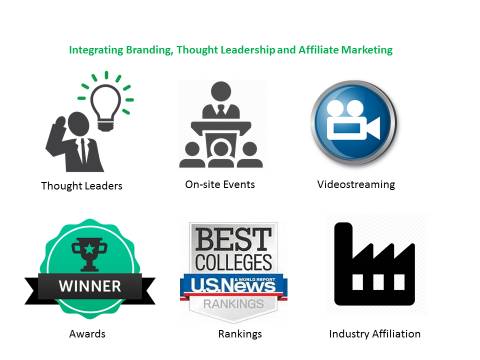
![](https://www.insidehighered.com/sites/default/server_files/media/image1_2.png)

One day, as we came close to filling in the last color on my planning charts, showing completed drafts of my lectures, active-learning challenges, resources, slides, readings and syllabi for each week, Ilan wondered whether I was all set for my first recording sessions.

“I’m not at ease,” I acknowledged. “I worry about my confidence. When I listen to tapes of webinars I’ve delivered, I often cringe hearing my hesitations and repeated ‘uh-uh,’ put-putting like a failing car engine.”

Ilan listed closely. “Everyone is worried about how they will perform. Most faculty are not trained, but you’ll be in a very supportive environment during your video sessions,” Ilan reassured me. “Just a few students in the studio.”

“Between takes,” he continued, “students usually carry on lively conversations with the faculty. They are very interested in what instructors are saying. It’s very intimate. Quite relaxing.”

Ilan relieved me by saying that if the first recordings are not up to standard, they do get progressively more polished. “Occasionally,” he predicted, “at the end of a session, if your first videos are not at their best, and if there’s still time, the crew goes back to re-record them.”

The night before my first lecture, I awoke at 2:30 a.m. from a nightmare, unable to return to sleep. I slipped out of bed, careful not to disturb my wife, burrowed in her duvet, and took off to the living room sofa, awake until 4:00 a.m. Consciously, it was not the video session the next morning that kept me awake, but the bubbling dailiness of my life. Doubtless, I was suppressing my anxiety over my first-ever video lecture.

The next day, I arrived as directed at 9:00 a.m. at a very professional-looking studio, equipped with giant stage lights and video cameras resting on tripods like tall, steel insects. A long, paper-covered table at the side displayed breakfast goodies — bagels, cream cheese, sliced meats and cheeses. Coffee was served in large cardboard dispensers, supplied by Murray’s, a local Greenwich Village institution nearby. It felt thrilling, as if I had wandered into a sophisticated film shoot. Red Dot, the school’s video production staff, consists almost entirely of students, going about their various tasks like Hollywood crew.

As I sat in front of the cameras, as if I were a newscaster on TV, I thought of the weeks that Shira and I had devoted to this moment. At first, it all seemed so fragmented, but as the bullet points scrolled up on a screen in front of me, suddenly, it all came together, finally making sense.

Filming at first was bumpy as I stumbled over words and phrases, struggling to deliver the points I hoped to make. The crew was very patient.

“You’re doing fine,” they encouraged, running another take. As we progressed, and as Ilan had predicted, I felt more comfortable, delivering a string of sentences without stumbling. At the end, as I unbuttoned the top of my shirt to unhook my microphone, I felt I’d done reasonably well.

Later that day, viewing some of the clips from the session in his office, Ilan called excitedly. “You were fantastic!” he exclaimed.

Afterward, I reflected on just how remarkable and unexpected my experience turned out to be. All the preparatory work Shira and I did last spring was surprisingly transformed from random notes, jottings and bullet points — accompanied by serious jitters — into a sustained and logical script. Later, the crew will edit it, add my slides and marginal text, and merge it all into a five-week online course.

Original URL: https://www.insidehighered.com/digital-learning/views/2018/10/17/online-dean-describes-how-he-gained-confidence-teach-virtually

Does Online Education Help Low-income Students Succeed?

From the start, access has been the defining achievement of online learning. Or so I thought.

For a couple of decades, I championed online learning for its ability to uproot entrenched ideas in education, especially by engaging students in active learning, a pedagogical style [rarely](https://www.facultyfocus.com/articles/teaching-and-learning/lecture-continues-dominant-instructional-strategy/) [practiced](https://www.facultyfocus.com/articles/teaching-and-learning/massive-study-finds-lectures-still-dominate-stem-fields/) on campus. But I was even more taken with digital learning’s ability to let underrepresented students leap virtually over high campus gates to earn college degrees as never before.

Then came several new studies concluding that low-income students at U.S. community colleges may not be as well served online as their residential peers. One [headline](https://www.nytimes.com/2018/01/19/business/online-courses-are-harming-the-students-who-need-the-most-help.html) in The New York Times summed-up the findings: “Online Courses Fail Those Who Need Help.”

Reading initial coverage of the research, I worried that virtual access may not be accomplishing all that was it promised. Is online the educational and economic game changer I thought it was?

So I decided to take a close look at a handful of recent studies measuring online against face-to-face at U.S. community colleges. While some showed relatively poor online results, others were not that bad. As has been common since the very first large-scale studies were reported more than ten years ago, blended models—ones that mix and match face-to-face with online—emerged with the strongest outcomes.

Community colleges in the U.S. serve about 11 million students, representing 45 percent of the nation’s college population. Students enrolled in two-year, as compared with four-year schools, look very different, with about 60 percent in community colleges drawn from the bottom two rungs of the most economically disadvantaged families, while most students at four-year colleges are from the country’s most financially secure ones—a widely acknowledged disparity.

If you want to learn whether online is good for the nation’s underserved population, studying the effects of virtual instruction at community colleges is a good place to start. After all, chances are students taking these courses are not as well-prepared for college as residential students at four-year colleges, and they are commonly drawn from the most economically-challenged populations.

A recent Columbia University Teachers College [study](https://files.eric.ed.gov/fulltext/ED517746.pdf) at Washington State Community and Technical Colleges found that students were more likely to fail or withdraw from online courses than from face-to-face classes. The report also showed that in other outcomes, too, online students were not as strong as their residential peers. In contrast—and as was found in many studies—students were equally likely to complete a hybrid course, one that delivers both face-to-face and digital components—as to complete a face-to-face course.

“Students are more likely to graduate if they blend,” remarked Peter Shea, associate provost for online learning at the University of Albany, in a telephone interview. Shea is also editor-in-chief of the Online Learning Journal.

Another [finding](https://eric.ed.gov/?id=ED512396) by the same Columbia team, measuring the Virginia Community College System, uncovered similar results—that students were more likely to fail or withdraw from online courses than from face-to-face classes and were less likely in other ways to do as well as face-to-face learners.

Just as I was most discouraged, I did find some research with a much brighter outlook. Arizona State University [concluded](https://campustechnology.com/articles/2018/04/12/research-online-courses-associated-with-improved-retention-access.aspx) that among those who took an online or blended course, retention rates at Houston Community College for first-time freshman was 9 to 10 percentage points higher than in face-to-face students.

## Supporting Online Students

As I stepped back and wondered what to conclude, I realized that it’s worth focusing on one piece of the puzzle that can be overlooked: student services.

Student services on campus—study centers, career services, healthcare services, clubs and support for learning and other disabilities, among dozens of other benefits—are widely available on many campuses. But few colleges offer the same expansive attention to remote learners. On campus, students are coddled with high-end services, with 20 percent of higher education budgets [going to student services](https://nces.ed.gov/fastfacts/display.asp?id=75) and related costs at state schools and 30 percent at private colleges.

In contrast, virtual student support is often an afterthought. In a literature search I performed while researching this article, I found just a handful of references covering online services, with none quoting how much schools spend on them—a good sign that very little attention is paid and, distressingly, little is invested.

Some colleges hardly consider online services, especially colleges and universities just beginning to think of launching digital instruction programs. Instructional design, technology and faculty participation are investments that must be made, but my own experience bears out that online student services often don’t make the cut. In several programs with which I am familiar, online student services didn’t even make it onto the planning agenda. In one case, when it was finally identified as something that should be addressed, it took months for a special committee to be formed. Regrettably, it met only once and, alarmingly, no action was ever taken.

While remote learners commonly receive fewer services than their residential peers, surely they require more. At their best, online staff hover like helicopter parents, inquiring routinely about what’s happening in their academic and home lives—wondering, for example, why they didn’t post this week on their class forum, why they didn’t log in to take their virtual proctored exam or why they hadn’t enrolled in courses for next semester—inquiries that monitor behavior that is crucial in the long run. Commonly, faculty track academic achievement, but student services help remote students get through their stressful daily lives.

While digital courses give online students access when work and family prevent them from coming to campus, online students confront yet other obstacles—virtual alienation and technical demands for which many are unprepared.

Today, residential students work more than ever to cover steep tuition as well as life’s day-to-day needs, but digital learners don’t enroll as equals. Virtual students are [under far more stress](https://www.learninghouse.com/knowledge-center/research-reports/ocs2018/), with 70 percent of undergrads and 80 percent of graduate students working full or part time. By contrast, just 25 percent of residential students work full time.

It turns out there are things community colleges as well as the rest of higher education can do, in addition to providing enhanced digital support for remote students. Online learners deserve better—and certainly no less than their richer on-campus peers.

While residential students are often encouraged to enroll in more than two or three classes a semester to speed them through to graduation, that’s a big mistake for virtual learners. At NYU—where I was online vice dean at the engineering school for nearly a decade—we learned very quickly that remote students don’t do well taking more than two courses per semester. Work and family obligations often undermine their studies, leading to a cascade of failures and dropouts.

## Making Online Learning Work

It’s in the best interest of economically distressed students that higher education make online learning work; that online students not only toss their mortarboards up in the air at graduation, but go on afterwards to lead solid, productive lives.

Getting a degree seems more urgent than ever in today’s economy—a curious American alchemy that turns a sheepskin into gold and a chance at happiness.

Comparing the lifetime potential earning power of students who graduate from high school to those who earn a bachelor’s degree, a U.S. Census Bureau report calculates that over an adult’s working life, a college degree is worth nearly twice a high school diploma—or [$2.1 million](https://www.thoughtco.com/lifetime-earnings-soar-with-education-3321730), compared with $1.2 million. A very cool extra million.

In addition to more money, a college degree yields dramatically meaningful social dividends for graduates—better career opportunities, greater job security, higher work satisfaction, employee benefits. And [studies have shown](https://classroom.synonym.com/positive-effects-college-degrees-4134.html) that college completion correlates with other, more subtle psychological and personal effects—deeper self-worth, better health, and not least, greater personal satisfaction.

If virtual education fails to succeed with poor students, then it will merely replicate the severe economic imbalance that is already the shame of the nation’s campuses. Online will merely emerge as yet another luxury product for America’s privileged students.

Better to fix online for underserved students by making sure instructional design is at its best, that online students make reasonable decisions about their course load, and that higher education recognizes its obligation to provide serious, high-touch services for its remote students.

Colleges need to remain as mindful for their online students—if not more supportive—than what it offers its residential students.

Original URL: https://www.edsurge.com/news/2018-07-17-does-online-education-help-low-income-students-succeed

An Inside Look at Why Accreditation Works

In response to a recent signal that U.S. Education Secretary Betsy DeVos [may be exploring alternatives to our present higher education accreditation practices](https://www.insidehighered.com/news/2018/05/23/trump-administration-says-it-will-re-examine-rules-higher-ed-oversight-bodies), let’s take a look at what it’s like to be on the inside of a regional accrediting team.

Several weeks ago, I spent four enlightening, engaging, intimate, collaborative, debate-filled — and exhausting — days as a member of a team at a nearby university. (Sorry — since deliberations are confidential, I’m not at liberty to reveal the name of the school, nor who was on my team.)

It wasn’t my first. Impulsively, I had agreed to participate in five others over 20 years at modest and grand institutions — some with deep pockets, others hanging by a thread; some with meager enrollments, others with tens of thousands — but all required to go through it. All forced to run an academic marathon every 10 years, hoping at the finish line to get a thumbs-up by one of the seven U.S. regional bodies, concluding that your school has been anointed, censured — or, rarely, denied the laurel crown of accreditation.

Regional accreditation is a really big deal. It’s the gold standard guarantee that a school can announce on its website to students and their families that it clinched its final exam. Once a higher education institution is accredited, students can enroll with confidence, unafraid it will suddenly fold or be revealed as just another scam, a shabby diploma mill. It assures the public that universities and colleges are legitimate, so reliable that the federal government recognizes them as worthy enough for enrolled students to receive U.S.-backed grants and loans. While institutions enter into accreditation voluntarily, without it, Uncle Sam won’t give you a nickel to go college there.

Our team’s credentials were not at all shabby. It included the president of a high-profile university, the provost of another notable school, distinguished professors and other reputable scholars and top staff drawn from highly ranked colleges and universities, public and private. While most of us were from nearby schools within an hour or two, one flew in all the way from California. Impressively, their specialties covered every aspect of university life — accounting, finance and data analysis; curriculum, instructional technology and course design; assessment, accreditation, institutional effectiveness, governance, planning and student affairs. A serious group with solid experience, no less than any of my previous teams.

Our chair, the president of a peer university, mused aloud over dinner one night, “I feel it’s my obligation to serve. Other presidents take the time to visit my school. I feel I must do the same.”

Evenings in our hotel conference room, the nine of us — five women and four men — would sit, hunched over our black laptops around a long table, writing our reports like graduate students in a library. Sometimes the room was so still, except for the clacking of keyboards, you’d think we were writing our dissertations. Together for four days, in classrooms, over meals, during interviews, engaging in our deliberations, we grew very close to each other, similar to a time, long ago on a vacation in the Caribbean, over a long weekend, when I became fast friends with others lounging on the beach — but this time without surf and palm trees. The feeling of closeness bound us together, not only this time, but at all my previous team evaluations.

Months before our visit, a thick packet of brochures, documents and reports arrived on my office desk. Inside, the principal item was the university’s self-study report, a dense, 174-page, spiral-bound book, wrapped in a glossy, clear plastic cover, adorned with a montage of color photos of campus. One showed a young woman wearing blue rubber gloves, performing an experiment under a lab hood. Another depicted a romantic, snow-covered scene, framed by an antique iron gate; a very dignified classic college bell tower stood under a moonlit sky in the distance. Placed in the center of the report was the school’s shield and logo. A digital version arrived separately by email.

During my visit to campus, I overheard a faculty member say that the self-study took the school three years to compile. Together with the regional commission’s standards for accreditation and requirements of affiliation, the self-study formed the basis of our team’s on-campus evaluation. Representing the institution’s own assessment of its programs and services, positive and problematic — a unique higher education intellectual exercise, not performed anywhere outside the U.S. — it focused especially on student learning and achievement, a relatively recent emphasis in response to public criticism that higher education is failing to educate its students effectively.

Flipping through the report, I came upon dozens of single-spaced pages, illustrated with colorful charts and graphs. One showed a series of stacked boxes calling out the school’s “aspiration,” “strategic priorities” and other key goals. In an email, soon after the document arrived, we were asked to read the report carefully, making notes in the margins about themes we may not have understood or items that may have concerned us. Like facing a mirror, the self-study is a close-up. Looking outside the frame, the team has a wider view.

We were then asked to propose names of faculty and staff or chiefs of particular academic departments or services, say, the head of athletics, or in my specialty, online learning, to flesh out the text with questions we would raise during interviews. We were also encouraged to ask for a deeper dive into data, asking for additional evidence to get a better feel for what may not have been fully illuminated by the text. For example, I asked for data on online enrollment, retention and graduation rates.

On the evening before we were to meet with assembled university faculty and staff, we were asked to draft reports on what we learned from the self-study, deciding what we thought before we ran the gauntlet of interviews with faculty, staff and students. In advance of engaging with the university community, we were to reveal what we felt; what we needed to note; what we might conclude; which things could be applauded as significant accomplishments; what matters could be assigned as a recommendation or suggestion; which features must be attended to as requirements.

Interviews tested our initial insights against what we learned. Among other groups, I participated in Q&As with trustees, medical school officials, faculty and students. Colleagues — not detectives — we weren’t out to grill them, but to help guide them. Students were the most rewarding and most exciting.

To our surprise, we discovered that the conclusions reached in the self-study lacked a full-throated acknowledgment of the school’s impressive successes. We also uncovered blind spots we needed to call to their attention.

In our deliberations over what we might conclude, our team shifted between judging the school’s past performance on the one hand and recognizing on the other that teaching and learning and associated support services are constantly emerging, like headlights beaming out of a tunnel. In the end, we withheld certainty in favor of offering suggestions for improvement. Wisdom won out over discipline.

“Accreditation teams are being asked to make an argument that assures academic peers and the public about current and near-term promise,” remarked Daniel J. Royer [in a recent paper](https://onlinelibrary.wiley.com/doi/full/10.1111/ajes.12190). “They are not being asked to give an award or make a judgment related to past achievement or failures.”

Unhappiness with the state of American higher education — poor student learning, rising college costs, serious student loan indebtedness and lack of work-force preparation, among other troubles — often leads observers on the right and left to propose alternatives, some so severe they call for shutting down regional accreditors in favor of imposing state or federal rules, moving toward increased bureaucratization and compliance, snuffing out the democratic spirit that animates our system.

Unwisely, critics blame the blameless, pointing a finger at regional accreditation, rather than recognizing serious social dysfunction outside the gates of the university — economic inequality and racism — that deeply trouble many of our vulnerable students. Disturbingly, our team learned about homeless students going hungry and how the institution struggles to find ways to care for them.

Going back to late nineteenth century, regional accreditation in the U.S. is an uncommon practice. This is the only country in the world that engages institutions in their own scrutiny. In Europe, Asia and elsewhere, ministries of education and similar government agencies are solely responsible. Some call the American way an exercise in “deliberative” democracy, an idea that reaches as far back as Aristotle, contending that scholars, together with their peers, are [the most competent judges of academic quality](https://onlinelibrary.wiley.com/doi/full/10.1111/ajes.12190).

\* \* \*

On our final morning — ready for departure, our suitcases stacked in the corner of a large assembly hall — our team chair stood at a lectern facing about 100 or so senior staff and faculty. Solemnly, the president of the university was seated in the front row. In a relaxed and friendly talk that lasted no more than five or 10 minutes, our chair smiled, announcing that everything was just fine. Our report would recommend, happily, that the school fulfilled the requirements of regional accreditation. Complimenting the assembled on having done a fine job — so good, in fact, he said that our report praised the school on achieving five major accomplishments — he noted that our team also found a number of recommendations and suggestions that they should take in the collegial spirit in which they were offered.

You could feel the tension easing out of the room, like a puffed-up cushion deflating as you take your seat.

Later, when the faculty and staff get to dive into our report, after the regional commission approves it, they will find not just a handful but dozens of proposals for improvement, some responding respectfully to their needs; others it will do well for them to take very seriously. Like good friends, we didn’t tell them only what they wanted to hear; we also told them things that must be said. Many of our recommendations supported changes for improvement that they had insightfully and revealingly proposed themselves in their self-study, a confident result of deliberative academic democracy.

At its best, the American style of accreditation, while recognizing the government’s interest in it, does not act as a police force, demanding compliance. Instead, regional accreditation, just like the members of our team, enters into a dialogue with faculty and staff in a collaborative effort to raise the bar of American higher education.

Original URL: https://www.insidehighered.com/views/2018/06/14/inside-look-why-regional-accreditation-works-opinion?utm_source=Inside+Higher+Ed&utm_campaign=365ebc9b26-DNU_COPY_01&utm_medium=email&utm_term=0_1fcbc04421-365ebc9b26-199397649&mc_cid=365ebc9b26

How Online Learning Takes You to Unexpected Places

In my [**recent article in _EdSurge_ about satellite campuses abroad**](http://web.archive.org/web/20231003033501/https://www.edsurge.com/news/2018-05-15-how-risk-averse-universities-take-risks-with-satellite-campuses-abroad), I recalled my time, more than a dozen years ago, running a couple of branch campuses in Beijing. My story didn’t say how proud we were at Stevens Institute of Technology about what we accomplished, winning the Sloan Consortium, now the Online Learning Consortium (OLC), award as [**an Outstanding Online Program in 2007**](http://web.archive.org/web/20231003033501/https://onlinelearningconsortium.org/about/olc-awards/past-recipients-olc-awards/).

Designed to avoid investing immense sums required to set-up remote sites far from campus, the blended-learning solution we introduced in partnership with two notable universities in China—Central University of Finance and Economics and Beijing Institute of Technology—was a relatively low-cost option that offered Stevens Institute of Technology’s technical degrees in China by merging online delivery with face-to-face instruction, uniquely taught by both U.S. and Chinese faculty. The International Finance Corporation, part of the World Bank, was so impressed with what we had accomplished, they invited us to deliver an address outlining what we achieved at a 2005 conference in Beijing.

While student cultural immersion is one of the principal objectives of opening international branches, it turned out that launching a remote campus 7,000 miles away from Hoboken, NJ—where Stevens sits on the Hudson with a knock-out view of glittering Manhattan skyscrapers—totally unexpectedly, our Beijing program opened an entirely new world for me.

Before I was recruited to run our sites in Beijing, China fell behind a dark curtain of my ignorance. Invisible to me were 1.4 billion Chinese and a grand cultural history of dynasties and revolutions going all the way back astonishingly to 2070 BC. By contrast, the Greeks go back merely to 700 BC. Compared with China’s ancient civilization, the West is just a toddler. The Shāng Dynasty alone lasted 554 years.

![Robert Ubell Article – Satellite Campuses](http://web.archive.org/web/20231003033501im_/https://olc-wordpress-assets.s3.amazonaws.com/uploads/2018/05/Robert-Ubell-Article-Satellite-Campuses.jpg)Before flying off halfway around the world to negotiate agreements with peer institutions, I knew almost nothing about China. As a child in a leftist summer camp, we learned to sing, “Arise, ye who refuse to be bond slaves,” the opening line of the Chinese Communist national anthem. I could recall crumbs of recent Chinese history—Mao, the Cultural Revolution, the Gang of Four—but otherwise, like Mao’s Little Red Book, I remembered just a series of catch phrases.

Soon after we concluded agreements with our Beijing partners, I enrolled in a class in Mandarin at The New School. (Curiously, this fall, I will head a four-course online certificate at The New School, entitled “Designing Online Learning Programs.”) I became an obsessive Amazon consumer, clicking links to books on Chinese ancient and current history. In China, I’d frequent government shops, hunting for unusual objects. As I write this, a pair of antique Chinese tomb figures—that I guess are musicians serenading their honored interred master—are standing on my desk, watching my fingers tell this story on my keyboard.

Just like most things in life, you can never guess the consequences of your decisions. I never suspected, when I first agreed to go to Beijing that I’d pull aside a dark curtain in my own life, opening an unexpected fascination with a world I hardly knew. Of all of Confucius’ wise sayings, “Real knowledge is to know the extent of one’s ignorance,” is perhaps the most profound.

I’ll be back in China in November, delivering a keynote address at an educational technology conference in Wuhan, happy to return to a country that continues to tantalize me.

You can never guess where online learning will lead you.

Robert Ubell ([**bobubell@gmail.com**](http://web.archive.org/web/20231003033501/mailto:bobubell@gmail.com)) is vice dean emeritus of online learning at NYU’s Tandon School of Engineering. He is the author of [**Going Online**](http://web.archive.org/web/20231003033501/https://www.routledge.com/Going-Online-Perspectives-on-Digital-Learning/Ubell/p/book/9781138025325) (Routledge, 2017) and serves on the Advisory Board of OLC’s [**_Online Learning_**](http://web.archive.org/web/20231003033501/https://onlinelearningconsortium.org/read/olc-online-learning-journal/) Journal. Ubell’s website can be found at [**wp.nyu.edu/robertubell/**](http://web.archive.org/web/20231003033501/https://wp.nyu.edu/robertubell/).

Original URL: https://onlinelearningconsortium.org/how-online-learning-takes-you-to-unexpected-places/

How Risk-Averse Universities Take Chances with Satellite Campuses Abroad

Original URL: https://www-edsurge-com.cdn.ampproject.org/v/s/www.edsurge.com/amp/news/2018-05-15-how-risk-averse-universities-take-risks-with-satellite-campuses-abroad?amp_js_v=0.1&usqp=mq331AQGCAEYASgB#origin=https%3A%2F%2Fwww.google.com&prerenderSize=1&visibilityState=prerender&paddingTop=54&p2r=0&horizontalScrolling=0&csi=1&aoh=15264490286813&viewerUrl=https%3A%2F%2Fwww.google.com%2Famp%2Fs%2Fwww.edsurge.com%2Famp%2Fnews%2F2018-05-15-how-risk-averse-universities-take-risks-with-satellite-campuses-abroad&history=1&storage=1&cid=1&cap=swipe%2CnavigateTo%2Ccid%2Cfragment%2CreplaceUrl

Why College Is Not an Employment Agency

A new book makes “[The Case Against Education](https://press.princeton.edu/titles/11225.html).” It’s decidedly not something to give to a high-school junior looking to get into college.

The author, Bryan Caplan, a professor of economics at George Mason University, draws a picture of college as a bleak and miserable place, a Dickensian ordeal, peopled with distracted students, taught by mediocre faculty who, apart from mathematics, science and English, have nothing worth teaching their bored and listless students. In his telling, higher education is all a big, expensive scam—such a dark place that you imagine that students are housed in a prison, not on campus. “The harsh reality,” argues Caplan, “is that most students suffer in school. Nostalgics who paint their education as an intellectual feast are either liars or outliers.”

Caplan says that a college degree is largely useless, claiming that it does not show that students learned anything useful for their future in the workplace. “We have to admit,” Caplan assures us,” academic success is a great way to get a job, but a poor way to learn how to do a good job.”

Companies take it on faith that that a college degree is worth the handsome salaries graduates command; in contrast, dropouts suffer with little to show for their aborted time in school.

Craftily, Caplan pretends to discredit education because it’s a worthless training ground for industry, but his aim is more insidious, making the case for the withdrawal of state support from public education. “Stop throwing good money after bad,” he commands. “Cut education budgets. Shift the financial burden of education from taxpayers to students and their families.”

Caplan, a conservative libertarian, doesn’t demand the same austerity from private or for-profit schools, but instead, he targets the very place where students from families without means can achieve something and can go on to live decent, fruitful lives. Caplan would deny them that opportunity.

In his argument against the efficacy of education, Caplan marshals impressive-looking pseudoscientific bar charts on almost every page, standing like tall, upright soldiers defending his claims. But in his unsupported case for privatization, curiously, his armor disappears. Not a single chart or graph is displayed showing the benefits of defunding higher education. That’s because the actual data would undermine his case.

The nation has tried for-profit higher education [and it failed](https://www.insidehighered.com/digital-learning/views/2017/08/30/bob-ubell-says-its-time-shut-down-profit-institutions).

“Publicly funded education has an awful track record,” Caplan claims, “wasting hundreds of billions every year.” However, shutting down state education is a disastrous idea, not only for reasons of ensuring equity in education, but also for its long-term effects on the economic health of the country. Universities are among the key driving forces in our thriving state economies—in California, Texas, Florida, New York and elsewhere—where colleges are the vibrant intellectual centers driving research and business development.

While Caplan dismisses the possibility that universities offer society any real economic benefit, data shows otherwise. After studying [new data from UNESCO’S World Higher Education Database](https://theconversation.com/how-universities-boost-economic-growth-65017), covering 15,000 colleges and universities across 78 countries between 1950 and 2010, Anna Valero, a London School of Economics scholar, found that “the expansion of higher education from 1950 onwards was not just the product of growing wealth, it has also helped fuel economic growth around the world.”

Take a look at the 20 finalist cities in Amazon’s search for a second headquarters—universities are located at the heart of nearly every one. “All these places have something in common—nearby reputable universities that can churn out the young and the hopeful straight into Jeff Bezos’s welcoming arms,” observes Chris Matyszczyk, a consultant, [in Inc.](https://www.inc.com/chris-matyszczyk/after-amazon-picks-its-20-hq2-finalists-a-new-favorite-emerges.html)

America is supposed to be the Land of Opportunity, where a son of a Jewish tailor from an impoverished shtetl in Poland—as well as millions of other children from immigrant and other poor families—can go to college and learn “useless” things like poetry and art history, as I did at Brooklyn College, then a free city school. Neither poetry nor art history—a waste of time for Caplan—will get most graduates a job after graduation, but we should be proud of a society that educates its citizens broadly and not just trains them as docile workers.

Many other economists tell us that the solution to the coming crisis in the workplace is more education, not less. As [Harry Anthony Patrinos at the World Bank reports](http://blogs.worldbank.org/team/harry-patrinos), “Post-secondary education graduates are at the lowest risk of losing to automation. Those with high levels of education are less likely to be in automation-prone occupations. ”

But Caplan believes that the university fails completely in preparing students for jobs. His assumption is that higher education is the place where students should gain the skills they need to get them good jobs. But universities are not employment agencies. His mistake is that he confuses procedural with conceptual knowledge.

In my new book, [Going Online](https://www.routledge.com/Going-Online-Perspectives-on-Digital-Learning/Ubell/p/book/9781138025325), I clarify the difference:

“Procedural knowledge means knowing how to manipulate a condition or how to perform a task; for example, how to run a science experiment or solve a mathematical equation. Procedural knowledge is also a measure of our skills, tasks we know how to complete, and techniques we know how to follow. Training is designed to give workers procedural knowledge in order for them to do their jobs effectively. Conceptual knowledge, on the other hand, refers to our ability to appreciate major parts in a system, understand complex relationships, or categorize elements logically. At their best, universities are expected to equip students to excel at conceptual knowledge.”

Caplan smirks about the U.S. higher education dropout rate, arguing that his bored students are voting against college with their feet. “Excruciatingly bored students fill classrooms.” he laments. “Well, ‘fill’ isn’t quite right, because so many don’t bother to show up.”

But students drop out for all sorts of reasons. Boredom may be one, but surely it’s not the principal impediment that drives them away—a suspicious claim Caplan repeats continuously, vilifying students for slumping in their seats with ennui. But the most devastating reason why students drop out is not lethargy, but high tuition.

For most, college is a luxury product, equal to buying a Mercedes every school year at many private schools. One of the most shocking consequences of the steep price of higher education is that some 40 percent of students who actually get accepted don’t even show up because they [can’t pay the admission price](https://spectrum.ieee.org/tech-talk/at-work/education/can-moocs-cure-the-tuition-epidemic).

Peterson’s college guide says that the number one reason students drop out is because of lack of funds to keep them going. “Many students take out school loans, but that isn’t always enough,” [reports Peterson’s Brian Pivik](https://blog.petersons.com/2015/11/11/top-11-reasons-why-college-students-dropout-dont-let-it-happen-to-you/). “Between the costs of classes, books, rent, and just trying to survive, students are more and more learning that while worth it in the long run, the cost of education is high.”

If Caplan’s book was your only guide to what matters in college, you’d never come across ideals that secure a more just and honorable society—that enlighten thoughtful citizens. In the brief section Caplan devotes to “values,” he dismisses them out of hand, claiming that higher education has little or no effect on conveying them to students. You’d conclude that education has no place in democracy. It’s only what you can take to the bank that seems to matter to the author. If you look up “democracy,” “ethics,” and “wisdom” in the index, you won’t find them. None of these ideas on which education has been founded since ancient Greece are even mentioned in passing.

It turns out, however, that education does play a decisive role in our democracy. Nate Silver, the data journalist who founded FiveThirtyEight, calculated the effect of voter education in the last presidential election. Soon after results were in, Silver studied all 981 U.S. counties to see how they voted, sorting the numbers by least and most educated, among other slices of the data, especially income and race. His conclusion? Education, not income, [predicted](http://fivethirtyeight.com/features/education-not-income-predicted-who-would-vote-for-trump/) who would vote for Trump and who wouldn’t.

As an economist, Caplan is surely familiar with “commodification,” a concept at the heart of Karl Marx’s [case against Capitalism](https://www.marxists.org/archive/marx/works/1848/communist-manifesto/ch01.htm#023). Marx theorized that under Capitalism, everything is measured in terms of monetary value, even knowledge. Doubtless, Caplan teaches the concept to his students at George Mason University. In The Case Against Education, Caplan has so thoroughly embraced the idea, he is convinced that hardly anything taught in today’s classrooms has any intrinsic worth. Caplan takes commodification to an absurd extreme—that only skills that can be turned into high-paying jobs after college are of any value. The rest—art, music, history, literature—he deems worthless. If it weren’t so grotesque, it would be funny, more Groucho than Karl.

My fear is that Caplan’s prescription for American higher education will not be laughed off, but will be taken far too seriously. While Caplan believes he is a contrarian, expressing views thoroughly at odds with mainstream thought, regrettably, he is not alone. Jane Karr, former “Education Life” editor of The New York Times, [warns](https://www.nytimes.com/2017/11/03/education/edlife/saying-farewell-to-education-life.html?_r=0) that “State funding of public universities is on a track to reach zero in less than 20 years in some states and as soon as six in Colorado and nine in Alaska.”

State legislatures are already way ahead of Caplan, savaging state support for public education, shifting the burden from taxpayers to families—just as Caplan advocates.

_Correction: This article originally misspelled the name of the author of The Case Against Education._

Original URL: https://www.edsurge.com/news/2018-02-06-why-college-is-not-an-employment-agency

From Neutrality to Inequality

Faculty members who teach face-to-face may imagine that last week’s vote by the Federal Communications Commission to dismantle net neutrality doesn’t touch them, since their instruction is exclusively on campus, not plugged in to the web. Unfortunately, they’re mistaken.

Online or off, teaching and doing research in today’s immersive digital environment makes it almost impossible for anyone—even technophobes—to hide from the web. These days hardly a class exists at any college or university that operates without logging onto a learning management system. The college library, catalog, financial aid, admissions, registration, and of course, the school’s website, all have important digital services and are all easily accessible on the net. Today, no one can teach, perform research, issue grades, enroll, or engage in a thousand and one other routine functions, without clicking on a computer or smartphone. Like blood rushing through the university’s veins, the internet is the juice that connects everything.

Previous FCC standards for the internet were mandated in 2015 under President Obama and initiated earlier in the Bush administration with the FCC’s Open Internet Order in 2010. Core net-neutrality principles [go back to the very early days of the web](https://www.wired.com/story/how-the-fccs-net-neutrality-plan-breaks-with-50-years-of-history/) with its cyber-utopian ideals. Under previous FCC action, internet-service providers (ISP) were prohibited from blocking, slowing-down or speeding-up access to web content and services. The old rules also prevented providers from charging content producers and customers extra fees for faster service. Under the new FCC guidelines, these historic protections will now be crippled.

That’s why nearly every major higher education body—American Association of Universities, Council of Independent Colleges, and EDUCAUSE, among nearly a dozen others—has [come out against](https://er.educause.edu/blogs/2017/5/higher-education-and-library-groups-respond-to-new-fcc-rule-making-on-network-neutrality) the move led by FCC chairman, Ajit Pai, the new FCC chair who is a former Verizon senior executive.

Key higher-ed technology executives, [writing in The Chronicle of Higher Education](https://www.chronicle.com/article/Digital-Life-in-the-Slow-Lane/241965), warn that “One thing is certain: After December 14, higher education will face a new online world—one in which the almighty dollar, not equity, will reign.”

Jon Fansmith, of the American Council on Education, [told Inside Higher Ed](https://www.insidehighered.com/news/2017/11/29/colleges-voice-concern-over-planned-net-neutrality-rollback) that the cost to schools is likely to be “massive” as “there is no part of higher education that doesn’t depend on the internet.” Of course, elite institutions with deep pockets will easily sustain the blows, but smaller, less well-heeled schools will bear the brunt along with public universities that already suffer austerity.

Under the new rules, these are some possible scenarios facing higher education:

* Pay for Play. Institutions offering online programs may be required to pay ISPs a premium to deliver virtual courses. Digital courses often run on heavy data usage with serious information transmission demands.
* Sky-High Cloud. It’s possible that universities will be slapped with extra charges for using their relatively new cloud-based storage and services.
* Slow Lane. Without FCC protection, institutions that rely on low-cost connections may see their online content [moved to a slow lane](https://www.computerworld.com/article/3240993/mobile-wireless/how-killing-net-neutrality-will-impact-enterprises.html) as they watch others, who pay top dollar, speed along the internet superhighway.
* Monopoly Gauging. Many rural areas are served by a single internet provider. “There’s no competition in many parts of the country,” Keith Krueger, executive director of the Consortium for School Networking, [told Education Week](https://marketbrief.edweek.org/marketplace-k-12/will-reversal-fccs-net-neutrality-policy-help-hurt-schools/). Under the previous FCC rules, ISPs were prohibited from charging more in rural areas, but that protection has been removed.

* Stalled Research. Modern research today depends crucially on high-speed access to massive datasets; now colleges could be saddled with new charges for comparable access.
* Clogged Streams. Coursera, edX, Khan Academy and other massive course providers run almost exclusively on HD video streaming—an innovation initially propelled by internet neutrality. Who knows how much ISPs will now bill MOOCs and others for eating-up vast chunks of bandwidth?
* Trickle-down Student Fees. As web costs go up for colleges, the institutions may pass them along to the last in line—the nation’s students, already [strapped with $1.2 trillion in debt](https://www.marketwatch.com/story/americas-growing-student-loan-debt-crisis-2016-01-15).
* Academic Unfreedom. When the web was just emerging, it was ushered in during a confident era of inclusion. Some imagined it was poised to liberate the public square as the culmination of a utopian democratic dream, with massive citizen participation. Much of its promise actually happened. Wikipedia is a popular example of the dream come true. In China and other autocratic societies, however, the internet has been used as a weapon of state control.

Stewart Brand, who founded the Whole Earth Catalog in the 1960s, is said to have originated the slogan “Information wants to be free,” an idea that eventually sparked the open-source movement.

“On the one hand information wants to be expensive, because it’s so valuable,” Brand declared. “The right information in the right place just changes your life. On the other hand, [information wants to be free](http://fortune.com/2009/07/20/information-wants-to-be-free-and-expensive/), because the cost of getting it out is getting lower and lower all the time. So you have these two fighting against each other.”

The new FCC rules do not follow in the liberated direction imagined by the internet’s inventors. With ISPs given the reckless authority to block and shutdown sites, academic freedom is a potential target—along with other guarantees of equal access.

Original URL: https://www.edsurge.com/news/2017-12-20-from-neutrality-to-inequality-why-the-fcc-is-dismantling-equal-access-and-what-it-could-mean-for-education

For State Universities, Big Is In

Small doesn’t cut it anymore, at least not at picturesque independent colleges, largely in rural New England and the Midwest. Over the last decade, [nearly 50 colleges](https://www.edsurge.com/news/2017-11-21-how-online-can-save-small-private-colleges-from-going-under) that once represented the Jeffersonian pastoral ideal of American higher education — with students sprawling carelessly on soft green quads, guarded by classic library bell towers — have vanished, discarded from their arcadian place in idyllic academia. The trend is likely to accelerate as small colleges struggle with declining enrollment, fueled by relatively flat high school graduation rates, squeezing many small private schools, gasping for survival.

Just a few weeks ago, Memphis College of Art, a private institution in Tennessee, [announced it was closing](https://www.insidehighered.com/news/2017/10/25/memphis-college-art-announces-it-will-close), following the death march of dozens of failing schools. When I read the news, I shook my head in disbelief when I learned that the school had enrolled merely 307 students this year — shockingly fewer than were seated in just one giant lecture hall at Columbia University when I took a freshman cell biology class many years ago.

“We expect that there will be more college closures over the next three to four years,” Susan Fitzgerald, a senior vice president at Moody’s, [told _MarketWatch_](https://www.marketwatch.com/story/why-more-private-colleges-are-closing-2015-03-25). “I don’t think it’s going to be a landslide of college closures, but we are coming through a very tough period of time.”

At public universities, the continuing withdrawal of higher education funding by state legislators is destabilizing state universities, forcing them to turn elsewhere for support. “State funding of public universities is on a track to reach zero in less than 20 years in some states and as soon as six in Colorado and nine in Alaska,” Jane Karr, former “Education Life” editor of _The New York Times_, [warned recently](https://www.nytimes.com/2017/11/03/education/edlife/saying-farewell-to-education-life.html?_r=0).

Increasing tuition is one obvious, but perilous, source of funds, turning state institutions from easily affordable to a stretch for many families. With top tuition dollars coming from out-of-state and international enrollments, public higher education has [recently been accused](https://www.insidehighered.com/news/2017/10/26/report-criticizes-public-universities-catering-wealthy-students?utm_source=Inside+Higher+Ed&utm_campaign=99c33b076f-DNU20171026&utm_medium=email&utm_term=0_1fcbc04421-99c33b076f-199397649&mc_cid=99c33b076f&mc_eid=65f9a91ddf) of turning away from its historic mission of laying down the stepping-stones for poor and working-class kids to enter the middle class.

This is not a brand-new problem. For years, colleges and universities have juggled with academic productivity and pricing, hoping to solve their financial troubles in three treacherous ways: increasing the number of students per faculty member, crowding students into giant lecture halls as in my Columbia class; reducing labor costs by exchanging expensive tenured faculty with a much cheaper itinerant work force, with adjuncts now representing more than [70 percent of the nation’s faculty](https://www.aaup.org/issues/contingency/background-facts); and, precariously, raising tuition beyond already extravagant prices.

But more schools have been killed by the cruel cost of faculty teaching empty seats in thinning classrooms. Memphis College of Art employed 37 full-time faculty for 307 students. You do the math.

“Scaling is absolutely critical for higher education institutions in today’s marketplace. Through scaling, institutions can ‘do more with less’ — they can meet the sky-high expectations of today’s discerning students while keeping their costs and prices low,” [comments _Evolllution_ magazine](https://evolllution.com/doing-more-with-less-scaling-higher-ed/).

Apart from hoped-for pedagogical innovations, the big promise of online education was that it would help unlock the nation’s financial academic choke hold. The scale of the internet, just as it has bent the economic laws of most industries, would rescue institutions from the financial troubles facing our universities. It turned out that the first major experiment in internet education — online classes — didn’t do much to loosen the classroom economic squeeze. Virtual classes were mostly stuck in the locked jaws of the same student-faculty ratio as on campus, with small classes of merely 20 to 50 students. Online’s economic promise never really took off.

For years, the only thing that digital instruction changed was that it opened new markets. Students could now go online from outside the campus neighborhood, from just about anywhere — Indiana, Istanbul and beyond — enrolling without occupying beds in a dorm or parking spots in a campus lot.

Online also opened colleges and universities to local and distant midcareer adults, representing a gurgling new revenue stream, flooded by students who, because of demanding work and family life, cannot attend classes at nearby campuses. Otherwise, the tech revolution, which had powered the digital transformation of most of today’s economy, had not liberated higher education from its small-scale cottage industry paralysis.

When I first launched online programs at New York University, an insightful computer science professor who was quite supportive of what I was up to nevertheless doubted the long-term economic benefit of online education, wondering how many more students I could enroll in an online class than on campus. I responded that to assure quality education, class size would be about the same. “In that case,” he warned, “online will never offer significant economic advantages over face-to-face.”

With the invasion of internet marketing — first introduced cynically by for-profits and then imitated vigorously by MOOCs and OPMs (see my [previous _Inside Higher Ed_ piece](https://www.insidehighered.com/digital-learning/views/2017/10/04/longtime-online-observer-asks-why-harvard-turned-opm-online) on online program managers) an entirely unexpected source of funding has emerged. Until supercharged digital recruitment blew in, online recruitment was more like a hand-cranked machine than a jet engine. With MOOCs, the promise of the internet’s marketing power came into its own. Since they were launched, only about five years ago, an eye-popping 35 million learners [have signed up](https://www.class-central.com/). The [total number enrolled](https://www.statista.com/statistics/183995/us-college-enrollment-and-projections-in-public-and-private-institutions/) in all U.S. public and private colleges and universities today is about 20.4 million.

“Digital marketing has experienced the most significant revolution over recent times, with university brands, leaders and marketing departments now faced with a dizzying array of tools and techniques,” [Stuart Banbery](https://www.linkedin.com/pulse/higher-education-marketing-trends-2016-stuart-banbery/), marketing manager at SocialSignIn, wrote at _LinkedIn Pulse._

According to Arizona State University President Michael M. Crow, state universities must make a significant adjustment in capacity in order to educate the next generation of the U.S. work force. That’s why ASU is forging ahead to get to 200,000 students in less than a decade — numbers we haven’t seen since the heyday of for-profits.

“We have set a goal of enrolling 100,000 online and distance learners by 2025,” Crow confirmed via email. “Projections through 2024 for on-campus undergrad enrollment are approximately 80,000 and on-campus graduate enrollment is approximately 12,500. Our mission with respect to enrollment over all is to provide affordable access to all who qualify for admission.”

In a chart sent by email, ASU confirmed that it now has a combined enrollment of just over 103,000, already the top student population at any U.S. state university.

“The Iron Triangle is a 19th-century idea,” Crow said, referring to the three sides of the fierce demands of higher education — quality, access and cost — that have crushed many institutions. Crow claims that the aggressive immersion of technology in all aspects of student and faculty life, as well as cutting many courses down to seven and half weeks — with the same credit as the common 15 weeks — plus other academic innovations, has made rapid, quality growth possible.

ASU is not the only state university that is scaling up. The University of Central Florida, with more than 66,000 students, now the second-largest state university, has jumped by about 20,000 in the last decade — about 40 percent of which is now online. Commenting on what’s behind UCF’s growth, Joel Hartman, vice provost of information technologies and CIO, said, “You can be small and excellent, you can be big and good, but best of all, you can also be big and have impact.”

Michael Goldstein, co-chair of higher education at Cooley, the big high-tech law firm, said of the need for scale in higher education, “Size is a strategy to accomplish a mission — because the school’s mission requires it to be big.”

Goldstein concluded, “Increasing enrollment intentionally is in response to what you wish to accomplish, with mission-driven numbers, opening up the university to as many who want to come who can afford it.”

Online represents the forward column in the march to scale up the nation’s public universities.

Original URL: https://insidehighered.com/digital-learning/views/2017/12/06/online-necessary-strategy-age-when-size-matters-opinion

How Online Can Save Small, Private Colleges from Going Under

In the wake of a recent [series of small-college closings](https://www.insidehighered.com/news/2017/11/13/spate-recent-college-closures-has-some-seeing-long-predicted-consolidation-taking), the takeaway for small private colleges is that their days may be numbered. Since these schools are largely dependent on student tuition in a time when demographic changes mean [fewer available high school graduates](https://www.insidehighered.com/news/2016/12/06/high-school-graduates-drop-number-and-be-increasingly-diverse), they might as well be on an endangered-species list. Some [fifty have closed in the last decade alone](http://www.businessinsider.com/college-closings-chart-2015-3), and three have closed in the past few weeks.

To staunch the bleeding, many small colleges have cut things to the bone or, alternatively, invested in country-club style improvements to appeal to students and their families—strategies that may have saved some. But this may only delay the impact of relentless market forces. Some observers aren’t as pessimistic, it should be said. “We continue to believe—and we think we’ve documented it pretty well—that most small colleges have the capability to be resilient in the face of these challenges,” said Richard Ekman, president of the Council of Independent Colleges, [in Inside Higher Ed](https://www.insidehighered.com/news/2017/11/13/spate-recent-college-closures-has-some-seeing-long-predicted-consolidation-taking). “There are a small number of colleges that are in very serious trouble,” he said. “But there are also a significant number of small colleges, 20 percent of them, that are just soaring. They’re doing very well.” But [Moody’s predicts](https://www.insidehighered.com/news/2015/09/28/moodys-predicts-college-closures-triple-2017) that the number of small failing colleges and universities will triple in the coming years and mergers will double.

One strategy for these colleges to avoid extinction is to diversify—to avoid a precarious reliance on residential students. And one way to do that is by adding online programs to the mix.

The challenge for many small colleges is that they see online courses as at odds with their very identity. After all, these institutions embrace intimacy as central to their mission, with close, mentoring relationships between faculty and students, and deep, comradely connections among students—essential ingredients of highly engaged learning. For many, online fails to meet these crucial education ambitions. Instead, they reject virtual instruction as alienated learning, with isolated faculty and students coldly facing inert computer screens—not one another.

Yet in post-industrial America, the digital world is as “real” as it gets, with most of us doing our shopping, binge-watching our favorite shows, texting and chatting with friends and following them on Facebook, and clacking away at keyboards all day at work. Today, serious research is impossible without searching databases, hunting references on Google Scholar and emailing colleagues worldwide. Rejecting online is a retreat into nostalgia.

One problem is that some faculty long for a return to the simpler times of the past, as I argue [my new book, Going Online.](https://www.routledge.com/Going-Online-Perspectives-on-Digital-Learning/Ubell/p/book/9781138025325) Small schools—mostly in the Northeast and Midwest—are charming stage sets of Jeffersonian pastoral democracy, a fantasy even in its own time.

That’s one reason why so few small colleges have jumped into providing online programs. “About fifty percent of U.S. colleges and universities have no more than a smattering of online enrollments, with little, if any, offered by most small private schools,” said Jeffrey Seaman, co-director of the Babson Survey Research Group, which tracks online enrollment.

There is growing recognition of the quality of online models. With the scholarly literature [almost universally confirming](http://jolt.merlot.org/Vol11no2/Nguyen_0615.pdf) that online may be as good or better than conventional instruction, arguments against it seem a bit curmudgeonly, following those who turn their backs on solid evidence. With [Harvard finally going online](https://www.insidehighered.com/digital-learning/views/2017/10/04/longtime-online-observer-asks-why-harvard-turned-opm-online), you wonder why so many schools have let digital instruction pass them by.

It turns out that online programs open education to those who couldn’t attend otherwise. Nontraditional students now comprise [nearly three-quarters](https://www.aacu.org/publications-research/periodicals/research-adult-learners-supporting-needs-student-population-no) of America’s college population. With many young adults working, caring for families, or traveling on the job, commuting to campus is not so easy and may even present real hardship, an impossible burden when you’re occupied with sometimes crushing demands at home or at work. As small colleges reach out to these new students, they might also turn threadbare balance sheets from red to black.

## Daunting Shift

Since it’s likely that faculty and staff members at small private colleges have little or no experience delivering digital programs, here are a few tips:

There are more options than ever for colleges to enter the online-degree space. While it can seem daunting, it’s possible to go it alone—as I did 20 years ago at Stevens Institute of Technology, a small technical school in New Jersey.

You’ll need to come up with a modest investment in expert staff, skilled at instructional design and digital recruitment. You’ll also need to find an online-learning champion, an effective leader who is a strong advocate for the pedagogical benefits of virtual instruction. If you’re lucky, you may have just the right anchor right on campus, either on staff or among your faculty. Chances are, at first, you may not need to invest in wiz-bang learning technology, since, like most schools, you already have a learning management system in place for your residential students. There’s no need to replace it with an upgrade. Your present LMS is likely to do just fine.

Or you can turn to companies that help colleges build online programs, who will come to your aid for a fee to do pieces of the online puzzle for you, relieving you and your staff of tasks you may not be skilled at, especially digital recruitment and instructional design. Some, known as OPM’s (or online program managers) also act like banks, financing your virtual programs in exchange for a sizeable slice of your revenue (often requiring 50 percent of revenue from online programs for a set number of years). The good news about OPMs is that if your new digital program flops, you’ll get off scot-free (except for faculty compensation) since your OPM invested all the money. But just like going on your own, you’ll need to put an online champion in place to coordinate everything for you.

While faculty resistance to teaching online is still a serious obstacle, imagine how it was 20 years ago when I was asked to launch a new digital learning unit at Stevens Institute of Technology. In my appeals to the faculty to consider migrating their on-campus degrees online, Freud might have diagnosed their response as “passive aggressive”—many with blank stares; others only half paying attention, their gaze out the window or on the tips of their shoes.

A few [early adopters](https://www.harpercollins.com/9780062292988/crossing-the-chasm-3rd-edition) signed on, but it was slow going at first, with most ignoring my overtures. The turnabout came when a highly-respected scholar, a dig-his-heels-in opponent, not only dropped his disapproval of digital learning, but became a fervent advocate, teaching online himself and encouraging others to follow. Practically overnight, most of the rest of the faculty jumped in. The denouement is that today, Stevens offers nearly 60 online programs and has won national awards, too.

Small colleges have a good chance at turning things around and thriving if they give online a chance and recruit older, mid-career students. Chances are your online students will be honored to “walk,” diploma in hand, finally visiting your beautiful campus at commencement.

Original URL: https://www.edsurge.com/news/2017-11-21-how-online-can-save-small-private-colleges-from-going-under

Why Did Harvard Go Outside to Go Online?

Charles Darwin, teleported from 19th-century Cambridge, could enter any classroom at Harvard today and, without the least hesitation, stride directly to the lectern and deliver his lecture on evolution as if not a thing had changed in 150 years. (To keep up with the times, however, Darwin would need to learn how to display images of his finches on PowerPoint slides.)

But a professor who retired 20 years ago, clicking open her computer, would find digital education nearly unrecognizable. In just a couple of decades, MOOCs, flipped classrooms, video streaming, digital exercises, remote labs and other developments have transformed online instruction with new technologies and innovative pedagogies. Bewildered about how to respond to market forces compelling them to move online, most universities and colleges are mystified as to how to proceed.

“Universities have gone from the Pony Express to jet aircraft in one fell swoop,” observed Dominic Brewer, dean of New York University’s Steinhardt School of Culture, Education and Human Development, in a phone conversation. “Enrollment management is from the 19th century, with spreadsheets and file cabinets.”

To move ahead online, most senior college faculty and administrators must make decisions for which they are largely unprepared. With sufficient resources, they’re fairly comfortable going over blueprints with starchitects to erect new glass-and-steel academic structures, but when it comes to virtual education, most are as befuddled as Fred MacMurray in the Disney movie _The Absent-Minded Professor_.

Commonly elevated to academic leadership at a time before the internet invaded, few senior faculty members have taken an online class, let alone taught one. In an earlier [essay in _Inside Higher Ed_](https://www.insidehighered.com/advice/2016/12/13/advice-faculty-members-about-overcoming-resistance-teaching-online-essay), I noted that data showed that “older and higher-ranking faculty members exhibit the least support for online education.” It’s no wonder that schools, squeezed by shrinking budgets, often leave online learning on the cutting-room floor.

Take Harvard, for example. While a handful of selective schools have ventured into digital education as part of their basic curricula, Harvard does not offer a single completely online degree. So why, with all its firepower — at $37.1 billion, Harvard’s endowment is the richest in the world, and its partnership with MIT is the second biggest MOOC provider, edX — did Harvard turn to an outside online program management company (OPM) to help launch its new online business data analytics certificate? The new agreement calls for 2U, an OPM, remarkably valued at $3.025 billion, with top-brand university clients like Yale, NYU and the University of California, Berkeley, to [work jointly with Harvard faculty](https://www.insidehighered.com/digital-learning/insights/2017/08/09/harvard-teams-2u-online-certificate-program) to make it happen.

“We don’t have the resources to support a marketing effort of that magnitude nor provide individual user support of that intensity,” claimed Peter Bol, Harvard’s vice provost for advances in learning, in a telephone interview. Bol is admitting, in effect, that despite its cavernous deep pockets, Harvard was asleep at the virtual wheel while online learning was taking off across the nation.

[Commenting on the conundrum in _Inside Higher Ed_](https://www.insidehighered.com/digital-learning/article/2017/08/09/experts-react-harvard-2u-online-certificate-agreement), AnnaLee Saxenian, dean of Berkeley’s School of Information, observed, “Even universities with substantial endowments lack the technology and marketing expertise to bring high-quality online programs to scale.”

Over the last couple of decades since online learning was first introduced, universities have invested hundreds of millions in campus facilities — laboratories, maker spaces, football stadiums and so on. In contrast, while online learning (both in revenues and students) was expanding at double-digit growth and with the residential population flattening or declining, only a few schools recognized the strategic retreat of investing in the past as higher education starved its future.

Years ago, Harvard Business School, among others, accurately predicted that we were headed for a totally immersive digital economy, cautioning industry that it would enter a life-and-death struggle unless institutions accommodated themselves to new digital facts.

“The digitization of the economy is one of the most critical issues of our time. Digital technologies are rapidly transforming both business practices and societies, and they are integral to the innovation-driven economies of the future,” [proclaimed _Harvard Business Review_](https://hbr.org/2016/03/the-4-things-it-takes-to-succeed-in-the-digital-economy). Curiously, most academic leaders paid no attention to business-school wisdom, imagining somehow that higher education would be given a pass.

Worried about conservative faculty pushback and fearing the damage to their reputations if they delivered what many academics considered an inferior product, many schools [backed away from entering the online market](https://www.usnews.com/education/online-education/articles/2016-02-09/study-enrollment-in-online-learning-up-except-at-for-profits) during the past 20 years. I participated in interminably tedious deliberations over digital education as years slipped by while senior faculty and administrators scratched their eggheads and dithered, issuing grandiose reports on an online utopia yet to come.

Pretending to support online learning, some schools invested in “technology-enhanced” education, a sprinkling of digital gadgets around campus, mainly for residential students. In consequence, schools left a wide-open gap in the campus gates for OPMs to waltz in. Taking a lesson from Darwin’s Galápagos birds, OPMs occupied a rich commercial niche, feasting on swelling virtual enrollments as many in higher education sniffed at digital growth.

Schools that depend largely on tuition for their financial stability find themselves in a tight spot. As the traditional college-age population levels off, on-campus enrollments follow, often declining. Under stress, institutions are looking for alternative revenue streams. With the online national upward curve looking more like a smile than a frown, digital education might be a good bet. Playing catch-up, it looks like Harvard and other schools now have three principal choices to get them out of their present fix — go it alone, pay as you go or sign on with an OPM.

**Going It Alone**

Since most schools didn’t prepare for the digital future, going it alone like I did 20 years ago doesn’t look too promising now. In the early days, with little or no training, faculty members were nudged into cyberspace with a laptop and a passcode. “Go for it,” we encouraged, with a hesitant smile and a pat on the back, crossing our fingers that they’d get it right.

Twenty years ago, I opened an online learning unit at a small technical school in New Jersey, with a knock-your-socks-off skyscraper view of Manhattan and a modest investment of $350,000 to launch a half dozen online master’s programs. As amateurs, we didn’t do too badly, generating 20,000 virtual enrollments in a dozen years, ultimately delivering healthy surpluses, too — not too shabby.

But if you’re looking to generate big wads of cash to compensate for losses on campus or to speed your virtual entry into a competitive market, you’d better hurry up and launch some revenue-generating online programs pretty fast. Schools looking to move ahead are likely to be impatient. Waiting a dozen years for your payoff is a creepingly slow-to-market strategy.

For those not in such a hurry and happy with modest enrollments of dozens, rather than hundreds, going online on your own may be right for your school. Stepping away from grandiose plans, you can literally get off the ground with a moderate investment in technology and a small skilled staff.

**Pay as You Go**

While Harvard and others opted for an OPM, it’s not the only option. Companies such as ExtensionEngine, Noodle, Learning House and others will step in to do pieces of the online puzzle for you, relieving you and your staff of tasks you may not be skilled at, especially recruitment and instructional design. While OPMs offer a turnkey service, with many of the moving parts cranked by the company, if you pay as you go, you’ll need to coordinate everything on your own. If you fail, you’ll assume all the risk — out-of-pocket fees you paid vendors will have gone down the drain. But if you succeed, you won’t be sharing your online tuition earnings with an OPM partner.

**OPM in Charge**

In financial circles, OPM refers to “other people’s money,” but while OPM in higher education clearly means something else, one of the big attractions for universities from [the $1.5 billion marketplace](http://tytonpartners.com/library/observations-on-online-program-management/business) is that OPMs in education — in addition to providing instructional design, student support, recruitment and advanced digital techniques — also act as investment firms, financing virtual programs for colleges and universities in exchange for a big bite of tuition revenue, with many contracts sharing online income 50-50. (An aside: saying “OPM” quickly can sound like “opium.”)

“The revenue share is outrageous,” comments NYU Steinhardt’s Brewer, who partnered with 2U and HotChalk to launch several degrees. “But, of course, we couldn’t have done it ourselves.”

Ilan Jacobsohn, senior director of distributed education at the New School, says, “OPMs assume the risk. If your program fails, your school might look bad, but it’s the OPM that loses the money.”

OPMs provide services that on-campus higher education has largely ignored, chief among them web-savvy marketing and recruitment. “For many traditional colleges starting online programs these days, the solution has been to outsource as much of the business operations as possible (including marketing and advertising) by using companies like 2U,” [reports senior editor Jeffrey R. Young in _EdSurge News_](https://www.edsurge.com/news/2017-09-06-forget-us-news-rankings-for-online-college-programs-google-is-kingmaker). When it went public in 2014, 2U reported in its filing that it had increased its marketing costs from $32.1 million in 2011 to $45.4 million in 2012.

Meanwhile, OPMs emerge as villains, accused by the [Century Foundation](https://tcf.org/content/report/private-side-public-higher-education/) and _[The Atlantic](https://www.theatlantic.com/education/archive/2016/06/for-profit-companies-nonprofit-colleges/485930/)_ of fleecing university treasuries with outrageous terms and poor value for the money. Not that OPMs are blameless, but the real offenders are skittish universities that failed to invest in their own digital future. Compared with business elite, academic leaders are thought of as far more sensible and risk averse, but their heads-in-the-sand virtual education policies turned out to be irresponsible.

To pay for their inattention to the relentless digital economy — if they partner with OPMs — some universities must now split the take.

Original URL: https://www.insidehighered.com/digital-learning/views/2017/10/04/longtime-online-observer-asks-why-harvard-turned-opm-online