Is Online Running Out of Steam?

The little engine that could has had a terrific run.

After two decades, new federal data show that 6 million U.S. college students now take one or more distance education courses, an increase of more than 250,000 in 2015, or more than a quarter of all U.S. students. Until recently, virtual students racked-up double-digit gains, year after year, far outpacing no-growth, residential numbers. It’s one of the great American higher education [success stories](http://www.onlinelearningsurvey.com/highered.html]). 

Perplexingly, the data also show a slackening of the online curve, with digital enrollment recently puffing along modestly at 3 to 4 percent a year, not with its historic hockey-stick muscle. Some observers say that online may be running out of steam, calling digital growth “sluggish,” “flattening,” or “hitting a plateau.”

Others—like me—are less pessimistic, claiming there’s still fire in the belly. The big news from the just-released [Digital Learning Compass](https://www.insidehighered.com/digital-learning/article/2017/05/03/whos-and-whos-down-online-enrollments) study tells a strikingly up-beat story. Dramatically from 2012 to 2015, for-profits took a huge hit, while large private nonprofit institutions and big state schools steamed ahead. If we look closely at supply and demand, however, we may be able to make sense of what’s behind the numbers.

**Demand**

Eager to uncover what’s happening, investigators check-off five common market forces they say account for most fluctuations—declining demographics, showing a shrinking U.S. college-age population; troubling rates of family income inequality, forcing away many from poor and middle income families; an improving job market, attracting greater numbers to a more accommodating workplace; rising numbers of adult learners; and, crucially for digital education, stiff competition, with dozens of new virtual programs chasing after fewer and fewer students.  

Plus there is a new competitive intruder—MOOCs. With MOOCs giving away college courses to your potential customers, the result is certain to have a depressing effect on your sales. We’ll never know how many of the 58 million learners who took a free ride on MOOCs would have enrolled in university courses and paid tuition for the privilege.  MOOCs have demonstrated that there is a huge reservoir of internet fans out there, taking Coursera and edX digital classes, but not nearly as many are signing up at your local college.

These and other marketplace factors effect both  on campus and online enrollments, but they’ve been hammering the residential population brutally, bleeding more than 250,000 on-campus students nationwide by fall 2015. Were it not for online, Jeff Seaman, co-director of the Babson Survey Research Group, producer of the widely followed annual survey on virtual education and the Digital Learning Compass report, told me that the total loss of the nation’s university population would have exceeded one million in 2015 over the previously reported year.

**Supply**

While fluctuations are commonly attributed to demand—increasing or decreasing numbers of customers purchasing your product—surprisingly little attention has been given to supply; that is, the flow of new offerings in university course catalogs. Studying the digital education economy with your finger on the scale of the marketplace tends to unbalance the equation. With a heavy hand on sales and little or no attention paid to production, observers may be lead down a blind alley.

Andy Grove, founder and former CEO of Intel, [famously said](https://25iq.com/2016/07/29/a-dozen-things-ive-learned-from-andy-grove-about-business-and-strategy/), “The Internet doesn’t change everything. It doesn’t change supply and demand.” 

If the demand side of the enrollment equation is treacherous, the supply side is equally charged.  Take, for example, faculty resistance to online instruction, a serious obstacle in filling the pipeline of new online courses, a production barrier economists call occupational labor shortage. The obstacle to growth is often not accreditation—which can sometimes be rocky—but dig-your-heels-in faculty opposition to going online. Nearly all schools face faculty resistance, slowing the entrance of new online courses. In an earlier [essay in _Inside Higher Ed_](https://www.insidehighered.com/advice/2016/12/13/advice-faculty-members-about-overcoming-resistance-teaching-online-essay), I called attention to the depths of faculty reluctance. 

Looking back to the early days of web-based distance learning, online programs behaved like new start-ups with skyrocketing products. Early-to-market digital courses were not only fulfilling pent-up demand, but with the opening of the digital academic pipeline, streams of new virtual courses flooded learners with entirely new brainy products never accessible before.

At first, socially motivated faculty rushed in, eager to deliver digital classes that promised active-learning benefits—virtual teamwork, peer-to-peer learning and other progressive, constructivist practices. Over the first decades, they tested new teaching and learning methods, spearheading booming growth.

“In the early days,” recalled Karen Pollack, assistant vice provost for online and blended programs at Penn State World Campus, “faculty who went online believed in the transformative power of online learning because it provided greater student access. Early adopters did not see technology as a barrier, but rather as an enabler. Today, very few faculty or administrators ask how they can go online. They are not convinced it’s something they ought to do.”

New courses are now launched with an eye towards preparing students for post-industrial careers in business and STEM fields, with classes introduced less with the intellectually innovative zeal of first movers than with savvy, spread-sheet calculation.

In those early days, online faculty were often sent off into cyberspace with a computer, a passcode and a stack of PowerPoints, with little or no preparation—sink or swim. Today, digital instructors enter their virtual classrooms, not as autonomous teachers, but commonly as part of a team, partnering with instructional designers, videographers and game specialists, among other experts, driving-up the cost of entry.

Schools can no longer waltz into digital education with meager budgets, but must make serious investments to achieve the right balance of high-performance learning technologies with astute virtual pedagogy, aiming to satisfy heightened and more knowing online students. When university financial officers anxiously weigh benefits against risks, inevitably, the digital engine slows.

Supply also retreats when for-profits close and government withdraws its support. Over the last few years, about 100 for-profits fell off the radar in the wake of President Obama’s jaundiced view of predatory, corporate-run higher ed, chopping nearly 3 percent off digital enrollments from the previous year’s results. For example, the University of Phoenix lost nearly 200,000 online enrollments between 2013 and 2016. For-profit retrenchment dealt a damaging blow to online numbers. It’s quite a turnabout when nonprofits come out on top and big corporations suffer serious injury. Sadly, it looks like they may be speeding back under a more cynical administration.

**Blended Learning**

The surprising news in the digital supply chain is the surge of blended (or hybrid) learning. Offered partly on campus and partly online, blended courses satisfy a fired-up demand for flipped classrooms, low-residency programs, and digital labs and flex delivery. As Joel Hartman, vice president for Information Technologies and Resources at the University of Central Florida (UCF) in Orlando, acknowledges, “Digital education is no longer one thing, but a continuum.” 

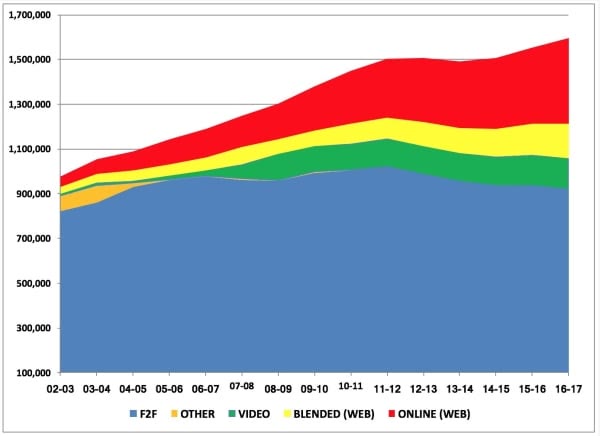
Take a look at UCF’s chart at the top representing student credit hours, to see where the steam is rising. Just as in the national trend, UCF’s face-to-face (F2F) numbers are falling, but unlike enrollments reported elsewhere, online at UCF is steaming ahead, pretty much paralleling the movement at other large state universities, where growth continues to outperform the rest of the country at more than 13 percent. In what seems like a contradiction, residential numbers have also climbed as on-campus students occupy virtual seats in blended courses. 

The hidden news is that UCF’s (and other schools’) dramatically Technicolor bands of rising blended and other courses are buried, not counted in the data released by U.S. Department of Education’s Integrated Postsecondary Education Data System (IPEDS), the nation’s primary source of college and university statistics. Nor are they shown in the Babson numbers. By not calculating the contribution of blended, we’re ignoring one of the most significant trends in higher education today.

The UCF chart confirms the quite surprising existence of a quiet revolution in virtual instruction in which blended is penetrating the often hermetic walls of conventional classrooms. As online learning observer Michael Horn notes in [Forbes](https://www.forbes.com/sites/michaelhorn/2015/04/23/report-that-says-online-learning-growth-is-slowing-misses-big-picture/#769fdc18296a), “Blended delivery of online learning doesn’t count toward the data.” 

Students enrolled in blended courses are the undocumented citizens of digital education. As the UCF chart shows, virtual instruction is not huffing and puffing. Blended represents the largely unacknowledged next generation of the academic economy.

Original URL: https://www.insidehighered.com/digital-learning/views/2017/05/10/online-running-out-steam

MOOCs Find Their Sweet Spot

After years of panning for gold in video streams, MOOCs may have finally hit pay dirt.

From the very first, when tens of thousands came out of nowhere—like monarch butterflies migrating in the fall—to enroll in free online university classes, the big question marks hanging over massive open online courses  was how can they survive without making money and will free MOOCs last?

Launched with piles of cash, top MOOC providers [Coursera](https://www.coursera.org/) and [edX](http://www.edx.org/) just ploughed ahead, inexplicably delivering free classes to millions of people without knowing where the money was going to come from. Company techies, who had figured out how to stream classes worldwide, were way ahead of C-suite executives who were still scratching their heads about how to extract cash from millions of online learners.

One [cynical blogger joked](http://www.creativitypost.com/education/monetizing_moc) that giving away your product is not a very effective business model. It “does not, in general, result in much income.” 

[Writing in _Fortune_](http://archive.fortune.com/magazines/fortune/fortune_archive/2000/02/21/273860/index.htm) during the dot-com boom, financial tech observer Erick Schonfeld recognized that what internet-based company CEOs “crave above all else is eyeballs…eyeballs mean customers.” But focusing on eyeballs alone, he cautioned, makes it hard to grasp the real business question: “Is there a chance they will ever turn a profit?” 

To everyone’s jaw-dropping surprise, by the end of last year, MOOCs had attracted [58 million learners](https://www.class-central.com/report/mooc-stats-2016/), representing a colossal number of eyeballs.

After filling its war chest with $145 million following three rounds of venture funding, the biggest MOOC provider, Coursera, kept hunting for the right strategy to make its vigilant investors happy—that is, turn a profit and pay handsome dividends. For edX, the nonprofit MIT-Harvard joint venture financed with a combined $60 million investment from sustainability—not profit—is the name of the game.

After five years of looking for the right formula, both seem to have uncovered how to turn all those eyeballs into cash, a weird 21st century alchemy. Meanwhile, Udacity, the third big MOOC company, took another path to generate revenue, offering “Nanodegrees,” a neologism, representing a group of career-focused, non-credit courses in such hot new fields as self-driving cars.

Long before they hit on the right money-making scheme, Coursera and edX had set the stage for big things by successfully recruiting many of the world’s top universities to join them. Their stunning success laid the foundation for everything that has followed.

It was a staggering achievement to have been able to entice, not only some of the most noted, but also among the most conservative, risk-averse institutions to share their formidable brands with these upstarts. It was an especially _Odd Couple_ arrangement—MOOCs, after all, are online courses, commonly dismissed by most selective universities as an inferior form of education.  But Yale, École Normale Supérieure and Peking University, together with more than 700 other of the world’s elite universities, signed on.

**The Sweet Recipe**

Three key ingredients account for transforming MOOCs into potential money-making machines. Here is their sweet-spot recipe:

**Step 1:** Convert your random catalog of disaggregated courses, across nearly all of scholarship, into distinct bundles of connected classes in targeted fields, say, cyber security or machine learning. It’s particularly sweet if they happen to be in appealing STEM or business fields.

**Step 2:** Make sure your bundles carry college credit, and brand them with gravitas, with such seductive titles as “MicroMasters.” Best of all, offer full or partial degree programs.

In an interview, edX CEO Anant Agarwal acknowledged, “Credit is the gold coin of education today.” MOOC credit bundles can often be stacked like Legos, giving students the flexibility of going just far enough to earn a partial degree; but if they wish, go on to earn a full degree.

**Step 3:** Hang a steep, discounted tuition price tag on your credit-bearing bundles. All the while, add millions of new learners each year by continuing to deliver free courses, admittedly, without the new bells and whistles offered to your paying customers. MOOC providers say they mostly split revenue with their academic partners, 50-50, but also negotiate separate deals with certain schools, often 60-40.

Once they got the ingredients right, it didn’t take long for an expanding menu of delicious new for-credit bundles at discounted tuition to come tumbling out of MOOC kitchens. When I looked at the edX site recently, it listed 16 MicroMasters; but because things were moving so fast, the company’s website team didn’t have time to update its offerings. Practically overnight, edX now offers 35 from premier schools—MIT, Columbia and Michigan, among a dozen or so others in the U.S. and elsewhere.

MicroMasters  give students who pass five graduate-level MOOC courses, plus a proctored final exam, the chance to apply for an accelerated, on-campus masters that is about a third less expensive than the on-campus equivalent. At MIT, a student who completes the master’s entirely on campus pays $67,000; someone who earns a MicroMasters and then caps it off with the residential program pays just $45,000.

At Coursera, its MOOC ovens were also working overtime. Just two weeks ago, in addition to its existing partnership with the University of Illinois—a joint venture in an iMBA and its recently announced Master’s in Computer Science in Data Science—it launched a new iMSA, a Master’s in Accounting, also at Illinois, plus a new Master’s in Innovation and Entrepreneurship with the Ėcole des Hautes Ėtudes Commerciales (HES) in Paris, one of the top business schools in the world and Coursera’s first degree with an international partner.

Coursera CEO Rick Levin, who moved to the company after serving as President of Yale, said that students can now “get a great education at a fraction of the cost” of earning degrees on campus. For example, at the University of Illinois, tuition for the residential Executive MBA is $97,000. But Illinois’ MOOC iMBA is a bargain basement $22,000.

In a [recent post](http://spectrum.ieee.org/tech-talk/at-work/education/can-moocs-cure-the-tuition-epidemic), I commented on how MOOCs might help contain the academic tuition spiral. edX, too, is in the degree-granting business, with two new master’s just launched with GeorgiaTech.

Five years into MOOCs, neither Coursera nor edX are in the black, but by stirring the three key ingredients—bundling, credit and discounted tuition—there’s a good chance that their trajectory is now set, moving from pin money to real money.

Steward Brand, who founded the _Whole Earth Catalog_ in the 1960s, is said to have originated the slogan [“Information wants to be free,”](http://fortune.com/2009/07/20/information-wants-to-be-free-and-expensive/) an idea that eventually sparked the open-source movement, a near cousin of the first “O” in MOOCs that stands for “open”— or free. For the millions who benefited from the generosity of free MOOCs, which happily still continues, it’s poignant to see some of the optimism of those early heady days succumb to the hegemony of the marketplace.

“On the one hand information wants to be expensive, because it’s so valuable,” Brand declared. “The right information in the right place just changes your life. On the other hand, information wants to be free, because the cost of getting it out is getting lower and lower all the time. So you have these two fighting against each other.”

Original URL: https://www.insidehighered.com/digital-learning/views/2017/04/12/three-steps-making-moocs-money-makers

Let’s End the War Between Online and On-campus Instruction

In the last few weeks, two new studies, one by [WCET](https://wcetfrontiers.org/2017/02/16/distance-ed-price-and-cost/) and another by [Caroline Hoxby](https://www.insidehighered.com/news/2017/02/28/working-paper-finds-little-return-investment-online-education), reported that online instruction is not only more expensive than face-to-face teaching, but also that it’s a poor investment compared with in-person education.

These and other studies are not only seriously flawed, but the fact is that digital and face-to-face learning are not fundamentally at odds. Despite what many believe, online and on-campus classes have been joined at the hip for years. Consider that at most schools, every course—whether online or on campus—must now post  syllabuses on every class website. Both virtual and residential students now log onto the same school-wide Learning Management System (LMS).

At many colleges, homework assignments, readings, watching videos and taking tests are commonly done online. “Flipped” classrooms depend on digital instruction for at least half of each semester and, increasingly, mass open online courses (MOOCs) have surfaced as part of many college curricula.  Not as common, but surely soon to infiltrate many classes, is the injection of social media, often serving as pedagogical illustrations, online and on campus.

In some classes, faculty teach face to face on campus while simultaneously streaming their lectures to other students, either located in a classroom at a remote site or accessing  video versions of the course on laptops or smartphones worldwide.  Some discover that virtual teaching can act like a training camp, where instructors acquire innovative pedagogical methods they exploit in residential classes. As digital education enters the academic mainstream, some instructors offer courses in conventional classrooms to on-campus students and deliver the same class in virtual space to distance learners at the same university during the same semester.

Today, both digital and residential students can manipulate the same software remotely as do scientists, engineers and scholars. Accessing large-scale systems at a distance is now possible in many industries, with virtual and face-to-face students performing experiments or running operations remotely with equal confidence as those at the site.

A few years ago at the New York University Tandon School of Engineering where I work, a state accrediting team was uneasy about approving an online electrical engineering master’s because they worried about student access to a virtual lab, a requirement that seemed pretty risky to them. Eventually, the degree was approved when reviewers recognized that students could perform experiments digitally, just as they might play a video game, by touching a screen and tapping on a keyboard. Ironically, students in the residential section of the program had been running the same virtual lab in their on-campus class for years.

At many schools—NYU Tandon, for one—students are free to mix and match, taking some of their classes on campus and others online.  The same is true for Stanford, Michigan and many others. Andy DiPaolo, executive director emeritus of Stanford University’s Center for Professional Development, told me, “We never made a distinction between online and on campus. Your degree doesn’t say you earned it online. Students have the option of going online or on campus or taking a blended degree. It’s a Stanford degree.”

It’s highly unlikely that a residential freshman, entering one of the nation’s colleges and universities this fall, will earn her degree without being plugged-in virtually. She might take at least one—if not several— fully online classes, perhaps participate in a flipped classroom (or two), enroll in a MOOC, and possibly access a remote lab. During her time in college, she will surely engage daily in dozens of other routine digital practices, supported by the school’s LMS and other academic software.  As I noted in an earlier [essay in _Inside Higher Ed_](https://www.insidehighered.com/advice/2016/12/13/advice-faculty-members-about-overcoming-resistance-teaching-online-essay), “The division between online and on campus is rapidly disappearing, and, at some institutions, technology has penetrated the classroom so deeply that the distinction will soon be obsolete.”

When history books are written about the current war between online and face to face, readers will wonder what all the fuss was about and why there was so much mischief. Looking back on the fierce battles between movies and television in the 1950s, when Hollywood worried that TV would put it out of business, it’s uncanny how today, the two have blended so closely that they have swallowed each other whole. Most of us can’t possibly imagine giving up one for the other.  Chances are, someday, the online versus on-campus dichotomy will be equally incomprehensible.

If you search Google Scholar for “comparing online with on-campus instruction,” you’ll be astonished to discover that there are more than 42,000 entries. When digital education was introduced more than two decades ago, after thousands of studies, slicing and dicing research in dozens of ways, results consistently showed that there was no significant difference between the two modes. A classic meta-analysis of high-quality studies, performed by the U.S. Department of Education several years ago, concluded that by and large, digital and face to face resulted in nearly a draw, with online given a slight edge. Not by much, blended topped both.

So why do scholars insist on performing divisive studies that heighten an “us” versus “them” antagonism?  The results of their inquiries tend to foment a false conflict, pitting mature face-to-face teaching against callow virtual instruction in academic warfare. But unlike schoolyard dust-ups, the consequences are not trivial, with trustees, state legislators and senior academic officers, among others, exploiting capricious comparative research outcomes to bolster entrenched ideological positions. Budgets, policy, oversight and investments hinge on public perceptions. A poorly executed piece of research that triggers bold headlines, concluding that online students don’t do as well as their on-campus peers, can end up killing innocent—even highly successful—programs.

Peter Shea, associate provost for Online Learning at the University of Albany, points out that there is still tough work ahead, despite the fact that _on average_ there is no significant difference between the two modes. Shea said, “Just as many studies find online learning to be as good as they find it to be worse than face-to-face education.”  The real question is to tease out what features of virtual instruction will show consistently better outcomes.

So let’s call for a moratorium on comparative studies that egg-on conflict between conventional and virtual instruction and open the way for research on the educational consequences of collaboration between virtual and face-to-face learning. That will turn our attention to more productive and insightful work on what is really happening in colleges and universities.

Original URL: https://www.insidehighered.com/digital-learning/views/2017/03/22/end-war-between-online-and-campus-instruction

Why Online Costs Less, Not More

In [a recent study](https://www.insidehighered.com/news/2017/02/17/study-challenges-cost-and-price-myths-online-education) comparing online with face-to-face courses, the online learning group WCET concluded that virtual courses are more expensive than those delivered on campus. If you focus on the report’s narrow results, based merely on course tuition and fees, as well as selected instructional elements, you’re sure to be led astray. We’ve seen perplexing media stories that inflate the report’s puzzling findings; “Online Education Costs More, Not Less,” declared a headline in a leading story in _Inside Higher Ed._

The study found that digital courses are not only more costly to produce than on-campus classes, but on the whole, after adding fees, online tuition is greater, too. While the results may be technically accurate, based on the limited terms set by the study’s investigators, its broader analysis is seriously flawed.

As an on-campus student, to get to your class each morning you either drive from your apartment and park your car at the nearest college lot, or you roll out of your dorm room bed and stroll across campus. After showing your ID to a security guard, you might stop off at the cafeteria for coffee and a bagel. After class, you may wander over to the campus gym to work out. None of the costs of these common university services outside of the classroom — parking, dormitory, grounds maintenance, security, cafeteria, and fitness center — were calculated in WCET’s research, nor are any of them available to remote learners. 

And while it appears to make perfect sense, when comparing online with on-campus teaching, to identify elements of instruction only — such as faculty compensation, instructional design and learning materials, among nearly two dozen other items selected for review in the WCET study  — to appreciate the crucial distinctions, what was ignored may be more decisive than what the study counted as essential.   

In his widely read [blog,](http://www.tonybates.ca/tag/wcet/)  consultant Tony Bates was quick to puncture the report’s methods and conclusions, commenting that it “confused rather than clarified the discussion about costs and price.” Troubled by its research bias, Bates observed that most elements under review in the study covered distance education, while routine expenses running face-to-face classes, especially substantial “sunk” costs, like buildings and parking, were largely missing.

Even the budget for academic information technology was excluded, while software that manages learning management systems, naturally found its way in.  An institution’s LMS — used equally by residential as well as remote students — represents merely a fraction of the substantial sums invested in information technology more generally. Excluded, too, are more commonplace costs of face-to-face education — air-conditioning in the summer, heat in winter, cleaning services all year long — costs conventionally lumped into “overhead,” expenses that fully apply on campus, but not one penny of which supports distance learners. Compared to the vast sums required to house an on-campus population, the costs of virtual instruction are trivial.

The WCET team dug meticulously into the data it collected, but it failed to ask all the right questions, nor did it look over the classroom walls to uncover meaningful clues elsewhere on campus. Residential students don’t attend classes in isolated nodes in undifferentiated space. They enter their face-to-face courses as part of a rich complex of academic, social, and learner services that, together, constitute the modern campus. To isolate the face-to-face classroom from the total on-campus student experience makes little sense. Today, the cost of running a substantial university, largely to accommodate residential students, often runs into tens of millions of dollars a year. A tiny fraction of these costs promote remote student instruction.  

Looking at on-campus tuition from a student’s perspective, in a far more incisive way than the study, families soon discover that it does not include air fare or gas to travel to and from campus, nor tolls or other travel expenses to get to college, say, four or five times a year. Nor does it include student accommodation and meals. The College Board says that, on average, families must add about $10,000 a year to cover room and board. 

In a virtual course, however, even if you’re hit with a modest technology fee, tacked-on to online tuition, that’s it. There are no surprises — no extra travel costs or room and board to cover. Yet WCET’s in-depth survey, with responses from 197 senior college and university officials, concludes that tuition for digital courses is greater than on-campus prices, leaving us with the false impression that the total cost to earn a digital degree is more expensive than face-to-face education.

Calculated from inside a family’s budget, going online is hands-down far less expensive than face-to-face instruction. Compared with their on-campus peers, students taking virtual classes save many thousands of dollars a year. To appreciate the difference in price between digital and face-to-face education, it’s misleading to look at what students pay for individual courses only — a curiously institutionally centric exercise.  It’s far more revealing, as well as decidedly more practical, to calculate what families can afford — based on a thorough account of _everything_ that goes into earning a degree — not on what counts in tallying a university balance sheet.

The knockout blow to the belief that online is more expensive than residential instruction comes from this thought experiment:  Your college is faced with enrolling, say, a thousand new students. To accommodate the unexpected increase in your on-campus population, massive new facilities will be needed — new academic buildings, lecture halls, laboratories and, of course, classrooms, requiring millions of dollars in unbudgeted charges. If your institution is like some in the U.S., chances are your trustees and managers will face a crisis, concluding that your college cannot afford to enroll them, forcing your eager new freshmen to apply elsewhere. In an illuminating alternative, however, enrolling a thousand new students online will be nothing like what is required on campus. More faculty, of course, and an additional cadre of instructional technologists, but not much more. Your thousand new students will be very welcome online.

Original URL: https://www.insidehighered.com/digital-learning/views/2017/03/08/essay-criticizes-report-costs-online-programs

MOOCs Come Back to Earth

### IEEE Account

* [Change Username/Password](http://web.archive.org/web/20250423015125/https://www.ieee.org/profile/changeusrpwd/showChangeUsrPwdPage.html?refSite=https://ieeexplore.ieee.org&refSiteName=IEEE%20Xplore)
* [Update Address](http://web.archive.org/web/20250423015125/https://www.ieee.org/profile/address/getAddrInfoPage.html?refSite=https://ieeexplore.ieee.org&refSiteName=IEEE%20Xplore)

### Purchase Details

* [Payment Options](http://web.archive.org/web/20250423015125/https://www.ieee.org/profile/payment/showPaymentHome.html?refSite=https://ieeexplore.ieee.org&refSiteName=IEEE%20Xplore)
* [Order History](http://web.archive.org/web/20250423015125/https://www.ieee.org/profile/vieworder/showOrderHistory.html?refSite=https://ieeexplore.ieee.org&refSiteName=IEEE%20Xplore)
* [View Purchased Documents](http://web.archive.org/web/20250423015125/https://ieeexplore.ieee.org/articleSale/purchaseHistory.jsp)

### Profile Information

* [Communications Preferences](http://web.archive.org/web/20250423015125/https://www.ieee.org/ieee-privacyportal/app/ibp?refSite=https://ieeexplore.ieee.org&refSiteName=IEEE%20Xplore)
* [Profession and Education](http://web.archive.org/web/20250423015125/https://www.ieee.org/profile/profedu/getProfEduInformation.html?refSite=https://ieeexplore.ieee.org&refSiteName=IEEE%20Xplore)
* [Technical Interests](http://web.archive.org/web/20250423015125/https://www.ieee.org/profile/tips/getTipsInfo.html?refSite=https://ieeexplore.ieee.org&refSiteName=IEEE%20Xplore)

### Need Help?

* **US & Canada:** +1 800 678 4333
* **Worldwide:** +1 732 981 0060

* [Contact & Support](http://web.archive.org/web/20250423015125/https://ieeexplore.ieee.org/xpl/contact)

* [About IEEE _Xplore_](http://web.archive.org/web/20250423015125/https://ieeexplore.ieee.org/Xplorehelp/overview-of-ieee-xplore/about-ieee-xplore)
* [Contact Us](http://web.archive.org/web/20250423015125/https://ieeexplore.ieee.org/xpl/contact)
* [Help](http://web.archive.org/web/20250423015125/https://ieeexplore.ieee.org/Xplorehelp)
* [Accessibility](http://web.archive.org/web/20250423015125/https://ieeexplore.ieee.org/Xplorehelp/overview-of-ieee-xplore/accessibility-statement)
* [Terms of Use](http://web.archive.org/web/20250423015125/https://ieeexplore.ieee.org/Xplorehelp/overview-of-ieee-xplore/terms-of-use)
* [Nondiscrimination Policy](http://web.archive.org/web/20250423015125/http://www.ieee.org/web/aboutus/whatis/policies/p9-26.html)
* [Sitemap](http://web.archive.org/web/20250423015125/https://ieeexplore.ieee.org/xpl/sitemap.jsp)
* [Privacy & Opting Out of Cookies](http://web.archive.org/web/20250423015125/http://www.ieee.org/about/help/security_privacy.html)

A not-for-profit organization, IEEE is the world’s largest technical professional organization dedicated to advancing technology for the benefit of humanity.
© Copyright 2025 IEEE – All rights reserved. Use of this web site signifies your agreement to the terms and conditions.

Original URL: http://ieeexplore.ieee.org/document/7864749/

There’s No Success Like Failure

Confronted with a thousand learners in a massive open online course, would you be able to give each your personal attention? It seems a far greater challenge than trying to connect with dozens of dazed students in a giant lecture hall on campus.

Armed with data analytics, virtual courses offer many extraordinary features — chief among them is that they are capable not only of mass communication but, counterintuitively, mass personalization as well. Exploiting these seemingly contradictory qualities, MOOCs not only offer unparalleled global reach and access, but they are equally capable of whispering into each learner’s ear electronically. MOOCs have excelled spectacularly in attracting millions to log on, but once students sign up, MOOCs have been less successful in communicating directly to each learner.

To help faculty scale individual responses to massive numbers of MOOC learners, computer scientists are giving it a shot. In a test of student coding skill in a machine-learning MOOC, the Next Gen team at Coursera, the biggest MOOC provider, first succeeded in teasing out some 20 to 40 coding errors learners commonly make. Students in an experimental section of the course no longer answer multiple-choice questions, as most MOOC learners do, but must now write computer code instead. Immediately after viewing a video lecture, students open a browser, inviting them to build a piece of software, demonstrating mastery — did they actually understand the lesson or did the video just float right by, as if they were nodding off during a TV commercial?

If their submission reveals they’ve made a common conceptual coding mistake, a pop-up window appears with a clue, suggesting why they may have made the error — “Like a friend looking over your shoulder, giving immediate feedback associated with your mistake,” said Coursera data scientist Zhenghao Chen, a member of the Next Gen team that devised the company’s new error-feedback loop. “Students should have a clear idea why they failed,” Chen said. “Feedback prompts them to correct their misconceptions, to think along different paths.”

In the experiment, Coursera scientists are turning education on its head, asking learners to dig into their failures to appreciate why they are mistaken. Failure is rarely exploited to illuminate why learners go astray. Students are commonly measured by how well they master material, not by how they triumph after struggling to correct their mistakes. John Dewey, American pragmatist and champion of learning by doing — the forerunner of active learning — [once remarked](http://www.skymark.com/resources/leaders/dewey.asp), “Failure is instructive. The person who really thinks learns quite as much from his failures as from his successes.”

Chen and his Next Gen team — Ruty Rinott, Andy Nguyen, Amory Schlender and Jiquan Ngiam — claim that motivation and perseverance, attributes honed by many in video games, are what learning is often about. In [my new book, _Going Online_, I observed](https://www.routledge.com/Going-Online-Perspectives-on-Digital-Learning/Ubell/p/book/9781138025325), “Students soon discover that learning is a gradual, often stumbling process that can lead down blind alleys, often hobbled by false starts. Marked by ruptures and dislocations, learning is a risk-taking exercise, not an elegant performance.”

Unlike most MOOC learners, those in the Coursera pilot machine-learning class are now required to perform real-time operations on the fly, as if they were playing a video game, actively engaged in their own knowledge discovery.

“Active learning is much more effective than just receiving lectures passively,” Chen said. “It helps with retention and avoids misconceptions learners stumble over when they don’t receive automated feedback.”

Chen says that his team’s approach increases persistence. Instead of dropping out in frustration, students who get positive feedback eventually succeed in solving problems.

“Learners are not asked to respond with a binary yes-or-no solution, but are asked to apply content from the lecture, reinforcing what they learned,” Chen said. “The method encourages learners to gain access to their own mastery, rather than being confused by what they believe they understand.”

The great Swiss clinical psychologist [Jean Piaget long ago theorized](https://www.verywell.com/what-is-a-schema-2795873) that our thoughts are structured by schema, a framework of preconceived ideas about how the world works. Mired by deeply held mind-sets, no matter how many times learners go back to a video lecture or a textbook, they still may get stuck, failing, exasperatingly, to understand essential concepts.

A famous riddle illustrates conceptual blindness. A father and his son are in a car accident in which the father dies instantly. The son survives, requires surgery and is taken to a local hospital. Soon a surgeon enters the operating room and says, “I’m afraid I cannot operate on the boy.”

“Why not?” a nurse wonders.

“Because he’s my son,” the doctor responds.

In a number of experiments, most people were so stumped by the puzzle they could not unpack their resistance to the fact that [mothers, too, might be surgeons](http://www.bu.edu/today/2014/bu-research-riddle-reveals-the-depth-of-gender-bias/). Similar blindness prevents students from recognizing their own misconceptions.

An early version of the MOOC now being tested by Coursera was [first launched in 2011 at Stanford University](https://www.coursera.org/learn/machine-learning?utm_source=bing&utm_medium=sem&campaignid=278172072&campaign=11_Machine%20Learning%20Stanford%20-%20US&adgroupid=1213860896477254&adgroup=Coursera%20Machine%20Learning%20-%20Branded%20\(Broad%20Match\)&creativeid=75866323554609&keyword=%2Bcoursera%20%2Bmachine%20%2Blearning&matchtype=b&network=o&device=c&searchterm=Machine%20learning%20Coursera%20Eng&hide_mobile_promo&utm_campaign=11_Machine%20Learning%20Stanford%20-%20US&utm_term=%2Bcoursera%20%2Bmachine%20%2Blearning&utm_content=Coursera%20Machine%20Learning%20-%20Branded%20\(Broad%20Match\)). To everyone’s astonishment, an eye-popping 100,000 students enrolled. It featured quizzes and graded programming assignments, ultimately emerging as one of the top MOOCs ever — over time, attracting a stunning 1.2 million learners.

The instructor of the legendary MOOC is Andrew Ng, former chief scientist at Baidu, the $12 billion Chinese web-service firm, often called the Chinese Google, one of the largest internet companies in the world. In 2012, Ng co-founded Coursera and is now chairman.

Admittedly, my enthusiasm for the Next Gen active-learning pilot may be premature. So let’s wait until results are in.

**Courting Big Data**

Coursera is not alone in exploiting big data and other advanced techniques. For example, Sense, a New York-based tech start-up with R&D labs in Tel Aviv, is testing pattern recognition and semantic analysis methods that automatically bundle student answers that exhibit common solutions. In a MOOC, with dozens or even thousands of students, automatic batching allows faculty to pinpoint responses to learners who give fairly similar answers, personalizing faculty-student interaction at scale.

Just as in the Coursera approach, instructors can deliver feedback to resulting clusters. In contrast, however, Sense does not require faculty or subject-matter experts to feed the system with examples of, say, common errors, as in the Coursera experiment. With Sense, instructors may feed 50 or more new quiz solutions at any time; the system then automatically reveals common patterns — successful responses, common mistakes, even novel solutions — that are shared among submissions. In addition to text, the Sense system, like Coursera, can interpret computer code, but also mathematical equations.

In choosing one of Coursera’s most prized MOOCs, the Next Gen team is departing from just delivering conventional video-streamed lectures — an exhausted pedagogy that has long since outlived its sell-by date. Instead, in their radical experiment, they are embracing a far more innovative active learning style — including digital interactive modules, like the computer code exercise — certain to lift students off their binge-watching couches, challenging them to face their screens to act and not glaze over.

With millions enrolled in MOOCs, it’s an unprecedented opportunity to demonstrate the superiority of learning by doing, a pedagogy not commonly practiced on campus, either. In addition to offering serious scholarship from some of the best minds in the world, it’s time for MOOCs to act responsibly and follow the Next Gen team’s lead. Failure to do the right thing is no success at all.

Original URL: https://www.insidehighered.com/digital-learning/views/2017/07/19/moocs-test-personalized-online-learning

Online Cheating

Spooked by horror stories of an online cheating plague, how should university faculty members and administrators respond? Should they launch a virtual anti-cheating crusade, armed with high-tech surveillance, ending in disciplinary terror — retribution, chastisement, and sanctions, marked by failing grades and expulsions? Or should they just throw up their hands in defeat, treating it as a chronic academic illness, no worse in our lecture halls and online than the lack of integrity found outside the campus gates, equally under siege by marriage infidelities, corporate malfeasance, and irresponsible politicians playing fast and loose with “alternative facts”?

Even though cheating is relatively common on campus—[between 50-60 percent of U.S. college students say they cheated at least once](http://onlinelibrary.wiley.com/doi/10.1111/j.1475-682X.1990.tb00138.x/abstract) — one of the first suspicions raised by those skeptical of virtual education is: Isn’t there more cheating online than in face-to-face instruction?

Without any data to back them up, most doubters quickly conclude that virtual dishonesty is endemic, far worse online than in traditional classrooms. But the paradoxical truth is that a handful of studies unexpectedly report that there is less of it happening online than on campus; with some saying there is no significant difference between the two. (I was astonished myself when I discovered [these surprising results](http://www.westga.edu/~distance/ojdla/fall123/stuber123.html) while researching this article.)

Looking for blame, we tend to accuse students of being more untrustworthy now than ever, or we denounce the wider society as more corrupt, the source of moral decline. But my guess is that students — online or face-to-face — are no more unethical now than they once were, nor is society more depraved today than in earlier times. History has a way of uncovering far worse behavior — say, in the Victorian period — than in our own. The fact is, despite our belief that our permissive age gives students more license to transgress than ever, over a number of years, the rate of academic dishonesty has stayed pretty much the same.

In a cascade of studies, serious scholars have tried to unearth what’s out of shape in student psychology or in our collective environment that moves students to cheat. Some identify deep ethical lapses; others point to more common causes — peer and parental pressure, grade anxiety, competition, resentment of authority, feelings of unfairness, and so on. While conventional wisdom seems to agree with the literature — that there are psychological and social reasons why students cheat — nonetheless, we might do better to turn our attention in the other direction. Rather than investigate _student_ behavior, it may be far more illuminating to see what _faculty members_ are doing.

To my mind, cheating is more a consequence of conventional classroom instruction, an exhausted pedagogy that has long since outlived its effectiveness. Most of the nation’s colleges and universities are still stuck in a century-old, faculty-centered style, forcing students to parrot their teachers in midterms and final exams, as if mass memorization is the object of education. Radical Brazilian education innovator Paolo Friere long-ago ridiculed traditional teaching for its “banking concept of education,” with students dutifully memorizing content, turning them into instructional depositories.

Instead of subjecting students to a pair of menacing tests each semester — midterms and finals — research has shown that instructors can seriously reduce test-taking anxiety by administering low-stakes quizzes, distributed frequently throughout the term. With low-stakes quizzes, rather than high-stakes summative exams, students reveal the cumulative results of learning over time, rather than inflated outcomes drawn from all-nighters. 

Like an intravenous feed, rather than the stab of an injection, the mind absorbs lessons drip-by-drip, not in a single shot. With frequent, relaxed tests, facts and ideas are more likely to be retained long after grades are posted, while binge studying for high-stakes exams can easily evaporate on the last day of class. 

In learning theory, 19th-century German psychologist Hermann Ebbinghaus first noticed that when learning is divided into a number of short sessions over a long time, rather than in one long session, in a phenomenon known as _spacing practice,_ results are commonly more effective than intense study. _Massed practice,_ consisting of fewer, longer sessions, often ends in poorer outcomes. In one study reporting on the value of low-stakes quizzes, students who took a series quizzes during the semester performed significantly better than those who didn’t. Since not much rides on a chain of low-stakes quizzes — especially when they are not counted as central to your grade — there’s no reason to scribble answers on the inside of water-bottle labels or mark your forearm with your ball-point, an academic tattoo hidden under your long-sleeved shirt. Why cheat, if there’s so little at stake?

To reduce test-taking anxiety even more, prudent instructors divide instruction into small chunks. With this approach, online students are graded on a long series of tasks — homework assignments, message-board participation, virtual exercises, teamwork roles, and low-stakes quizzes, among other things with no single element dominating any other, reflecting student performance, not in one or two make-or-break summative exams. 

With one click, virtual instructors can easily distribute frequent quizzes. They can also quickly update and change exam questions, preventing students from posting questions and answers online. Most learning management systems give faculty the ability to randomize test questions so that no two students receive exactly the same exam. Tech companies like Proctor U and Tegrity offer remote proctoring, with company staff monitoring test-takers with screen-sharing and webcam feeds. Recently, new keystroke biometric software measures the uniqueness of student keyboard typing, a white-hat hacker’s sci-fi dream.

On campus, primitive surveillance — no cameras, just human vision — is the most common and relatively porous cheating-prevention tactic. The bored and uncertain gaze of faculty or graduate students is the university’s principal permeable defense. In large lecture halls, rarely, if ever, does anyone ask students to display their identity cards, allowing anyone to slip into your place. Online, you can’t take your virtual exam without showing your driver’s license or student card to your virtual proctor.

No strategy — however seemingly foolproof — is safe from inventive students or commercial interlopers from gaming the system. Some of the ways students devise to do an end-run around online exams are so ingenious that their brilliance would have been better spent actually studying and taking the exam — and very likely acing it.

Original URL: https://www.insidehighered.com/digital-learning/views/2017/02/06/robert-ubell-online-cheating-and-what-colleges-can-do-about-it

Why Your Next Job Training Course May Be a MOOC

[

![This is part of a series on MOOC and online learning](https://spectrum.ieee.org/media-library/this-is-part-of-a-series-on-mooc-and-online-learning.png?id=25582281&width=980)

](https://spectrum.ieee.org/tag/moocs)

Over the past two decades, the great [Internet](https://spectrum.ieee.org/tag/internet) wave that swept through industry and revolutionized everything in its wake—including manufacturing, product development, supply-chain management, marketing, financial transactions, and customer service—likewise [transformed on-the-job training](https://www.forbes.com/sites/joshbersin/2014/02/04/the-recovery-arrives-corporate-training-spend-skyrockets/#4db555f4ab74). Companies eager to cut costs saw the overwhelming economic advantage of online instruction over the conventional classroom, and so they shuttered lavish country-club-style training parks and canceled employee travel to [professional development](https://spectrum.ieee.org/tag/professional-development) courses in exotic locales. These days, most workers tend to receive their training at their desks, the better to maintain productivity.

Web instruction has also helped companies expand internationally because they can easily circulate self-learning modules to a geographically dispersed labor force at relatively low cost. As Australian scholar Paul Nicholson observed, “E-learning in business and training \[is\] driven by notions of improved productivity and cost reduction, especially in an increasingly globalized business environment.”

Over the past decade, employee enrollment in online programs has grown 20 times faster than has student enrollment at traditional colleges and universities. By 2020, [60 percent of worker](https://www.edassist.com/~/media/BH/EdAssist/resources-media/research-reports-webinars/tuition-assistance-benchmark-report/424%20EdAssist%20%202012%20Tuition%20Assistance%20Benchmarking%20Report.ashx)s receiving tuition reimbursement will be enrolled in online programs, according to [EdAssist](https://www.edassist.com/), a corporate tuition-assistance consulting firm.

Yet despite the corporate romance with online training for employees, companies have had a more troubled relationship with the virtual education offered by colleges and universities. When digital university programs first became available in the mid-1990s, many companies simply ignored them, refusing to provide tuition assistance to employees who enrolled in digital degree programs. Later, when it became apparent that some of the nation’s most selective schools actually offered high-quality online master’s degrees, especially in fields that paralleled industry needs, businesses grew more accepting. 

To be sure, not every program offered a high-quality education, and a number of companies unwittingly allowed their employees to enroll in for-profit online schools that [turned out to be scams](https://billmoyers.com/story/the-for-profit-college-scam-that-these-students-are-still-paying-for/). “For a time, companies were not as serious about vetting universities as they are today,” says Allan Weisberg, former chief learning officer at Johnson & Johnson. “When we finally looked into some for-profits, we discovered they were [scams](https://spectrum.ieee.org/tag/scams), and turned them down.”

A number of Fortune 500 companies responded by setting stricter rules on their tuition-reimbursement programs to prevent unsuspecting employees from throwing away money—the company’s as well as their own—on discredited programs at for-profits and other substandard schools. Other companies sensibly steered their workers toward approved universities, which must be ABET-accredited, perform serious research that parallels the firm’s own research interests, and employ significant numbers of the school’s own alumni. “Today, wise companies invest their tuition dollars in established non-profit and public schools,” says Weisberg. “With stricter polices, companies want to make sure that tuition assistance is valuable to all parties—employees, corporations, and universities.”

Ideally, online training should give personnel the chance to acquire new and valuable skills, perhaps in emerging fields like cyber security or [data science](https://spectrum.ieee.org/tag/data-science). Such training helps the company, of course, and it also gives workers an edge in a tricky economy. Earning a degree online is also a huge convenience for workers, whose days are already filled as it is. A mid-career engineer with job, family, and travel responsibilities can more easily study online at his or her own pace—at 10 at night after the kids are in bed—than commute to campus.

Given that the switch to online job training was largely a cost-cutting move, it’s only natural that when MOOCs—massive open online courses—came on the scene in 2011, companies were curious. Because they’re designed to reach hundreds or thousands of students at once, [MOOCs](https://spectrum.ieee.org/tag/moocs) benefit from economies of scale that smaller online programs don’t share.

[Google](https://spectrum.ieee.org/tag/google) and [Instagram](https://spectrum.ieee.org/tag/instagram) are experimenting with [MOOC](https://spectrum.ieee.org/tag/mooc) provider [Coursera’s “Specializations,”](https://www.coursera.org/featured/top_specializations_locale_en_os_web) which are groups of related courses in key areas of interest to industry. The fee for a [Coursera](https://spectrum.ieee.org/tag/coursera) Specialization runs from $150 to $500 for anywhere from three to ten courses, plus a capstone project. The most popular offerings include data science (from [Johns Hopkins University](https://spectrum.ieee.org/tag/johns-hopkins-university)), [Python](https://spectrum.ieee.org/tag/python) (from the University of Michigan), and [machine learning](https://spectrum.ieee.org/tag/machine-learning) (from the University of Washington). Compared to the thousands of dollars for a more conventional training program, MOOCs are a relative bargain. And if a company’s aim is for workers to quickly acquire in-demand skills, rather than earning an accredited degree that may take a year or more to complete, a set of focused MOOCs may be the way to go. This skills-centered approach, known in education circles as competency-based education, is a growing trend at U.S. schools.

But before companies jump on the MOOC bandwagon, they might consider whether their ideal employee is someone with up-to-date skills in a narrow specialty, or a truly thoughtful professional who is prepared to go beyond his or her defined tasks and can adapt flexibly to new conditions and new markets. Ultimately, industry must decide who will fill the labor pipeline: an army of MOOC-trained workers or deeply talented personnel who’ve earned richly complex degrees from the nation’s best universities.

_About the Author:_

_Robert Ubell is Vice Dean Emeritus of [Online Learning](https://spectrum.ieee.org/tag/online-learning) at_ [_NYU’s Tandon School of Engineering_](https://engineering.nyu.edu/)_. A collection of his essays on digital education_, [Going Online: Perspectives on Digital Learning](https://www.routledge.com/Going-Online-Perspectives-on-Digital-Learning/Ubell/p/book/9781138025325)_, was recently published by Routledge. He can be reached at_ [_bobubell@gmail.com_](mailto:bobubell@gmail.com)_._ _This is the last in a series on MOOCs and online learning._

Original URL: https://spectrum.ieee.org/tech-talk/at-work/education/why-your-next-job-training-course-may-be-a-mooc

What Do Employers Really Think About Online Degrees?

[

![This is part of a series on MOOC and online learning](https://spectrum.ieee.org/media-library/this-is-part-of-a-series-on-mooc-and-online-learning.png?id=25582281&width=980)

](https://spectrum.ieee.org/tag/moocs)

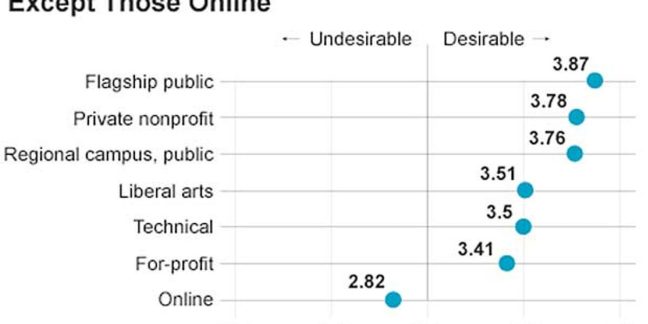
In a 2012 poll of U.S. employers, respondents were asked which types of colleges they preferred to hire from. The results were unambiguous: Company executives and hiring managers considered online colleges inferior to every type of on-campus college. They even preferred for-profit colleges to online colleges, despite the [shady track record](https://billmoyers.com/story/the-for-profit-college-scam-that-these-students-are-still-paying-for/) of many for-profit schools.

The curious thing about the survey is not the result, but the way the question was posed. Executives were asked to evaluate a variety of on-campus programs—“flagship public,” “private non-profit,” and so on. In contrast, only one choice was given for digital education: online. The unstated assumption is that [online learning](https://spectrum.ieee.org/tag/online-learning) comes in just one flavor—plain vanilla—while on-campus offerings are far richer—caramel fudge swirl, mint chocolate chip, rum raisin, take your pick. Instead of teasing out insightful responses, the question encouraged respondents to fall back on bias.

The creators of that 2012 survey, the _Chronicle of Higher Education_ and the public radio program _Marketplace_, never followed up with another one. But let’s suppose they did and that in their next survey, the pollsters posed questions as nuanced for online degrees as for on campus. Companies would then be asked to select among online options that reflect the way virtual education is actually offered, with a list of categories comparable to that for on-campus programs—flagship public, private nonprofit, and so on.

“Society has not quite accepted the legitimacy of virtual learning… But over the longer term, when a younger generation fills positions at companies, they will be more receptive”

Even then, the poll would still be missing one critically important mode of delivering education: blended learning—the pairing of online and in-class approaches within the same program. It’s hard to find a conventional classroom these days that does not have a digital or Web component. It could be a flipped classroom, in which lectures are typically online, and face-to-face discussion is reserved for homework review and projects; online interactions with instructors and classmates; social media; or dozens of other computer- and Web-mediated activities.

That means it’s highly likely that a student graduating this year will have had some sort of virtual experience in pursuit of his or her degree. And so while the employer survey suggested that “online” and “on campus” are distinct from one another, in fact that dichotomy has not existed for at least a decade.

Indeed, for students who receive their diplomas at the most selective schools, the distinction between online and on campus vanishes entirely. Andy DiPaolo, executive director emeritus of [Stanford](https://spectrum.ieee.org/tag/stanford) University’s Center for Professional Development, told me: “We never made a distinction between online and on campus. Your degree doesn’t say you earned it online. Students have the option of going online or on campus or taking a blended degree. It’s a Stanford degree.”

Likewise, a degree earned from [NYU](https://spectrum.ieee.org/tag/nyu), University of Michigan, and a number of other schools do not indicate whether it was earned online or on campus. An engineering student who completes her master’s degree online through one of these programs will have the same chances finding a job, getting a raise, or being promoted as she would had she earned her degree on campus. Data from the latest online graduating class at NYU’s Tandon School of Engineering show that nearly three quarters received a promotion or a raise after earning their degree, and all of them were employed six months after graduation.

These results suggest that employers now are more likely to accept job applicants who’ve had an [online education](https://spectrum.ieee.org/tag/online-education). But there are still some hold outs. “We’re in an era of educational transition,” says [Amy Lui Abel](https://www.conference-board.org/bio/index.cfm?bioid=1343), managing director of human capital at The Conference Board, a business consulting firm. “Society has not quite accepted the legitimacy of virtual learning. There is still a lot of suspicion. But over the longer term, when a younger generation fills positions at companies, they will be more receptive, unlike older managers who have little familiarity with digital education.”

One 2013 study that looked at the market value of online degrees confirms Abel’s insight. It concluded that an employer’s attitude toward online education tends to be more positive if he or she has had some personal experience with online learning. “As more people attend online schools over time and the number of graduates sitting on the hiring side of the desk increases, we can anticipate more favorable treatment of online university graduates,” the study’s authors noted.

And so in comparing and contrasting online to on-campus degrees, it’s important to tease out and appreciate the differences. The results shown in the graph above are suspect, because they do not reflect the real world of higher education today. Imagine if the survey respondents had been asked instead: “Would you prefer to hire graduates who earned their degrees online at Stanford or on campus at Fly-By-Night University?” In this absurd choice, online would of course beat on campus hands down. 

_About the Author:_

_Robert Ubell is Vice Dean Emeritus of Online Learning at_ [_NYU’s Tandon School of Engineering_](https://engineering.nyu.edu/)_. A collection of his essays on digital education_, [Going Online: Perspectives on Digital Learning](https://www.routledge.com/Going-Online-Perspectives-on-Digital-Learning/Ubell/p/book/9781138025325)_, was recently published by Routledge. He can be reached at_ [_bobubell@gmail.com_](mailto:bobubell@gmail.com)_._ _This is the third in a series on [MOOCs and online learning](https://spectrum.ieee.org/tag/moocs)._

Original URL: https://spectrum.ieee.org/tech-talk/at-work/education/what-do-employers-really-think-about-online-degrees

Can MOOCs Cure the Tuition Epidemic?

[

![This is part of a series on MOOC and online learning](https://spectrum.ieee.org/media-library/this-is-part-of-a-series-on-mooc-and-online-learning.png?id=25582281&width=980)

](https://spectrum.ieee.org/tag/moocs)

In the [United States](https://spectrum.ieee.org/tag/united-states), the biggest obstacle standing in the way of students going to college is not their high-school grades or their test scores. It’s cash. For low-income applicants especially, soaring tuition is one of the main reasons that [as many as 40 percent](https://hechingerreport.org/why-are-low-income-students-not-showing-up-to-college-even-though-they-have-been-accepted/) of those accepted in the spring don’t show up in the fall. According to the College Board, for the 2016-17 school year, [average tuition and fees](https://trends.collegeboard.org/college-pricing/figures-tables/tuition-fees-room-and-board-over-time) are about US $33,500 at private colleges, $9,650 for state residents at public colleges, and $25,000 for out-of-state residents. To these charges, add about $10,000 a year for room and board. In general, tuition has been rising far faster than the cost of living. Going to college can be like buying a new Mercedes every year.

How did this affliction invade our universities? While there are many causes, two factors account for much of it. For public schools, the answer is simple: State legislatures have savaged higher education over the last decade. Previously, up to two-thirds of a state college’s budget came from the state; now only about half of the budget does. Students and their families pick up [much of the difference](https://www.cbpp.org/research/recent-deep-state-higher-education-cuts-may-harm-students-and-the-economy-for-years-to-come).

When the first [MOOCs](https://spectrum.ieee.org/tag/moocs) appeared, they seemed like the answer to a prayer

The bloating of academic bureaucracy is another cause. While the number of new students and faculty hasn’t grown much, non-academic staff at colleges and universities has ballooned—more than doubling in a generation. What’s more, compensation for administrators is often far higher than faculty pay.

One painful result of the tuition [epidemic](https://spectrum.ieee.org/tag/epidemic) is that U.S. student debt is now at an all-time peak of more than a trillion dollars. According to the Project on Student Debt, the average college student graduating in 2015 [carried debt of about $30,000](https://ticas.org/sites/default/files/pub_files/classof2015.pdf) \[PDF\]; in 2004, the average was a more manageable [$18,550](https://ticas.org/sites/default/files/pdf/classof2014_embargoed.pdf).

Under stress, most schools have opted for cost-cutting. Perhaps most troubling, they have replaced full-time tenured faculty with cheaper adjuncts. [According to a 2013 report](https://www.agb.org/trusteeship/2013/5/changing-academic-workforce), full-time tenured and tenure-track positions at U.S. universities fell from 78 percent of teaching staff in 1969 to just 33 percent in 2009. Over the same period, the share of non-tenured positions in the teaching staff more than tripled. On average, adjuncts earn just a third of what tenured faculty make and have no job security and few benefits; in a sense, they were the bellwethers of the gig economy.

Despite these and other cuts, tuitions continued to climb. So when the first MOOCs—massive open online courses—appeared on the scene, they seemed like the answer to a prayer. As described in [my previous post](https://spectrum.ieee.org/tech-talk/at-work/education/how-the-pioneers-of-the-mooc-got-it-wrong), MOOCs made it possible to reach many thousands of students at a time, so long as they had a computer and a robust [Internet](https://spectrum.ieee.org/tag/internet) connection capable of (https://spectrum.ieee.org/tag/video-streaming). [Sebastian Thrun](https://spectrum.ieee.org/tag/sebastian-thrun), a [MOOC](https://spectrum.ieee.org/tag/mooc) pioneer, famously suggested that [the technology would so disrupt education](https://www.wired.com/2012/03/ff_aiclass/) that in 50 years, only 10 institutions of higher learning would remain.

A number of established schools soon began experimenting with MOOCs, and four of them—Georgia Tech, the University of Illinois, the Arizona State University, and MIT—now offer degrees based on MOOCs. Introducing the MOOC model, they discovered, required significant up-front investment. [Georgia Tech](https://spectrum.ieee.org/tag/georgia-tech) reportedly spent [$200,000 to $300,000 for each virtual course](https://www.wsj.com/articles/SB10001424127887324031404578483670125295836) in its MOOC-based master’s degree program in computer science. The courses were built in partnership with MOOC provider [Udacity](https://www.udacity.com/), with AT&T kicking in a total of $3.9 million to help launch them.

What accounts for MOOCs’ high startup costs? Unlike traditional classroom instruction, producing a MOOC involves not just an instructor, but also videographers, instructional designers, simulation experts, and multimedia specialists, who must prepare videos, interactive presentations, and online quizzes, among other digital content. Like automobile manufacturing, MOOCs thrive on economies of scale. If it costs $300,000 to create a MOOC in which 10,000 students enroll, the cost per student falls to a trivial $30.

Incoming Arizona State University freshmen can take 10 first-year courses online for $6,000

Nelson Baker, Georgia Tech’s dean of professional education, told me that scale allows the school to offer its digital degree for far less than what it charges residential students. There are about 4,000 students enrolled in the school’s MOOC-based computer science master’s, compared to the on-campus cohort of 300. Georgia residents pay about $20,000 per year for the on-campus degree program, with out-of-state tuition nearly double that. Tuition for MOOC students is [just $7,000 per year](https://www.insidehighered.com/news/2016/04/27/georgia-tech-plans-next-steps-online-masters-degree-computer-science).

(For comparison’s sake, the cost of creating a new online course at my school, [NYU Tandon School of Engineering](https://engineering.nyu.edu/), is about $60,000 to $70,000, not counting faculty compensation. One possible reason for the lower startup cost is that we build our online courses in-house rather than relying on commercial vendors. That said, [NYU](https://spectrum.ieee.org/tag/nyu) charges the same tuition for an online degree as for one earned on campus. Since our online courses are not MOOCs, the school does not benefit from economies of scale. But students benefit from the small class sizes, offering personal attention in an active-learning environment.)

Launched in 2014, Georgia Tech’s MOOC-style master’s was the nation’s first. Just this month it announced a [second MOOC-based master’s, in data analytics](https://www.news.gatech.edu/2017/01/11/online-master-science-analytics-degree-be-offered-less-10000). Several other schools have followed Georgia Tech’s lead. At the University of Illinois, for example, tuition for the residential Executive [MBA](https://spectrum.ieee.org/tag/mba) is $97,000. But [Illinois’ online iMBA](https://onlinemba.illinois.edu/), developed in an alliance with [Coursera](https://www.coursera.org/university-programs/imba/), one of the principal MOOC companies, is a bargain basement $22,000.

In 2015 [MIT](https://spectrum.ieee.org/tag/mit) collaborated with [edX](https://www.edx.org/), a nonprofit MOOC joint venture between MIT and [Harvard](https://spectrum.ieee.org/tag/harvard), to offer what it calls a “[MicroMasters](https://www.washingtonpost.com/news/grade-point/wp/2015/10/07/mit-floats-a-new-online-credential-the-micromasters/?utm_term=.83d0735ae0a7).” This new credential gives students who pass five graduate-level MOOC courses plus a proctored final exam the chance to apply for an accelerated, on-campus master’s that is about one-third less expensive than its on-campus equivalent. MIT’s first MicroMasters is in [supply chain](https://spectrum.ieee.org/tag/supply-chain) management. While a student completing the master’s program entirely on campus would pay $67,000, someone who did the MicroMasters and then the residential program would pay just $45,000. MIT has since rolled out a second MicroMasters, in data, economics, and development policy, and [13 other universities have joined them](https://www.edx.org/micromasters).

Ultimately the tuition epidemic is a symptom of a serious problem that MOOCs probably can’t solve

Meanwhile, Arizona State has been experimenting with [MOOC courses for undergraduates](https://www.insidehighered.com/news/2015/04/23/arizona-state-edx-team-offer-freshman-year-online-through-moocs). Its [Global Freshman Academy](https://www.edx.org/gfa) offers MOOCs through edX at $600 a course. Incoming freshmen can take all ten of these first-year courses online for $6,000, earning university credit in the process. By contrast, out-of-state and international students enrolled on campus pay more than twice that. But the Global Freshman Academy has greater ambitions than just tuition reduction. Because students do not pay for each online course until after they pass it, the Academy claims that it is “[one of the lowest-risk ways for students to start their college careers](https://www.edsurge.com/news/2016-05-27-how-to-set-up-students-to-succeed-in-online-learning),” according to Adrian Sannier, a professor at Arizona State.

It’s still early days for MOOC-based degrees and much too soon to say whether these tuition-reduction experiments will have a lasting effect. Ultimately, though, the tuition epidemic is a symptom of a larger and far more serious problem that MOOCs probably can’t solve. Rather than treating a college education as an essential element of civil society, we have thrown higher learning into the merciless pit of the marketplace. These days, rather than expecting our state and federal governments to fully support colleges and universities, we force students and their families to shoulder an increasingly unsustainable burden.

This is a sea-change in the structure of higher education over the past half century. When I enrolled at Brooklyn College in the late 1950s, I paid no tuition. In post-war America, college was considered a citizen’s right—not a commodity to be purchased, online or otherwise.

Even as schools continue to search for ways to reduce tuition, through MOOCs or other means, the answer may come from outside of academia. Recently, Rhode Island Governor Gina Raimondo proposed giving residents [two years of free tuition at the state’s public colleges](https://www.providencejournal.com/news/20170115/ri-students-to-get-free-tuition-for-2-years-at-state-colleges-under-raimondo-budget–poll). And New York’s governor, [Andrew Cuomo](https://spectrum.ieee.org/tag/andrew-cuomo), has offered to [waive tuition for any state resident accepted at a state or city university](https://www.ny.gov/programs/tuition-free-degree-program-excelsior-scholarship), provided their family income is $125,000 or less. If there’s a cure for the tuition epidemic, such progressive moves seem far more promising than simply leaving it in the hands of colleges and universities.

_About the Author:_

_Robert Ubell is vice dean emeritus of [online learning](https://spectrum.ieee.org/tag/online-learning) at [NYU’s Tandon School of Engineering](https://engineering.nyu.edu/)__. A collection of his essays on digital education_, [Going Online: Perspectives on Digital Learning](https://www.routledge.com/Going-Online-Perspectives-on-Digital-Learning/Ubell/p/book/9781138025325)_, was recently published by Routledge. He can be reached at [bobubell@gmail.com](mailto:bobubell@gmail.com)__. This is the second in a [series on MOOCs and online learning](https://spectrum.ieee.org/tag/moocs)._

Original URL: https://spectrum.ieee.org/tech-talk/at-work/education/can-moocs-cure-the-tuition-epidemic