LATEST ARTICLES

Why Colleges Should Pay Attention to Strikes by Their Most Precarious Teachers

There’s a news story in higher ed that’s not getting enough attention. The nation’s adjuncts are rising up.

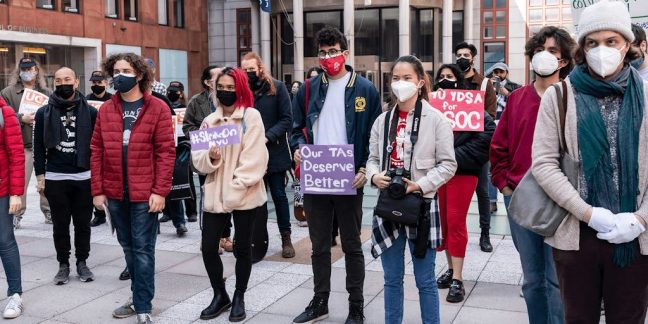
Just a few weeks ago at Rutgers University, for instance, adjuncts, grad students and others [held a five-day strike](https://whyy.org/articles/rutgers-university-strike-union-workers-faculty/) over unequal treatment compared to other academic employees. In the end, after a year of contract negotiations, they [won a big jump in pay and benefits](https://gothamist.com/news/rutgers-faculty-has-contract-deal-after-long-negotiations-and-a-strike-unions-still-must-vote).

Similar scenes are playing out across the country. This year alone, adjunct faculty on 12 campuses went on strike, and in many cases winning pay gains and other concessions.

“We broke through the temporary status of contingent higher ed employment under a framework that offers some semblance of job security,” said Amy Higer, a lecturer at Rutgers’ Newark School of Arts and Sciences and president of PTLFC-AAUP-AFT, unions representing part-time employees. In the new agreement, part-time faculty who teach two years or more are now entitled to a year’s appointment. Adjuncts won a 40 percent pay hike, as well as binding arbitration and other advances.

“Our labor is our power,” Higer told me recently. “We didn’t know we’d be forced to go on strike, but we had to get a fair contract.”

I’m seeing this up close at New York University, where I am vice dean emeritus. After a threatened strike, part-time faculty also won decisive gains in compensation and benefits in a six-year contract negotiated by the NYU Adjuncts Union and ACT-UAW.

“Contingent academic labor has become a pillar of the neoliberal university, and this agreement goes a long way toward raising standards for precarious academic workers everywhere,” declared union president Zoe Carey. Under [the new agreement](https://gothamist.com/news/nyu-strikes-tentative-deal-with-adjunct-professors-on-union-contract), adjunct pay jumps from $6,200 for a four-credit course to $10,400, with increases scaled up over the next four years. In a first, the university will contribute to health care, retirement and other benefits.

Across higher ed, it wasn’t always this way. In the 1960’s, adjuncts taught only about a quarter of college classes. Since then, the percentage of adjunct faculty has mushroomed to occupy the vast majority of instructors on many campuses, a deeply troubling dependency on precarious academic workers.

Online, the adjunct load is even greater. At two of the country’s biggest colleges — Western Governors and Southern New Hampshire, each with more than 100,000 students — there are no full-time faculty. Every virtual class is [taught by contingent instructors](https://www.edsurge.com/news/2023-03-02-how-mega-universities-manage-to-teach-hundreds-of-thousands-of-students).

## Growth in Faculty Union Membership

To understand these recent labor battles at colleges, let’s step back and look at the bigger picture.

With the deindustrialization of the American economy, the nation’s factories fled to low-wage countries in Asia, Latin America and elsewhere. And with the decline in manufacturing in the U.S., union membership nosedived in parallel. In the heat of the American assembly line in the 1950’s, union employment peaked, compising a third of the private-sector workforce. But in today’s service economy, union membership has [shrunk to merely six percent](https://www.npr.org/sections/money/2015/02/23/385843576/50-years-of-shrinking-union-membership-in-one-map). In sharp contrast, faculty union membership is on an upward swing, with a fifth of part-time instructors unionized.

![](https://edsurge.imgix.net/uploads/photo/image/10136/union_chart-1684956887.png?w=216&h=108&auto=compress,format&fit=fill&bg=fff&pad=0&blur=10&px=4)

Source: [National Center for the Study of Collective Bargaining in Higher Education and the Professions](https://www.google.com/url?q=https://www.hunter.cuny.edu/ncscbhep/assets/files/SupplementalDirectory-2020-FINAL.pdf&sa=D&source=editors&ust=1684960390131508&usg=AOvVaw2lEH6HG_pEhmYY3DMDXym9)

In the last decades, industrial unions, representing low-wage staff on campuses across the country — such as the Service Employees International Union, United Auto Workers and United Steel Workers — recognized the similar plight of part-time, non-tenure faculty. Adjunct demands were not often treated with the same urgency by traditional academic organizations, such as the American Association of University Professors, National Education Association and American Federation of Teachers, who mostly represented tenured and tenure-track faculty. Adjuncts were looking for more strident champions.

“There has been a degree of alienation between tenure and non-tenure faculty,” says William A. Herbert, executive director of the National Center for the Study of Collective Bargaining in Higher Education and the Professions. “Non-tenure faculty are looking for respect for their work as well as improved salaries and benefits. They feel that they’re better off dealing with unions that represent low-wage workers.”

But the recent union success at Rutgers may be a sign of a shift. “We merged Rutgers’ AAUP-AFT union with our part-time faculty union,” Rutgers adjunct union president Higer told me. “We are at the same bargaining table with full-time faculty. Rutgers’ full-time faculty have been extraordinary in helping pull-up contingent faculty.”

Why are so many adjuncts mobilizing now? Adjuncts’ already precarious situation has worsened in the wake of the pandemic and continuing inflation. So adjunct and other faculty unions have ramped up demands for economic justice.

Of course, not all part-time faculty are in the same fix. Some are professionals who work full-time in industry, and who teach in fulfilling side hustles, as I did several years ago at The New School.

But a [recent survey](https://www.aft.org/news/report-shows-alarming-poverty-among-adjunct-faculty) of contingent faculty reveals the more uncertain situation most adjuncts find themselves in. A third of respondents earn less than $25,000 a year, falling below federal poverty guidelines for a family of four. Fewer than half receive university-provided health insurance, with nearly 20 percent on Medicaid.

These alarming economic facts for most in adjunct life are in addition to their day-to-day struggles. Without job security, many don’t know if they will be teaching as late as a month before class starts. Most are not compensated for academic work performed outside their classroom. Few are given funds for professional development, administrative support or even an office.

In a stinging irony, many tenured faculty teach courses on equity and social justice, where students learn about oppression engendered by privilege. Yet just down the hall, someone else with the same level of education is teaching a similar course for vastly less pay and with little or no benefits.

It’s part of a growing inequality in our society, as Kim Tolley and Kristen Edwards point out in their book “[Professors in the Gig Economy](https://www.press.jhu.edu/books/title/11908/professors-gig-economy#:~:text=Professors%20in%20the%20Gig%20Economy%20is%20a%20compelling%20collection%20of,the%20new%20higher%20education%20economy),” noting that “many employment sectors are divided between a large precariat and a small, highly paid elite.”

But it doesn’t have to be that way. It’s inspiring to see that adjuncts are increasingly joining picket lines to improve their scandalous conditions.

Original URL: https://www.edsurge.com/news/2023-06-16-why-colleges-should-pay-attention-to-strikes-by-their-most-precarious-teachers

How Mega-Universities Manage to Teach Hundreds of Thousands of Students

In the early days of online education, I imagined that virtual classrooms would follow the same basic model as in-person ones, with an instructor leading the same number of students typical in a campus class.

One of my colleagues at New York University disagreed, cautioning even decades ago, that the belief was “pretty naive.” To make online financially viable, he predicted, “remote classes will need to enroll many more.”

It turns out he was right. Colleges found new ways of scaling, rethinking how teaching is done online.

It’s worth taking a step back to look at how the largest providers of online education in the U.S. teach remote students.

As a reminder of the scale we’re talking about, I asked industry-watcher Phil Hill to dig into federal enrollment data. He discovered that while enrollments from institutions that are almost exclusively online represent only a small percentage at nonprofit and state colleges, they make up about half of the student population at for-profits, a trend that started many years ago as investors poured money into digital education.

But when Hill honed in at the nation’s nonprofit online enrollments only, he found that about 35 percent of them are at these virtual mega institutions.

![](https://edsurge.imgix.net/uploads/photo/image/10005/online_enrollment-1677693383.png?w=216&h=216&auto=compress,format&fit=fill&bg=fff&pad=0&blur=10&px=4)

It turns out that colleges with giant online enrollments, some topping 100,000 students, run remote classrooms very differently from the way my virtual classes operated at Stevens Institute of Technology and NYU.

## Example 1: Western Governors University

The [biggest higher ed institution in the U.S.](https://philonedtech.com/ipeds-fall-2021-largest-institutions-by-online-enrollments-in-us-with-trends-since-2012/?utm_source=rss&utm_medium=rss&utm_campaign=ipeds-fall-2021-largest-institutions-by-online-enrollments-in-us-with-trends-since-2012) is Western Governors University, a [private](https://en.wikipedia.org/wiki/Private_university), competency-based institution, located in Utah, with 150,000 students — all online.

The institution was built with online in mind, and focuses on a so-called competency-based teaching method, where students work at their own pace and get credit when they show they know the material. Instruction at WGU discards key elements found in traditional colleges, with no physical classrooms and no fixed course schedule. Classes don’t start and end according to an academic calendar, but begin when a student clicks “start course” and gets assigned a faculty member. Class ends when the learner demonstrates competency in a given subject, a process that does not occupy a fixed number of weeks, but can conclude on the very first day if the student masters its content quickly, or it can take as long as competency is achieved — but no longer than the end of the term.

Students attend WGU entirely on screen, with instructors engaging with them virtually by email, phone, text and video. Classes aren’t led by a lone professor lecturing at the front of the classroom, but by teams of educators, with at least three virtual instructors and as many as ten to fifteen assigned to larger classes. On average, instructors are assigned 230 students at a time–a big change from the 20 or 30 I was used to at NYU and Stevens.

To stimulate peer-to-peer interaction, each course at Western Governors offers students a chat function where they post questions and where faculty and other students respond. Live streamed events are held once or twice a week, with break-out rooms open for students to interact virtually in small groups.

Performance assessment varies, with students submitting essays, videos or presentations to demonstrate they’ve learned the material. In a dramatic departure from convention, grading is not performed by instructors or TA’s, but by “evaluators,” experts who don’t interact with students directly. Course completion at WGU is 86 percent.

The university argues that its unusual teaching model makes its scale work for students, and that its focus on proving competency helps returning adult students who come to the virtual classroom with skills that should be recognized. Its leaders argue that it provides a faster and less-expensive way to earn a college degree, which remains key to marketable careers in today’s economy.

Some traditional professors have opposed the model as too great a departure from the classic liberal arts college.

“WGU offers us a vision of the university without intellectuals,” wrote Johann N. Neem, associate professor of history at Western Washington University, in [a critique of the model](https://eric.ed.gov/?id=EJ994775). “If the academy produced commodities, perhaps WGU’s approach would make sense. But the academy does not, and it is not served when faculty are replaced by managers, curriculum specialists, vendors, assessment specialists, and ‘course mentors’.”

## Example 2: Southern New Hampshire University

The next biggest online mega-university is Southern New Hampshire, a private college, [with 145,000 online students](https://philonedtech.com/ipeds-fall-2021-largest-institutions-by-online-enrollments-in-us-with-trends-since-2012/?utm_source=rss&utm_medium=rss&utm_campaign=ipeds-fall-2021-largest-institutions-by-online-enrollments-in-us-with-trends-since-2012). SNHU continues to run its traditional campus as well, with an on-campus population of about 6,000.

SNHU veers far from the pedagogical path taken by WGU, with undergrad classes as small as 24 to 35 and grad classes averaging 21. Courses are designed for busy working professionals who make up much of its online student body.

Sessions are divided into week-long modules, opening Monday mornings and ending Sunday evenings. Assignments, in largely project-based instruction, are due at the end of each week. Students gain access to their courses — syllabus, main project, required engagements, discussion forum and other materials — a week prior to the start of class. After students meet one-on-one with an advisor, they perform their studies in self-paced mode. Undergrad courses run for eight weeks; graduate courses are 10 weeks long. To determine whether students learned the material, faculty review student performance data — including participation, meeting deadlines and passing tests or other activities assigned by instructors. Southern New Hampshire’s course completion rate is 90 percent.

One key difference at SNHU is how it hires faculty, relying on an academic army of about 8,000 adjuncts who [earn](https://www.snhu.edu/about-us/employment/online-adjunct-faculty-teaching-jobs) $2,000 per semester for teaching an undergrad course and $2,500 for a grad course. Reliance on adjuncts, especially in online instruction, is a national trend. Today, gig faculty occupy [about three-quarters](https://www.edsurge.com/news/2019-11-06-higher-ed-has-now-split-into-dual-economies-online-and-traditional) of all U.S. college instructors. But Southern New Hampshire and other online operations depend even more on contingent labor than most of their traditional peers.

For colleges to depend entirely on an Uber-style instructional workforce may be financially prudent, but I argue it’s academically risky, with little continuity and no permanent faculty. It’s also exploitative, with instructors ending up in precarious work arrangements without living wages and benefits.

These models are worth highlighting at a time when higher education is no longer just for the privileged, but is an essential part of the nation’s economic life. Over their working lives, on average, college graduates [earn twice what high school grads make](https://www.brookings.edu/blog/up-front/2020/10/08/major-decisions-what-graduates-earn-over-their-lifetimes/).

A century ago, just [two percent of Americans](https://www.forbes.com/sites/garrettneiman/2015/02/04/4-innovative-ways-colleges-and-universities-are-fighting-poverty/?sh=284a4440c20d) were enrolled in college. While many colleges have long welcomed working-class kids like me — as Brooklyn College did when I enrolled there in the 1950’s — others still continue to exclude those who need degrees most. Abandoning convention, these new online large-scale universities swing open their virtual gates to students whose economic lives depend on a college degree to make it.

One of the greatest accomplishments of American higher education is its institutional diversity, with state and private colleges, small liberal arts schools, urban academic complexes and for-profit career academies, among others. To give students wide choice, U.S. higher ed has ample room to house both our old, conventional, slow-and-steady colleges, together with these new, fast-track, online academic gate-crashers.

Original URL: https://www.edsurge.com/amp/news/2023-03-02-how-mega-universities-manage-to-teach-hundreds-of-thousands-of-students

Why College Students Turned From Being Down on Remote Learning to Mostly in Favor of It

If you go back to the first days of the COVID crisis, when campuses across the country were shutting down, college students weren’t very happy with emergency online learning. Surveys conducted then showed deep dissatisfaction, with as many as 70 percent saying [they didn’t like it](https://tophat.com/press-releases/adrift-in-a-pandemic-survey/).

Low grades for remote instruction persisted for months. As the nation struggled under one of the worst public health threats in centuries, emergency instruction proceeded as the only viable way to keep higher education going, even though so few students liked it.

Since then, things have taken a surprising turn. Today, 70 percent of college students [give online and hybrid learning a thumbs-up](https://www.insidehighered.com/news/2021/04/27/survey-reveals-positive-outlook-online-instruction-post-pandemic).

How did that happen? What were the forces at play that turned disaffection into growing acceptance?

It’s totally understandable that students taking remote classes in those early pandemic months resisted. Remote education was not a choice, but a command. Higher education was like a country at war, with students conscripted online like soldiers fighting for their academic lives. By the second semester of the crisis, about 680,000 [dropped out altogether](https://hechingerreport.org/more-students-are-dropping-out-of-college-during-covid-and-it-could-get-worse/).

Students in those early days of COVID were under severe stress, tossed about with anxiety and depression; many found it [difficult to concentrate or even sleep](https://www.ncbi.nlm.nih.gov/pmc/articles/PMC8919103/), let alone stay in school.

Just before the COVID shutdown, about a third of college students were enrolled in at least one online course. Today, three years after the worst of the crisis, that percentage has [unexpectedly jumped to half](https://www.insidehighered.com/news/2021/10/13/new-us-data-show-jump-college-students-learning-online). As the pandemic waned, increasing numbers of students opted to enroll in online instruction, casting aside their early disappointment because remote learning fulfilled needs it had always provided students—convenience, speed to graduation, flexibility and lower tuition. For working adults, online is often the simplest and easiest path to earn a degree. It satisfies those eager to access courses anytime, day or night.

And some faculty teach with more effective active-learning methods in the online format.

The [often mediocre delivery of digital instruction](https://www.edsurge.com/news/2021-03-08-why-emergency-online-learning-got-low-grades-from-many-college-students) at the start of the pandemic shined a spotlight on college teaching, with students measuring their online experience against in-person instruction. Critics have long been unhappy with what goes on in those college classrooms, often with professors [lecturing interminably](https://www.insidehighered.com/news/2018/04/02/study-finds-lecture-remains-dominant-form-teaching-stem), as if the call for active learning has not been a [century-long cry by thoughtful educators](https://er.educause.edu/articles/2009/12/dewey-goes-online-virtual-teaming-on-campus).

Now, students were given the opportunity to compare. And they discovered that the often lackluster college classroom is not much better than what usually happens online. If everything is lecture, students are choosing between slumping on couches at home in front of their screens or passively nodding off in classrooms.

Few faculty were guided on how to teach during emergency remote instruction. They were just sent off online, with presidents and provosts praying students would survive the ordeal. It turns out that the same pedagogical failure that occurred online also happens widely on campus. Few professors step into their on-campus classrooms knowing best practices in teaching face-to-face.

Perhaps students in the early days of emergency remote instruction expected something different, exciting and new. But what they found, once they logged on, was [the same endless talking heads](https://www.ncbi.nlm.nih.gov/pmc/articles/PMC8919103) at home on video or Zoom or on campus face-to-face. Students have now grown accustomed to pretty much the same experience, and they’ve resigned themselves. Over the long haul, students came to terms with it, accepting online as they’ve always endured lectures in person. The reason why so many were disappointed with emergency digital instruction was not because it was alien, but because it was so very familiar.

Of course, not every on-campus or online course is conducted in lecture mode. Thoughtful faculty use their digital and analog classrooms to stimulate engaging academic experiences, with students and instructors participating in peer-to-peer learning and other innovative practices. Abandoning lectures, skilled professors teach remotely or in-person, treating students not as passive listeners in a theater audience, but as players up on the academic stage, collectively discovering knowledge.

## Feeling Alienated

Attending remote classes in the crisis, most college students felt alienated, [lonely on their screens](https://tophat.com/press-releases/adrift-in-a-pandemic-survey/). They lacked in-person conversation, and they wished they could return to ordinary, face-to-face conversation.

The campus, after all, is a far more socially accommodating environment, with students busy with others in clubs, sports and other interpersonal activities in the school cafeteria and dorm rooms.

The physical classroom was never designed to provide all of the student’s wishes for social interaction. Classrooms on campus commonly allow only limited one-on-one engagement, with students rarely connecting with their peers, except at moments when classes are open to discussion. In college, I remember often leaving class at the end of a term, never having said a word all semester long to classmates seated right next to me.

During the pandemic, with every other avenue of interchange shut down, remote classrooms were asked to fulfill urgent needs for student personal engagement—a capability they were never meant to deliver. Yearning for human connection during those first COVID days and weeks was painful, but online learning was never going to satisfy it.

Once normal life returned and students could rely on other ways of getting together with friends and classmates, the digital classroom could relinquish its overwhelming social burden. Students can now take classes online without expecting them to be a place not only for learning, but also for socializing.

## Pivoting to Video

One fascinating recent teaching strategy may have played a decisive role in changing student perceptions—increased use of video instruction. Many remote instructors now step away partially from delivering only Zoom sessions and produce instructional videos as well—as I did when I taught at The New School.

“This is the new normal,” says educational research psychologist Nicole Barbaro at GWU Labs, an affiliate of Western Governors University. “Professors are increasingly using videos to disseminate lectures and other instructional content to their students, and students are now [watching hours of recorded videos each week](https://behavioralscientist.org/should-video-lectures-be-the-new-normal-in-higher-ed/) for their courses.”

To my surprise, video—especially as a supplement in remote instruction—turns out to be a boon to greater student learning. A [new meta-analysis](https://journals.sagepub.com/stoken/default+domain/XK5QXBX6TVJFARNHFBZC/full) uncovers the striking finding that when instructional videos supplement in-class instruction, rather than when they replace in-person teaching, students gained the most—results that have clear implications for online instructors. If you are weighing whether to design your digital course with either static text or recorded videos, videos are surely the way to go, advises GMU’s Barbaro.

When I taught online at The New School, a crack team of instructional designers and photographers guided me on how to deliver professional, 7-minute videos, accompanied by graphics, text and other elements. Other videos were TV-style newscast interviews of scholars and practitioners I had invited to offer their expertise on topics covered in my course. In the 6 weeks my online course ran, my Zoom sessions consisted entirely of remote classroom discussions of the videos students watched at home and readings I had assigned. In all those weeks, I never once delivered a real-time lecture.

Over time, with months of practice as the pandemic proceeded, instructors and students learned how to use remote tools. Continuously online, enormous numbers gained proficiency with digital learning software. “The quality of a well-run synchronous, online class can now rival—and in some respects exceed—the quality of the in-person equivalent,” observes John Villasenor at the Brookings Institution.

The good news is that online learning is no longer reviled and resented, but after a rocky tryout in the pandemic, it’s now just another higher ed choice in which students and faculty, after years of digital stress, [have largely adapted to it](https://www.brookings.edu/blog/techtank/2022/02/10/online-college-classes-can-be-better-than-in-person-ones-the-implications-for-higher-ed-are-profound/).

Original URL: https://www.edsurge.com/news/2022-12-19-why-college-students-turned-from-being-down-on-remote-learning-to-mostly-in-favor-of-it

As Fewer Chinese Students Study at American Colleges, Will Indian Students Fill the Gap?

For years, China has been sending the greatest number of international students to the U.S. This year, to many people’s surprise, India took the lead.

In fact, the number of U.S. student visas issued to Indians soared 60 percent from Oct 2021 to July 2022, while Chinese student visas—until now at the top—[dipped 30 percent](https://www.asiafinancial.com/india-tops-china-as-source-of-most-students-in-us-nikkei#:~:text=India%20surpassed%20China%20as%20the,academic%20exchanges,%20Nikkei%20Asia%20reported%5C). According to the Bureau of Consular Affairs, Indian student visas this year jumped to nearly 78,000, while Chinese student visas [fell to just over 46,000](https://www.outlookindia.com/business-spotlight/reasons-why-india-beat-china-in-the-number-of-student-visas-to-the-us–news-224821).

Worldwide—in the U.K., Canada, and elsewhere—India has surpassed China as the [leading source of foreign students](https://marketentry.org/insights/2022/01/05/india-has-overtaken-china-as-the-largest-source-country-of-international-students/). And Coursera, the world’s biggest commercial online learning platform, reports that learners in India constitute its [greatest stream of new foreign students](https://www.weforum.org/agenda/2022/01/online-learning-courses-reskill-skills-gap/).

Doubtless, the decline in Chinese students is mostly the result of the country’s zero-COVID lockdowns and its contentious confrontations with the West.

The change will have a huge impact on many U.S. colleges. After all, more than [three million Chinese students](https://www.statista.com/statistics/372900/number-of-chinese-students-that-study-in-the-us/) enrolled in US higher ed institutions in the last decade alone. Many of those students, educated in the U.S., returned to China to help build their country’s infrastructure and manufacturing power. As a result, China was transformed from a peasant to a middle-class economy in one turbulent, dynamic century.

“Never in history have so many people made so much economic progress in one or two generations,” [comments](https://www.jstor.org/stable/10.7864/j.ctt6wpd8c) Kenneth Lieberthal at the Brookings Institution.

Mission accomplished, China may have less need for American technical expertise, and it may feel able to go it alone, with its own expanding higher education system, now at the [forefront of many key science and technology measures](https://www.edsurge.com/news/2021-12-10-in-china-online-degrees-on-hold-even-as-moocs-rise).

At last month’s twentieth Chinese Communist Party Congress, Premier Xi Jinping stepped back from his earlier ambition to lead “[a diversified and stable international economic system](https://www.cfr.org/in-brief/politics-determine-china-economic-future-xi-jinping-third-term).” In his new China-first posture, Xi called for technical self-sufficiency, signaling that Chinese students may do better to stay home, attending universities in Beijing and Shanghai, rather than fly across the globe to Harvard and Stanford.

That also signals that the flood of Chinese students in the U.S. since the turn of this century may be drying up.

“An American degree became a national obsession,” allowing middle-class kids to escape China’s highly competitive college entrance exam and its rigid curriculum, [writes](https://thechinaproject.com/2020/05/12/end-of-an-era-a-history-of-chinese-students-in-america) Eric Fish in the China Project newsletter.

Even with its decline in visas this year, though, China is [still the heavyweight](https://www.chronicle.com/article/number-of-new-chinese-students-at-u-s-colleges-plummeted-this-fall-visa-data-show?cid2=gen_login_refresh&cid=gen_sign_in), with the greatest number of international students in American colleges. More than a quarter of a million Chinese are enrolled in U.S. campuses today.

## Impact on U.S. Higher Ed

As China backs away from sending students, American colleges are feeling the financial crunch. After all, tuition from international students from China to U.S. campuses has recently reached about [$15 billion annually](https://www.scmp.com/news/china/article/3081163/coronavirus-us-education-faces-us15-billion-hit-chinese-students-stay), representing income from [about a third of international students](http://www.chinadaily.com.cn/a/201903/06/WS5c7f07c9a3106c65c34ecf74.html) enrolled here. Over the years, American colleges got high on Chinese cash, with Chinese funds often helping to stabilize rocky higher ed finances.

As that flood ebbs, colleges are worrying.

Rahul Choudaha, a senior researcher at the University of California at Berkeley, recently warned that the loss of Chinese students—who often pay top dollar—could be catastrophic for U.S. universities. “Public universities are even more dependent on international students, especially those from China, because of the decline in domestic enrollment and the government’s budgetary support,” he [said](http://www.chinadaily.com.cn/a/201903/06/WS5c7f07c9a3106c65c34ecf74.html).

Chinese tuition has been so crucial at the University of Illinois—which boasts more than 5,000 Chinese students—that the school negotiated an insurance deal that will pay $60 million if revenue from tuition for students from China [falls 20 percent or more](https://www.pbs.org/newshour/education/u-s-universities-see-decline-in-students-from-china).

As domestic enrollment in U.S. colleges plunges, college leaders are eagerly looking for students elsewhere to fill the gap. And lately, recruitment teams have been especially keen on India.

Over the last decade, enrollment of international students from India has doubled, with about 1.8 million students from the country showing up on U.S. campuses. India is now the [fifth-biggest economy](https://statisticstimes.com/economy/china-vs-india-economy.php) globally, giving Indian families unprecedented purchasing power to send their college-age students overseas. And many colleges in India these days are underfunded or stifled by bureaucracy.

About half of Indian students abroad [pursue study in the U.S.](https://thehill.com/opinion/international/3557750-indias-economy-cant-compete-with-chinas-and-that-should-concern-us-policymakers/), often attracted by enticing post-graduate opportunities to work in relatively high-paying jobs—a deciding factor for many Indian students.

For Indian students, America has been a land of opportunity. Indian graduates from U.S. colleges have assumed some of the most powerful jobs in American industry. Most notably in Silicon Valley boardrooms, Indians stand out, holding CEO posts at Microsoft, Alphabet, IBM, Adobe and other big-tech firms.

But despite Indian middle-class enthusiasm for sending their college-age kids to America, India is unlikely to catch up with China’s longtime passion anytime soon, without overcoming a huge gap in the size of their economies. China’s GDP is [15 times greater](https://statisticstimes.com/economy/china-vs-india-economy.php) than India’s.

“Western hopes of a modern, fast-growing, prosperous and free market-oriented India have not been realized,” [observes](https://thehill.com/opinion/international/3557750-indias-economy-cant-compete-with-chinas-and-that-should-concern-us-policymakers/#:~:text=From%20the%20perspective%20of%20the,stands%20at%20only%20%243.1%20trillion) Husain Haqqani, director for South and Central Asia at the Hudson Institute. “India’s current rate of economic growth is woefully inadequate for India’s domestic goals as well as the objective of becoming a serious rival to global economic juggernaut, China.”

Some say that India is not only too far behind China in economic power, but also too weak to fill all the seats left vacant by Chinese students foregoing American colleges. But others predict that India’s booming population—set to rise to 1.5 billion in 2030, compared with China’s, which is [expected to fall to 1.4 billion](https://www.weforum.org/agenda/2022/08/world-population-countries-india-china-2030/#:~:text=India’s%20population%20is%20set%20to,billion%20over%20the%20same%20period) in the same period—might do the trick.

But even if the new wave of Indian students goes part of the way to fill the gap left by the Chinese for now, American colleges will continue to be subject to hard-to-predict global political and economic uncertainties that lie ahead.

Original URL: https://www.edsurge.com/news/2022-11-22-as-fewer-chinese-students-study-at-american-colleges-will-indian-students-fill-the-gap

Do Online Degrees Lead to Jobs as Reliably as Traditional Ones?

One question often lurks in the minds of college students: “What am I going to do after I graduate?” For those who plan on graduate school, their immediate future is pretty much set. But for most, what happens next is often in doubt.

There’s long been the concern that employers won’t take online degrees as seriously as campus-based ones, though these days online degrees are pretty mainstream. But there are other considerations. On campus, there are the well-known tales of students forging friendships with roommates or classmates that turn out to be connections to big jobs. Think of the giant digital companies formed by founders who met in a dorm (most notably, Facebook and Microsoft).

But are those who study at all-online programs making the same connections—or are they finding other ways to connect to the job market after earning their diploma? What are their prospects of being steered into rewarding networks?

Students enrolled in online degrees are often far less well-off than others who attend residential campuses, with about 30 percent of online student families [earning less than $40,000 a year](http://web.archive.org/web/20251214011225/https://www.statista.com/statistics/956154/share-students-studying-online-income-education-level/).

As a student at most online undergraduate programs, it’s unlikely you’ll find yourself in an academic environment that exposes you to broad access to influential connections or that your financially strapped family knows people who can find a rewarding place for you.

Compared with on-campus, online college enrollments are booming. About 40 percent of college students in the US are now [enrolled in online degree programs](http://web.archive.org/web/20251214011225/https://philonedtech.com/2020-21-ipeds-data-profile-of-mid-pandemic-12-month-enrollments/). And enrollments at fully online colleges, like Western Governors and Southern New Hampshire, [are surging](http://web.archive.org/web/20251214011225/https://www.insidehighered.com/news/2022/10/14/more-traditional-age-students-enroll-fully-online-universities).

The good news for college grads today is that [the unemployment rate is at an historically low](http://web.archive.org/web/20251214011225/https://www.nytimes.com/2021/10/08/business/economy/college-graduates-jobs.html) 2.5 percent, compared with 5.8 percent for high school graduates with no college. But as I dug into the data, I couldn’t find parallel figures on how online graduates are faring.

What, I wondered, is the future of millions of online college students? What can they expect after they graduate?

Lately, scholars have turned to the influence of social capital—the effects of personal and network relationships—on one’s future position in society, especially on the consequences of where students go to college. Two theories proposed by notable twentieth-century scholars stand out—one by James Samuel Coleman, an American sociologist who worked at the University of Chicago, and the other by French structuralist Pierre Bourdieu, who taught at the [School for Advanced Studies in the Social Sciences](http://web.archive.org/web/20251214011225/https://en.wikipedia.org/wiki/School_for_Advanced_Studies_in_the_Social_Sciences) in Paris.

Bourdieu studied ways power is transferred and maintained across generations, claiming that your college marks you, [reproducing the class status](http://web.archive.org/web/20251214011225/https://www.socialcapitalresearch.com/bourdieu-on-social-capital-theory-of-capital/) you inherit from your family, with your social position frozen. In contrast, Coleman [argued](http://web.archive.org/web/20251214011225/https://files.eric.ed.gov/fulltext/EJ1128914.pdf) that social capital is a powerful force that activates class mobility, with students leaping over the economic divide, some waking up transformed by the American Dream after college.

For online students, the jury is out on which theory forecasts their future. Will they be set free to overturn barriers imposed by their social and economic status? Or will they be constrained—as Bourdieu’s theory holds—captives in class confinement?

## The Virtue of Virtual

If online students follow Coleman, virtual classes can open options to boost social capital. One way is for remote learners to join digital networks, especially those that engage them in online class discussions with offline participants. [Studies show](http://web.archive.org/web/20251214011225/https://academicinfluence.com/inflection/online-education/career-services-for-online-college-students) that the relationship between online learners and workers in industry or academic life in digital class discussions can be highly productive, generating strong career connections.

Or they can enter virtual internships, where students gain work experience remotely. Virtual interns communicate with employers and others using an array of digital communication applications—instant messaging, project management tools, and video conferencing platforms, such as Zoom, among others—often quite similar to the way many digital classes are conducted.

The giant financial services company, Citicorp, for example, is among [hundreds of big firms](http://web.archive.org/web/20251214011225/https://www.nationalinternday.com/top100-2020) that have opened opportunities for students and college graduates. The company’s internship program is [one of the most diverse](http://web.archive.org/web/20251214011225/https://www.forbes.com/sites/benjaminlaker/2020/08/20/2020-internship-programs-have-proven-to-be-the-most-creative-yet/?sh=1bde5181aaa9) in industry. Of its 1,500 participants, 50 percent are women and 27 percent are Black and Latino. In 2020, participants who met certain minimum requirements received an offer of a full-time job upon graduation.

With about 70 percent of online students working full or part time, [a Wiley report](http://web.archive.org/web/20251214011225/https://universityservices.wiley.com/wp-content/uploads/2019/07/OCS-2019-FINAL-WEB-Report.pdf) says that online learners are far more likely than on-campus students to click on links to virtual job fairs, networking events and other online employment services.

Tapping into digital communities, and clicking on social media sites, are among other ways online students can gain access to networks to jump-start social capital. The job-market service Handshake, a competitor to LinkedIn specializing in student employment, has enrolled more than 10 million students and graduates in less than a decade. With free access, students create profiles, receive job tips, and invitations to virtual career events. Just as on LinkedIn, users can connect with alumni and employees at prospective job sites. More than 750,000 employers—including Google, Nike and Target—and 1,400 universities are on the platform. Handshake’s leaders argue that online job hunting is far more favorable to women and minorities than in-person connection promoting digital equity.

Results of [a new study](http://web.archive.org/web/20251214011225/https://www.science.org/doi/abs/10.1126/science.abl4476) of 20 million LinkedIn users, published last month in Science, makes concrete the far-reaching employment effects of social media—platforms surprisingly more powerful than friends and family. The report reveals that “weak” associations—like forming acquaintances in social media—rather than close friendships, can be as much as twice as influential in securing a job.

In my online career over more than a quarter of a century, I have been drawn into friendships and engaged with colleagues, scholars and executives the world over, totally online—dozens of men and women I have never actually met face-to-face—with whom I carry on lively email correspondence on serious academic and commercial matters, asking and giving advice, seeking scholarly citations or looking for experts, occasionally writing job references or nominating an online friend for a key open position.

Without national data on comparative employment rates or lifetime income of online versus on-campus undergrads, it’s impossible to say how online graduates will do after college. Nor can we say whether Coleman or Bourdieu hits the mark in the online context.

It is clear, though, that the digital economy has totally overtaken the workplace. As a result, predictions about the long-term effects of online degrees can no longer rest on historical trends, but must take into account the shocks of the digital revolution.

Original URL: https://www.edsurge.com/news/2022-10-19-do-online-degrees-lead-to-jobs-as-reliably-as-traditional-ones

The Political Right Is Slamming the Door on College Access

The national consensus supporting higher education [is unraveling](https://bryanalexander.org/future-of-education/a-shattered-consensus-the-end-of-college-for-everyone/), as backing for college funding is increasingly becoming a partisan issue. And that’s having a disproportionate impact on poor and historically underserved students.

College enrollment is down nationwide, from about 17 million in 2020 to 15.9 million in the [latest data](https://nscresearchcenter.org/current-term-enrollment-estimates/) from the National Student Clearinghouse Research Center—a big historical change.

“With the exception of wartime, the United States has never been through a period of declining educational attainment [like this](https://hechingerreport.org/how-higher-education-lost-its-shine/),” says Michael Hicks, director of the Center for Business and Economic Research at Ball State University.

But not all types of students are opting out of college. The steepest declines are at [public two-year and four-year institutions, the more-affordable options that serve larger percentages of poor, working-class and minority students. Meanwhile,](https://philonedtech.com/the-post-covid-new-normal-is-looking-bipolar/?utm_source=rss&utm_medium=rss&utm_campaign=the-post-covid-new-normal-is-looking-bipolar) elite colleges that serve wealthier families are actually seeing a boost. The nation’s most-selective four-year colleges this year experienced a record [17 percent increase](https://www.nytimes.com/2021/02/20/us/colleges-covid-applicants.html) in applications.

Compared to last spring, the NSCRC report also revealed a 6.5 percent decline in Black freshman. Black students were the only segment this spring that declined among first-time freshmen. Enrollment in areas with large low-income and minority populations fell most sharply, [notes](https://www.chronicle.com/article/the-shrinking-of-higher-ed) Carleton College economics professor Nathan D. Grawe.

There are plenty of complaints about the high cost of tuition, and it can feel like it’s always been that way. But looking at historical trends reveals [steady rises in state college tuition](https://educationdata.org/average-cost-of-college-by-year), going back to when I graduated from Brooklyn College in the early sixes—when my classmates and I paid no tuition.

## Defunding Higher Education

Tuition at four-year state schools from the 1960s to the ‘80s stayed pretty flat, reflecting a national narrative that college is not only good for forming smart, well-informed citizens, but also for building a prosperous economy. In those years, the public supported higher ed equally for both its private and public benefits—on the whole, we were a nation that honored higher education.

But since then, many conservative state legislators, spurred on by right-wing critics of higher education, have succeeded in decimating state funding, resulting in tuition skyrocketing—making it tough for families with limited income to afford college. Such cuts have accelerated racial and class inequality.

The campaign to defund state universities was launched in earnest in the1960s, when California Governor Ronald Reagan severely slashed the state’s higher ed budget, moving from generous public support to relying on limited student family resources, a move that started the [nationwide shift in American higher ed](https://www.dissentmagazine.org/article/from-master-plan-to-no-plan-the-slow-death-of-public-higher-education). Today at state 4-year institutions students now must cover [nearly half of higher ed costs](https://shef.sheeo.org/report/#report-highlights).

About 50 years ago, libertarian Nobel laureate James M. Buchanan collaborated with billionaire Charles Koch in massive efforts, financed by Koch’s many deep-pocketed foundations, to [encourage state legislatures](https://solidarity-us.org/fighting-cuts-and-rightwing-attacks-on-education-in-tennessee/) to withdraw public funds from higher ed.

Recently released tax records show that in 2019, Koch’s campaign [totaled more than $112 million](http://www.unkochmycampus.org/funding-report), far outspending its common annual stake a decade ago of about $10 million.

These days, the right continues to call for even deeper cuts, proposing a heavier burden that already overwhelms the nation’s families. “Let’s defund our colleges and universities. Let’s cut their funding to the bone,” [says](https://intellectualtakeout.org/2020/06/lets-defund-our-universities/) [Jeff Minick](https://intellectualtakeout.org/author/jeffminick/), a conservative commentator.

## Trashing Higher Education

In a [recent interview](https://www.newsweek.com/fox-host-tucker-carlson-says-college-education-diminishes-you-everyone-should-opt-out-1586212) with “Newsweek,” controversial Fox News host Tucker Carlson made higher ed a target of his scorn. “There is this idea that college improves your worth,” he said. “But for kids like me who go in for liberal arts education, I believe it diminishes you.” He later added that “everyone should opt out, except people with very specific goals. I don’t believe in the system at all.”

It’s just the latest in a chorus against higher ed on right-wing media. The charge is that universities are elitist and have an entrenched liberal bias that indoctrinates students, even though research shows that college [does not result in a consistent shift](https://www.insidehighered.com/news/2016/07/25/academics-fact-check-pervasive-idea-liberal-academics-indoctrinate-their-students) either left or right for students. Such disinformation is accomplishing its objective, with more than half of high school students now believing that [college is not their best choice](https://www.studyfinds.org/high-school-students-college-career/) after graduation.

Data shows that students who are convinced to skip college will pay a financial price down the road. Our new post-industrial economy has pushed college-grad earnings way up. Forty years ago, college graduates earned 23 percent more than those who went into the workforce with only a high school diploma on their resumes. By 2019, a bachelor’s degree [generated 77 percent more](http://chronicle.com/article/the-shrinking-of-higher-ed?cid2=gen_login_refresh&cid=gen_sign_in) in a worker’s paycheck than a high school diploma.

As poor and working-class kids continue to be duped by right-wing rhetoric against attending college, they will be left out of the most productive parts of the American economy. The cruelty of misleading millions of young people is heartbreaking.

Of course, the right cannot be credited with causing all the current higher ed enrollment losses. The pandemic, inflation and the falling high school student population surely contributed. Even if the right isn’t entirely responsible, it continues to help slam the gates on wider college access.

Original URL: https://www.edsurge.com/news/2022-08-24-the-political-right-is-slamming-the-door-on-college-access

With Stressed-Out Students in Challenging Times, Faculty Must Embrace Caring Practices

In the bad-old days of college teaching, especially in technical subjects, professors would stand before a classroom of freshmen and say, “Look to the right, look to the left. One of them will not graduate.” The idea was fear of failure would motivate students to do whatever it takes to stay above water academically.

But these days more professors take a more caring approach to teaching—a compassionate response to the collective trauma driven by the COVID pandemic and other challenges facing today’s college students. That became clear to me a few months ago when I gave a talk on the benefits of active learning to more than 75 New York University faculty. In a poll addressed to attendees, I asked them to identify engaging teaching methods they use online and in person. What came back was a flood of responses with dozens of approaches, showing that this audience was putting plenty of thought and care on how to encourage students to participate and succeed online and on campus.

“There’s far more motivation when students perceive that they have more choice and control,” says Bahriye Goren, a visiting clinical assistant professor who teaches courses in competitive strategy and digital marketing. “We want students to experience that they are cared for—that we are helping them learn—rather than viewing us only as authorities.”

Yael Israel, an assistant professor who teaches courses in project management, agrees. “It is our practice to care about how our students learn, appreciate each student’s trajectory and open pathways where they feel safe to express themselves best.”

Goren and Israel say their emphasis on caring in teaching did not derive directly from what has come to be known as [the ethics of caring](https://iep.utm.edu/care-ethics), but from their own experience of the needs of students. Still, I was intrigued by their acknowledgment of caring as essential in effective student engagement. So I explored the notion of caring pedagogy and discovered, to my surprise, that it goes all the way back to the 1930s and ‘40s, to the pioneering work of Soviet psychologist Lev Vygotsky, noted in learning-science circles among the founders of social constructivist theory. Later, Stanford University philosopher of education Nel Noddings extended it into a broader ethical concept.

The ethics of care differs in crucial ways from 18th- and 19th-century ethical philosophy, largely based on duty or utility and supported by reason and logic, following universal, objective rules. By contrast, ethics of care depends on emotional qualities, such as compassion and empathy. Vygotsky pointed out that feelings and cognitive capacity are not separate; his classic research concluded that they are formed together.

Online or in person, caring pedagogy blends student-centered learning in a safe, responsive student-faculty relationship. Unlike a nurse treating a sick patient, or a parent raising an infant, caring in higher ed is an interpersonal practice, with faculty and students in complementary roles—listening carefully to one another, understanding each other, sympathizing, trusting, respecting and depending on one another—attributes that go hand-in-hand with active learning.

## Active Learning Faculty Support

I wondered what made the difference. Why did so many faculty at NYU’s School of Professional Studies’ Division of Programs in Business embrace active learning, while professors elsewhere often resist or ignore it.

As expected, many studies reveal a [high level of reluctance among professors](https://journals.physiology.org/doi/full/10.1152/advan.00014.2014) to abandon conventional lectures, with many saying they don’t have enough class time or they don’t have enough time to develop materials for active approaches. Other studies show that professors just don’t have time to devote to teaching amid other professional responsibilities, since most tenure-and-promotion guidelines emphasize research over teaching. Why should a rising professor take on alternative instruction strategies when it might not mean much to clinch a promotion?

But perhaps the greatest barrier is departmental culture. If your department [doesn’t support active learning](https://www.chronicle.com/newsletter/teaching/2019-03-21), why should you?

NYU’s Division of Programs in Business is one place working to encourage faculty to adopt active-teaching techniques. The school runs a vigorous effort to get faculty up to speed to teach in new and engaging ways. Running 4 to 6 faculty workshops a semester, attended by as many as 75, and occasionally much more—up to 120—with each session introducing a new learning tool, giving attendees a chance to practice with others in real time.

“Faculty have been educated their whole academic lives in the lecture mode, and that’s what they reproduce in their own classrooms as instructors,” says Negar Farakish, assistant dean of the division. ”Our overarching message is to show that faculty can move effectively from lecturing to active, experiential learning, leaving each workshop with two or three very practical takeaways. Working in small groups, faculty share their experiences and best practices with each other. It gives them an opportunity to quickly adopt new pedagogical approaches and techniques.”

In addition to attending workshops, novice instructors must run through a 25-week onboarding process in which practiced faculty closely monitor them, proposing alternative methods and giving them useful tips on how to excel.

## Urgent Care

College students are faced today with far more than common stresses caused by day-to-day struggles with motivation, test anxiety, procrastination and time management. They live under a cloud of massive gun violence, student debt, endemic racism—and now the brutal war in Ukraine.

The pandemic has not only unleashed a devastating disease, but has flung collateral damage at college students, causing them to suffer emotional disturbances at increasingly troubling rates—misery faculty say they never encountered before.

A new PsychologyToday, [report](https://www.psychologytoday.com/us/blog/helping-kids-cope/202202/depression-rates-soar-in-college-students#:~:text=%22Depression%20impedes%20the%20normal%20functioning,experience%20considerable%20amounts%20of%20stress.%22) says depression rates for college students doubled over the past decade, with 66 percent of college students experiencing overwhelming levels of anxiety. Most troubling, the report found that suicide is the second-most common reason for death among college students

Colleges cannot continue to go on as before, as if these realities can be brushed aside. Our faculty have a new and deeper obligation now, not only to open student minds to intellectual discoveries, but to turn the classroom into a caring refuge from cultural and economic abuse.

It makes perfect sense that [studies show](https://digitalcommons.usu.edu/cgi/viewcontent.cgi?article=5325&context=etd) that when students in higher ed are taught in a caring environment, motivation, desire to succeed and enjoyment increases along with improved attendance and attention, increased study time and additional course enrollment.

Active learning is not merely a collection of pedagogical tricks, but it has a deeper and more meaningful implication for higher education. It embraces philosophical and psychological insights that place caring for our students at its very heart.

Original URL: https://www.edsurge.com/news/2022-07-08-with-stressed-out-students-in-challenging-times-faculty-must-embrace-caring-practices

The Digital Revolution Is Saving Higher Ed

The most notorious oracle predicting the coming death spiral of academia was the late Harvard University professor Clayton Christensen, who in 2011 [famously forecast](https://www.insidehighered.com/blogs/just-visiting/disruptive-innovation-more-destructive-innovation) that “50 percent of the 4,000 colleges and universities in the U.S. will be bankrupt in 10 to 15 years.” His prophecy was based on the notion that digital alternatives to face-to-face education—in his view, much cheaper and friendlier than conventional instruction—would convince millions of college students to turn their backs on stodgy, old campuses to earn degrees in internet alternatives instead.

A year earlier, Stanford University computer scientist Sebastien Thrun, co-founder of commercial MOOC provider Udacity, outdid Christiansen, predicting an even bleaker future for face-to-face classes, claiming that in 50 years streaming lectures will so subvert conventional higher ed that [only 10 U.S. colleges will remain standing](https://www.economist.com/special-report/2017/01/12/established-education-providers-v-new-contenders).

Even [Microsoft’s Bill Gates](https://www.chronicle.com/blogs/wiredcampus/bill-gates-predicts-technology-will-make-place-based-colleges-less-important-in-5-years) predicted that online education would undermine the very foundations of U.S. colleges, entirely destabilizing the university.

But rather than landing a crushing blow, just the opposite happened.

The high priests of high tech have spoken, but they were mistaken. Digital innovation did not bring traditional higher education to its knees. Instead, it has played a key role in helping it survive. Not one college went under wholly because of digital competition.

And think what might have happened to colleges during the pandemic without the ability to switch to online instruction?

“Bottom line, remote learning in higher ed avoided what could have been an unmitigated catastrophe,” says Michael Goldstein, a managing director at Tyton Partners, an investment banking and higher ed consulting firm. “In the pandemic, digital education allowed students to continue their education almost entirely uninterrupted, faculty to remain largely employed, and institutions to continue in business—remarkably sustaining most of their academic revenue streams.”

“If it weren’t for fairly pervasive digital infrastructure in place before the pandemic,” Goldstein continued, “it wouldn’t have been possible for online to surge so seamlessly, with classes lined up as in ‘Hollywood Squares.’”

The tumbling cascade of bricks-and-mortar colleges never happened. Fewer than 90 colleges went under in the last few years, more likely in part as a consequence of COVID-19 pressures than death by digital disruption. And a third of those are for-profits, which [had already been under stress for years](https://www.insidehighered.com/news/2021/08/02/number-colleges-shrinks-again-including-publics-and-private-nonprofits) before the pandemic.

Colleges are under plenty of stress, but competition from online alternatives to traditional campuses is low on the list of pressures. Bigger forces include [falling high-school graduation rates](https://www.edsurge.com/news/2018-04-17-a-slow-moving-storm-why-demographic-changes-mean-tough-challenges-for-college-leaders), especially in New England and the Midwest and reductions in state funding in many regions. While the pandemic hit higher ed very hard, it also fueled [growth in the number of students enrolled in exclusively distance education](https://www.highereddive.com/news/pandemic-fueled-huge-online-only-enrollment-growth-report-finds/608522/).

Unlike the newspaper industry, which suffered internet wipeouts, [shutting down thousands of local papers in the last decades](https://www.edsurge.com/news/2021-06-17-a-sideways-look-at-the-future-of-higher-education), colleges and universities slowly adapted to the virtual revolution by letting online courses and degrees stealthily infiltrate higher ed. A recent review of the Department of Education’s Integrated Postsecondary Education Data System revealed the surprising new finding that, even before the pandemic, [more than half of college students in the U.S. were enrolled in at least one online course](https://philonedtech.com/alternative-view-more-than-50-of-us-higher-ed-students-took-at-least-one-online-course-in-2019-20/). The biggest universities in the U.S.—Western Governors and Southern New Hampshire—report more than 100,000 mostly online enrollments each.

Widespread faculty opposition to digital education over the years did not keep remote instruction from taking hold. As the digital revolution elbowed its way into the nation’s cultural and commercial spheres, virtual versions split off from earlier industrial-era products, often overturning them. But the university kept the lights on in old classrooms and left the windows open to let in digital clouds. While the internet fractured the global economy, luckily, the university kept instruction going in both analog and digital classrooms, side by side.

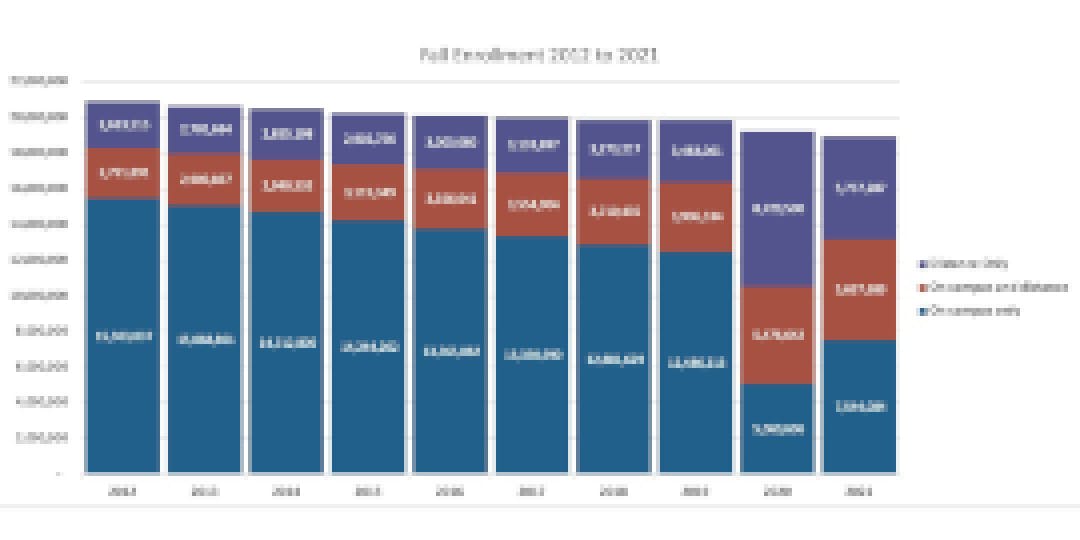
Perhaps the most telling recent data reveals that if it weren’t for online enrollments, the current decline in the higher ed student population would be far more severe. As the graph below, prepared by the insightful edtech consultant Phil Hill, shows, enrollments—when counting fully online college students in the mix—fell 1.5 million from fall 2012 to fall 2020. But excluding online students, the present downturn in higher ed enrollment plunged significantly more—to nearly 7.5 million.

![](https://edsurge.imgix.net/uploads/photo/image/9393/phil_Hill_chart_IPEDS-1649861103.png?w=216&h=121&auto=compress,format&fit=fill&bg=fff&pad=null&blur=10&px=4)

The graph is an arresting depiction of how much virtual education has helped save the nation’s colleges and universities from suffering even worse distress.

I’m not suggesting that remote instruction is so powerful that it alone will emerge as a utopian driving force capable of turning around higher ed. Colleges and universities are faced with a storm of troubling challenges that cannot be mitigated only by digital education. But in an unexpected shift since the pandemic, senior academic leaders no longer place it on a back burner.

Recognizing its crucial role in sustaining higher ed, [many colleges and universities are now prudently moving online up front](https://hbr.org/2020/09/the-pandemic-pushed-universities-online-the-change-was-long-overdue).

Original URL: https://www.edsurge.com/news/2022-04-13-the-digital-revolution-is-saving-higher-ed

Learning How to Blend Online and Offline Teaching

In the pandemic many higher ed faculty, forced onto Zoom and other videoconferencing platforms, have continued teaching online just as they always did face to face, delivering lectures over streaming video as they did in person. Many are unaware that teaching online can actually open new possibilities to innovate their teaching practice.

In fact, many college instructors have been downright grumpy about having been thrown into a new teaching format.

“Having made the decision to teach online, teachers are faced, often alone and unprepared, with the challenge of functioning in an entirely technology-mediated environment, where rules and behaviors are radically different,” writes Edwige Simon of the University of Colorado in [her dissertation](https://www.colorado.edu/atlas/sites/default/files/attached-files/the_impact_of_online_teaching_on_higher_education_faculty.pdf) on the professional identity of university faculty teaching online. Facing the screen, faculty can erupt in frustration, sadness—even anger.

Even so, there are some instructors who have found new and rewarding ways to teach, thanks to the forced experiment with online—by doing things that stimulate active learning, turning video conferencing classes into engaged, peer-to-peer discussions of what students explored on their own or with others between class sessions—activities such as viewing videos, visiting websites and reading scholarly books and articles, among other offline resources. Some instructors are so taken by active learning working so effectively that they expect [to continue offering courses online, even when the pandemic restrictions completely lift and things are fully back in person.](https://www.insidehighered.com/advice/2020/11/11/switching-online-teaching-during-pandemic-may-fundamentally-change-how-faculty)

Digital instruction is commonly divided into “asynchronous” and “synchronous” modes, with “synchronous” referring to real time teaching in a classroom or virtually over Zoom or other video conference tools. “Asynchronous,” on the other hand, refers to activities performed by students and instructors anytime—at home, in the library, even while commuting, doing homework, emailing, posting messages, and consuming videos and podcasts, reading, writing and so on. Since these words derived from Greek can be off-putting technical jargon, I’m proposing “online” instruction as a substitute for synchronous and “offline” for asynchronous.

When digital instruction first entered higher ed about a quarter of a century ago, most interaction was conducted in text offline. It was years before video streaming allowed virtual classes to be conducted universally in real time, too, opening the way to deliver remote classes both online and offline.

Siva priya Santhanam, an assistant professor at Metropolitan State University of Denver, said she uses online time for reviews and discussions. “I avoid lecturing during this time, and use several activities to clarify questions and confusions, provide feedback, and create discussion opportunities,” building a relationship with students online, [even if they have been in her face-to-face classes](https://www.facultyfocus.com/articles/online-education/online-student-engagement/ideas-to-make-your-synchronous-online-classes-more-fun/).

I took a very similar approach when I taught online at The New School in Manhattan a few years ago. I never delivered a lecture in real time on Zoom. Instead, students viewed my seven-minute video lectures on their own, [also watching videos of interviews I conducted with experts on topics covered in my course](https://www.insidehighered.com/digital-learning/views/2018/10/17/online-dean-describes-how-he-gained-confidence-teach-virtually). Afterward, we spend the next virtual classroom hour in conversation exploring what they discovered offline.

Whitney Kilgore, chief academic officer at iDesign, an online program management company that specializes in instructional design, told me that when students are doing the talking and deliberate in groups, solving problems and correcting each other, “it gives them the opportunity to perform as the teacher as well as the learner.” Kilgore says students retain lessons better in student-led discussions than they do listening passively to lectures or watching videos on YouTube.

Kilgore urges senior academic officers to recognize that moving from face-to-face lectures in conventional classrooms to active learning online may not be easy. She encourages colleges and universities to acknowledge that quality online learning does not happen merely by placing instructors in front of live cams on Zoom. “Learning design is a discipline,” she says. “Not everyone can shift online without the proper level of support.”

“Think of the screen as a place for two-way conversations rather than just talking at your students,” says Kristen Sosulski, executive director of NYU Stern School of Business Learning Science Lab. “If you recognize it as a space for conversation, rather than a lecture, you’ll design your course with that in mind.”

Before they click on Zoom, Sosulski says instructors must recognize that they won’t get the feedback they usually expect—in person real eye-contact. “But if you need evidence of student engagement, you’ll need to design your online course to stimulate it, with mini-quizzes and mini-exercises, among other interactive activities.”

Faculty members who have been teaching seminars face-to-face for years, encouraging peer-to-peer interaction, animating engagement and debate may not find the shift online as intuitive when facing a screen. Not every instructor is adept at translating what works face to face to remote instruction.

As Joshua Kim, director of online programs and strategy at Dartmouth College, cautions, “Faculty experience in conventional classrooms—generating discussion, guiding students to explore and create knowledge—these mental muscles are strengthened over years of practice on campus, but may not be easy to exercise in digital media.” It can take time and creativity to incorporate on-campus, active-learning strategies delivered effectively on campus into successful remote instruction.

Most of us don’t think remote students can flip from online to offline and back again—students are either offline or online. In one mode or the other. But breakout rooms and chat have broken through the binary opposition, like actors who slip into the wings and then appear back on stage. A key strength of the virtual format is that students can be asked to take time on their own or with other students in a group to reflect on material before coming back together for online reflection.

I often share my experiences in digital instruction with my daughter, Jenn Hayslett, [head of her own coaching and counseling firm](https://www.jennhayslett.com/), who has taught at Marlboro College and now teaches online independently.

“I try to give learners an opportunity to reflect every time I pose a question,” she recalled in a recent conversation, allowing students about two minutes “offline” to write and reflect on a question she raises “online.” She then gives them additional time to explore their thoughts with their partners in a breakout room. “Students love reflection time,” Jenn concluded enthusiastically.

Student reflection is a key part of working in breakout rooms, encouraging students to think about their virtual collaboration experiences, with faculty members helping them build communication and critical thinking skills.

Just over a hundred years ago, American philosopher, psychologist and education reformer John Dewey, a very early supporter of active learning, recognized that reflective thought is nourished by “[doubt, hesitation, perplexity](https://www.google.com/books/edition/How_We_Think/WF0AAAAAMAAJ?hl=en&gbpv=1&printsec=front)”—frames of mind often discouraged, when certainty, confidence and conviction are demanded of students.

“Reflective thinking,” Dewey observed, “means judgment suspended during further inquiry. Time is required in order to digest impressions and translate them into substantial ideas.”

As the pandemic ebbs, we don’t know yet when or whether colleges and universities will once again come to depend on remote instruction to keep colleges in business. But lessons learned by faculty teaching remotely in a crisis may be needed again.

Original URL: https://www.edsurge.com/news/2022-03-18-learning-how-to-blend-online-and-offline-teaching

Triumphs and Troubles in Online Learning Abroad

I’ve always thought of the U.S. as the leader in digital learning, representing the most adventurous innovations. But lately I’ve realized my perception may be flawed by a false sense of American exceptionalism.

In Canada, for example, about [two-thirds of colleges offer online degrees](https://www.tonybates.ca/2021/09/22/staying-online-a-new-book-by-robert-ubell/)—and many have for years. While here in the U.S., a far smaller number grant degrees online.

I thought it would be good to do some digging to explore a more nuanced appreciation of the status of virtual instruction outside the U.S.

At the very dawn of digital education, Canada introduced one of the very first learning management systems, WebCT, a pivotal application, invented at the University of British Columbia in 1997. Branded eventually as Blackboard, it was the market leader in the U.S. and Canada for some time, and even today the company is in second place, with DTL Brightspace, a Canadian firm, [close behind](https://philonedtech.com/state-of-higher-ed-lms-market-for-us-and-canada-year-end-2021-edition/).

Years before the University of Phoenix launched its first online course in the U.S., powered by CompuServe, an early online service provider, the University of Toronto, achieved the historical distinction of running the [world’s first-ever completely online course](https://adamasuniversity.ac.in/a-brief-history-of-online-education/) five years earlier in 1986. Since those early days, two million Canadian students avoided COVID-19 danger, [continuing their studies remotely during the pandemic](https://thoughtleadership.rbc.com/the-future-of-post-secondary-education-on-campus-online-and-on-demand/) at Canada’s fully online colleges—including Athabasca University in Alberta and at highly ranked colleges like McGill University in Montreal.

South of the U.S. border, Tecnológico de Monterrey, a private university, founded in 1943 by a group of wealthy local business executives, supports 33 campuses across the nation and in 15 countries abroad. Commonly known as Monterrey Tech, it broadcast its first class more than 20 years ago via satellite. Today, its Virtual University enrolls 12,000 students. Another 26,000 study at a lower-cost affiliate, Tech Millennium. That college requires its 60,000 traditional students—many of whom come from other Latin American countries—to take at least one online course before they graduate. Following Monterrey’s success, other Mexican higher ed institutions [have launched new online programs mirroring Monterey Tech’s model](https://www.chronicle.com/article/mexicos-monterrey-tech-pushes-e-learning-as-some-worry-it-wont-solve-regions-burgeoning-need/?cid2=gen_login_refresh&cid=gen_sign_in).

But the situation in the rest of Latin America is less ambitious, with fairly low online learning penetration in the region’s colleges and universities, a troubling plight found throughout the underdeveloped world. In Latin America, only about 15 percent of higher ed institutions offer hybrid options, and only about 20 percent deliver fully online courses. Unfortunately for students, [only a third of these are accredited](https://www.thedialogue.org/blogs/2016/04/role-of-e-learning-in-higher-education-in-latin-america/).

In Europe, most colleges moved to remote learning as the COVID-19 pandemic forced health restrictions. Even before the crisis, practically all European higher ed institutions offered digitally enhanced learning, and [more than half were delivering or planning to introduce online degrees](https://eua.eu/downloads/publications/briefing_european%20higher%20education%20in%20the%20covid-19%20crisis.pdf). In the U.S., it took the pandemic to propel the online rush, only recently leading to [half of all American higher ed students taking at least one online course](https://www.insidehighered.com/news/2021/10/13/new-us-data-show-jump-college-students-learning-online#:~:text=The%20number%20of%20students%20enrolled,to%2022.7%20percent%20of%20them).

In the United Kingdom in particular, the Open University is among the greatest online learning success stories. Launched in 1969 as a distance-learning college, broadcasting courses on television, it is the largest university in Britain and one of the biggest in Europe, with [more than 175,000 students](https://www.open.ac.uk/) and more than two million alumni.

In light of simmering U.S. conflicts with China and Russia, I thought it useful to take a look at digital education in those two countries. The contrast between the two is quite extraordinary, with Russia forging ahead as China holds back. Since the Bolshevik Revolution, first the Soviet Union, and now the Russian Federation, pushed remote learning as key to its goal of promoting mass education. To my surprise, I discovered that more than half of its 7.4 million higher ed students are in online programs, supported by [a thriving system little known in the Wes](https://files.eric.ed.gov/fulltext/EJ1001018.pdf)t. China, on the other hand, [offers no online degrees](https://www.edsurge.com/news/2021-12-10-in-china-online-degrees-on-hold-even-as-moocs-rise) and is unlikely to introduce any for another several years.

## Poor Internet Access Cripples Online Higher Ed

When the pandemic careened across the globe in spring 2020, U.S. higher ed responded swiftly by [opening online in a few weeks](https://philonedtech.com/us-higher-ed-set-to-go-fully-online-in-just-four-weeks-due-to-covid-19/), a feat made possible only because privileged American secondary intuitions long ago introduced digital access in nearly every college in the nation. As campuses locked their gates out of fear of infection, most American college students rushed to their laptops to study from home.

![](https://edsurge.imgix.net/uploads/photo/image/9191/Ubell_image1_worldmap-1645036494.png?w=216&h=121&auto=compress,format&fit=fill&bg=fff&pad=0&blur=10&px=4)

Elsewhere, not everyone was as fortunate. During the global crisis, 1.6 billion young people in 161 countries were not in college. Shockingly, without internet access, COVID-19 locked out close to 80 [percent](https://blogs.worldbank.org/education/educational-challenges-and-opportunities-covid-19-pandemic) of the world’s enrolled students. Africa was hit hardest, cruelly, with 82 percent of college students in sub-Saharan Africa [without internet access](https://www.universityworldnews.com/post.php?story=20210707124818759).

Most college students in the U.S. continued to attend class remotely as the virus erupted and receded like storm waves, largely unaware that so many elsewhere were locked out. Globally, the greatest obstacle to universal online higher ed is not stubborn academic officers who reject digital education as being inferior substitutes for face-to-face instruction, but poor internet access, [mostly in Africa and elsewhere in the Global South](https://worldpopulationreview.com/country-rankings/global-south-countries).

Worldwide, more than [half of households have an internet connection](https://en.unesco.org/news/new-report-global-broadband-access-underscores-urgent-need-reach-half-world-still-unconnected). In the developed world, nearly 90 percent are connected, but in the least developed countries [only about 20 percent are plugged in](https://www.weforum.org/agenda/2020/04/coronavirus-covid-19-pandemic-digital-divide-internet-data-broadband-mobbile/). With the lowest internet access in the world in sub-Saharan Africa, average broadband penetration is at a mere 2 percent, with n[early 90 percent of students without computers at home](https://www.africanews.com/2019/11/07/sub-saharan-africa-tops-global-offline-population-itu-report/) South Africa, the continent’s bright spot, is the strongest early adopter of digital education with [63 percent of the population online](https://www.statista.com/statistics/685134/south-africa-digital-population/).

![](https://edsurge.imgix.net/uploads/photo/image/9192/Ubell_image2_cellownership-1645036618.png?w=216&h=288&auto=compress,format&fit=fill&bg=fff&pad=0&blur=10&px=4)

Phil Hill, a prominent edtech consultant, told me that because Africans are forced to introduce mobile, not as an add-on, but as a priority, “from day one, Africans optimize digital learning for mobile. They are quite resourceful in ways we haven’t seen in the developed world.”

Cell phone use is as common today in South Africa and Nigeria as in the U.S. While smartphones are not as widely available, the devices are beginning to proliferate in several nations, [including 34 percent in South Africa](https://www.pewresearch.org/global/2015/04/15/cell-phones-in-africa-communication-lifeline/). Compared to building hugely expensive schools on ground, virtual campuses with direct mobile access are much cheaper and a far more rapid way forward. Some observers predict that [mobile learning will be the principal mode in Africa in this decade](https://www.bbc.com/future/article/20120823-what-africa-can-learn-from-phones).

Countries that have seriously invested in web infrastructure found themselves with a major advantage during the pandemic. Take the small Baltic country, Estonia. Long before the coronavirus invaded, Estonia made high-speed internet access a national priority—one of the first countries in the world to declare internet access a human right. And its colleges were [some of the quickest to move online during COVID-19](https://e-estonia.com/covid-19-is-likely-to-change-the-future-of-learning-in-estonia-this-is-old-news/).

The pandemic taught us that the internet is no longer a nice-to-have, but decisively, a need-to have, an essential utility, like electric power and running water. Virtual learning, too, must be as ubiquitous as conventional higher education, especially for students too far from college campuses to attend face to face, and now for many in our post-industrial economy, forced to work to earn college degrees.

_**Clarification**: This article has been updated to note that Open Universities in Asia offer education in a range of formats, not just online education._

Original URL: https://www.edsurge.com/news/2022-02-18-triumphs-and-troubles-in-online-learning-abroad